
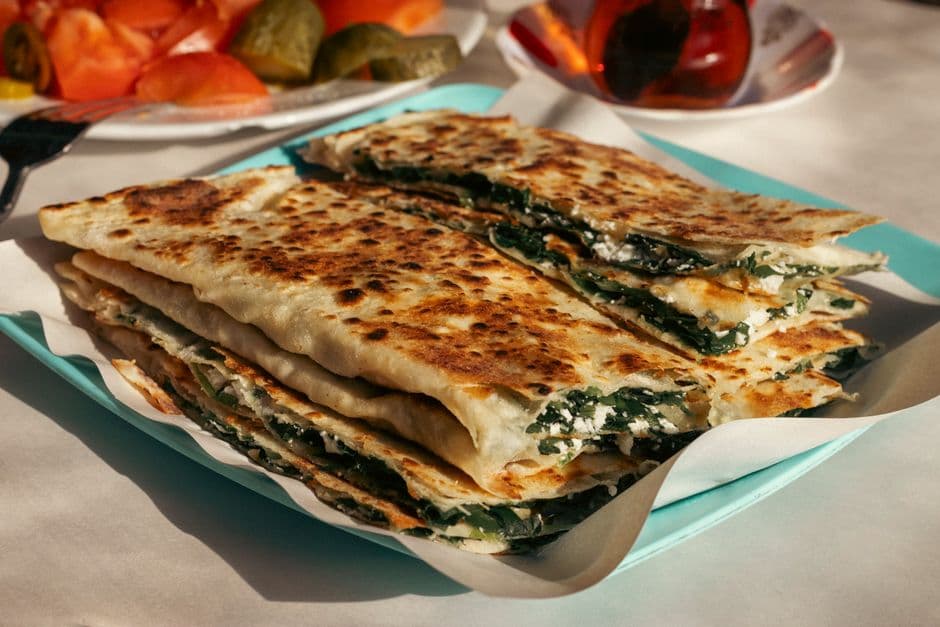
Turkish Börek with Cheese and Spinach
Crispy, layered phyllo pastry filled with tangy white cheese and wilted spinach — one of Turkey's most beloved pastry traditions.
About This Recipe
Börek is the cornerstone of Turkish pastry culture, found in every bakery, household and celebration across Turkey and across the former Ottoman world from the Balkans to the Middle East. Made by layering yufka or phyllo pastry sheets with savoury fillings and baking or pan-frying until shatteringly crisp, börek exists in dozens of regional variations. The su böreği (water börek) is boiled before baking; sigara böreği are rolled into cigar shapes and fried; tepsi böreği (tray börek) is the most manageable home version, where phyllo sheets are stacked in a baking tray with filling in between, brushed with a yoghurt-egg mixture that creates a golden, lightly bubbled top. This recipe makes a classic tepsi börek with a filling of fresh spinach and beyaz peynir (white cheese similar to feta). Rooted in the everyday cooking of Turkish kitchens, Turkish Börek with Cheese and Spinach balances technique and tradition: the phyllo (filo) pastry sheets is treated with care, drawing on time-honoured ratios that locals have refined across generations. The dish carries an unmistakable sensory signature — aromas that fill the kitchen as it cooks, layered textures that reveal themselves bite by bite, and a depth of flavour that comes from patient seasoning rather than shortcuts. Whether served as a weeknight lunch or as the centrepiece of a celebratory table, it reflects a regional pantry where local produce, seasoning habits and cooking vessels shape the final result. Home cooks who make this dish often note how forgiving it is once the core method is understood, and how a few small choices — the freshness of the phyllo (filo) pastry sheets, the order of additions, the resting time at the end — separate a good version from a memorable one. This recipe walks through those choices so the dish arrives with the character it has on its home turf.
Ingredients
Serves 6
- 400 gphyllo (filo) pastry sheets(thawed if frozen)
- 400 gfresh spinach(or frozen, thawed and well-drained)
- 250 gbeyaz peynir or feta cheese(crumbled)
- 2eggs(for the filling)
- 1onion(finely diced)
- 2 tbspolive oil
- 0.5 tspblack pepper
- 0.5 tspred chilli flakes(optional)
- 2eggs(for the top glaze)
- 3 tbspplain yoghurt
- 4 tbspolive oil or melted butter(for brushing)
- 1 tbspnigella seeds or sesame seeds(for topping)
Instructions
- 1
Prepare the filling
Sauté onion in olive oil until soft, about 5 minutes. Add fresh spinach in batches and cook until completely wilted, about 3–4 minutes. Squeeze out all excess moisture using a clean cloth or pressing in a sieve — this step is critical to avoid a soggy börek. Allow to cool completely. Combine cooled spinach with crumbled feta, 2 eggs, black pepper and chilli flakes.
Removing all moisture from the spinach cannot be overstated in importance. Even slightly wet spinach will make the börek soggy. Squeeze, press and squeeze again.
- 2
Make the glaze
Whisk together 2 eggs, yoghurt and 2 tablespoons of olive oil until smooth. This glaze is what creates the distinctive golden, bubbly top that characterises tepsi börek.
- 3
Layer the first half
Preheat oven to 180°C. Brush a 30x20 cm baking tray generously with olive oil. Layer half of the phyllo sheets into the tray, lightly brushing each layer with olive oil or butter. Let the edges hang over the sides.
Keep unused phyllo covered with a slightly damp cloth at all times — it dries out and cracks within minutes of air exposure.
- 4
Add the filling
Spread the spinach and cheese filling evenly over the layered phyllo. Fold the overhanging edges over the filling.
- 5
Layer the top and glaze
Layer the remaining phyllo sheets on top, again brushing each with olive oil. Tuck all edges under the börek. Pour the yoghurt-egg glaze evenly over the entire top surface. Scatter nigella or sesame seeds over the top.
- 6
Bake
Bake at 180°C for 35–40 minutes until deeply golden and crisp on top. The glaze should be set and slightly puffed. Allow to rest for 10 minutes before cutting into squares.
If the top is browning too quickly, tent loosely with foil for the last 10 minutes of baking.
Did you make this?
Rate it and help other cooks find the recipes that actually work.
One tap to sign in, and we'll save the rating you just picked.
Everything you need to plan your week — free
- Meal calendar
- Grocery list
- AI recipe ideas
Track what you eat
Snap your meal to log calories and macros, run fasting timers and track water in the free SnapCal app.
Pro Tips
- →
Room temperature phyllo is far easier to work with than cold — remove from the fridge 30 minutes before use.
- →
The yoghurt-egg glaze is a Turkish speciality that produces a unique soft-crisp texture. Do not substitute with plain butter — it changes the character of the börek.
- →
Leftover börek reheats exceptionally well in a 170°C oven for 10 minutes. Avoid the microwave — it makes the phyllo soggy.
- →
Turkish white cheese (beyaz peynir) is less salty than Greek feta — if using Greek feta, rinse it under cold water before crumbling.
- →
Source the freshest phyllo (filo) pastry sheets you can find — it is the flavour anchor of the dish.
Variations
- •
Kıymalı börek (meat börek): Replace the spinach-cheese filling with spiced minced lamb or beef cooked with onion, tomato paste and Turkish spices.
- •
Patatesli börek (potato börek): Fill with mashed potato seasoned with sautéed onion, paprika and dill — a popular street food version.
- •
Sigara böreği: Roll individual triangles of phyllo into cigar shapes around a strip of filling, seal with egg wash and deep-fry or oven-bake until crisp — ideal as a party canapé.
- •
Vegetarian: replace the main protein with mushrooms, paneer, tofu or hearty beans for a meat-free version.
- •
Spicier: add fresh chilli, a chilli paste or a pinch of cayenne with the aromatics for a warmer profile.
Storage
Börek keeps at room temperature for up to 1 day or refrigerated for 3 days. Reheat in the oven to restore crispness. Unbaked assembled börek freezes well — freeze tightly wrapped for up to 1 month and bake directly from frozen at 170°C for 50–55 minutes.
History & Origin
Börek traces its roots to Central Asian Turkic cooking traditions that predated the Ottoman Empire. As the Ottomans expanded across three continents from the 14th century onward, they carried börek throughout the Balkans, Middle East and North Africa, where local variations evolved — burek in the Balkans, brik in Tunisia, bastilla in Morocco. The word börek likely derives from the Old Turkic 'börmek', meaning to wrap or fold. Turkish palace kitchens elevated börek into an art form during the Ottoman imperial period, and the palace börekçi (börek master) was a position of considerable prestige.
Frequently Asked Questions
Can I make Turkish Börek with Cheese and Spinach ahead of time?
Yes — most components hold well in the fridge for a day or two. Reheat gently with a splash of liquid to bring it back to life.
What can I substitute for phyllo (filo) pastry sheets?
If phyllo (filo) pastry sheets is hard to find, the closest substitutes share its texture and water content. Adjust seasoning slightly since substitutes often carry less character of their own.
Is this recipe authentic to Turkish cooking?
It follows the most widely accepted home-cook template. Regional variants exist and we note the main ones in the variations section.
Why did my version turn out bland?
Usually under-seasoning or rushing the aromatic stage. Build flavour in layers, taste as you go, and finish with a touch of acid or salt to brighten the dish.
Nutrition Facts
Per serving (280g / 9.9 oz) · 6 servings total
Time Summary
Have Questions?
Ask our AI cooking assistant anything about this recipe — substitutions, techniques, scaling.
Chat with AI Chef →Featured in Guides
This recipe is featured in the following curated guides:
More Turkish Recipes
You Might Also Like
Similar dishes from other cuisines around the world.
Browse by Ingredient
More recipes built around the same core ingredients.
Free Kitchen Tools
Calculators and converters that pair with this page — no signup needed.
Put This Into a Plan
Schedule it, shop for it, and track what you already have.
Read Next
Longer reads that go deeper on the ideas behind this dish.
Community
Join the conversation
Sign in to leave a comment and save your favourite recipes