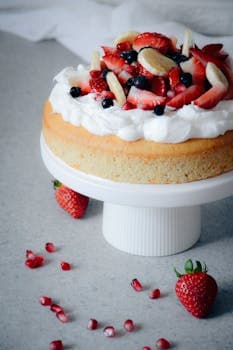
britishdessert✨ New
Victoria Sponge Cake
Light vanilla sponge layered with jam and whipped cream.
Prep
20 min
Cook
25 min
Servings
8
Difficulty
Medium
★★★★★
4.8(3,400 ratings)#british#cake#baking#afternoon tea#classic
About This Recipe
The Victoria Sponge is the quintessential British cake, named after Queen Victoria who famously enjoyed a slice with her afternoon tea. Two golden, pillowy layers of vanilla sponge sandwich a generous spread of strawberry jam and clouds of freshly whipped cream. Simple, elegant, and utterly satisfying, it is the benchmark against which all British baking is measured.
Ingredients
Serves 8
- 225 gunsalted butter, softened
- 225 gcaster sugar
- 4 largeeggs, at room temperature
- 225 gself-raising flour
- 1 tspvanilla extract
- 2 tbspwhole milk
- 150 gstrawberry jam
- 300 mldouble cream
- 1 tbspicing sugar, for dusting
Instructions
- 1
Prepare tins and batter
Preheat oven to 180 °C (350 °F). Grease and line two 20 cm (8 in) round cake tins. Cream butter and sugar together until pale and fluffy, about 5 minutes with an electric mixer.
- 2
Add eggs and flour
Beat in eggs one at a time, adding a tablespoon of flour with each to prevent curdling. Fold in the remaining flour, vanilla, and milk with a large metal spoon until just combined. Divide evenly between the tins.
- 3
Bake
Bake for 20-25 minutes until golden and a skewer inserted in the centre comes out clean. Cool in tins for 5 minutes, then turn out onto a wire rack to cool completely.
- 4
Whip the cream
Whip the double cream to soft peaks using a whisk or electric mixer. Be careful not to over-whip.
- 5
Assemble
Place one sponge on a serving plate. Spread with strawberry jam, then top with whipped cream. Place the second sponge on top and dust generously with icing sugar.
Pro Tips
- →
All ingredients must be at room temperature for the lightest sponge.
- →
Do not open the oven door during the first 15 minutes of baking.
- →
Use a kitchen scale for precision — equal weights of butter, sugar, eggs, and flour is the golden ratio.
- →
Weigh dry ingredients on a scale instead of using cups — grams are the difference between a tender and a tough crumb.
Variations
- •
Replace strawberry jam with lemon curd for a tangy twist.
- •
Add 2 tbsp cocoa powder to the batter and use chocolate ganache for a chocolate Victoria sponge.
- •
Vegetarian: swap the protein for roasted king oyster mushrooms, smoked tofu or cooked chickpeas — adjust seasoning slightly upward to compensate.
- •
Spicier: add a finely chopped fresh chile or a teaspoon of crushed Aleppo/Urfa pepper to the aromatics for warm, layered heat instead of a single sharp hit.
Storage
Best eaten on the day of assembly. Store unfilled sponges in an airtight container up to 2 days. Freeze unfilled sponges up to 1 month.
History & Origin
Victoria Sponge Cake is a hearty fixture of British kitchens where pub culture and Sunday tables shape the canon. Regional variations are the rule rather than the exception — neighboring villages, families and even individual cooks adapt the dish to what's in the pantry and what's in season, which is why no two versions taste exactly alike and why the recipe has stayed alive for so long.
Frequently Asked Questions
Can I make this ahead of time?
Yes — most of the components can be prepared up to a day in advance and refrigerated separately. Reheat gently and assemble just before serving so textures stay distinct.
What can I substitute if I don't have all the ingredients?
Stay close to the role each ingredient plays: swap aromatics for similar ones (shallot for onion, lime for lemon), and keep the fat-acid-salt balance intact. Spice blends can usually be approximated with what's in the cupboard.
How do I know it's authentic?
Authenticity sits on a spectrum — what matters more is honoring the technique and balance of flavors. If the dish tastes harmonious and respects how cooks in its home region would build it, you're on solid ground.
Why didn't mine turn out as expected?
The two most common issues are under-seasoning and rushing the heat. Taste as you go, season in layers, and give aromatics and proteins the time they need to develop color and depth before moving on.
Nutrition Facts
Per serving (150g / 5.3 oz) · 8 servings total
Calories480kcal
Protein6g
Carbohydrates48g
Fat30g
Fiber1g
Protein6g
Carbs48g
Fat30g
Time Summary
Prep time20 min
Cook time25 min
Total time45 min
Have Questions?
Ask our AI cooking assistant anything about this recipe — substitutions, techniques, scaling.
Chat with AI Chef →More British Recipes
Community
Join the conversation
Sign in to leave a comment and save your favourite recipes