
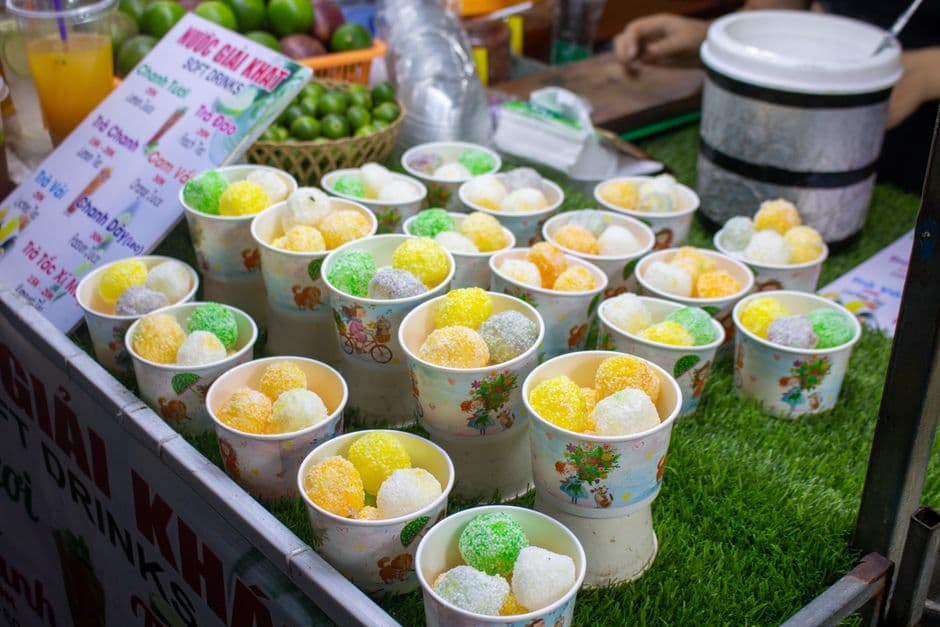
Vietnamese Chè Ba Màu (Three Color Dessert)
Vietnam's beloved street-cart dessert — three vivid layers of sweet mung bean, red bean, and pandan jelly under crushed ice and coconut cream.
About This Recipe
Chè ba màu — literally 'three-color dessert' — is one of southern Vietnam's most photogenic and beloved street desserts, sold from glass-fronted carts on Saigon street corners and at every chè vendor across the Mekong Delta. The 'three colors' are yellow sweet mung bean (đậu xanh), red adzuki bean (đậu đỏ), and green pandan agar jelly (rau câu pandan) — each cooked separately into soft, sweet, distinct layers, then assembled in a tall glass with crushed ice on top and a final drizzle of thick coconut cream. The eating ritual: stir everything together with a long spoon until the layers collapse into a multi-colored slush, then sip-eat with a wide straw-spoon. The flavors are subtle and gentle — sweet but not cloying, milky from the coconut, mildly fragrant from the pandan, with the meaty starchiness of beans giving substance. Unlike the maximalist Filipino halo-halo, chè ba màu is restrained — three colors, three flavors, balance over chaos. It's the perfect dessert for Saigon's relentless 33°C heat and the snack that homesick Vietnamese around the world fly home for. Made over a weekend, the assembled jars are an extraordinarily pretty showstopper at any summer dinner.
Ingredients
Serves 4
- 100 gsplit yellow mung beans (đậu xanh), soaked 4 hours
- 100 gdried adzuki / red beans (đậu đỏ), soaked overnight
- 120 gsugar, divided
- 10 gagar agar powder
- 500 mlwater (for jelly)
- 60 gsugar (for jelly)
- 5 leavesfresh pandan leaves (or 1 tsp pandan paste)
- 400 mlthick coconut milk
- 20 gsugar (for coconut milk)
- 1 pinchsalt
- 1 tbsptapioca starch (slurry in 2 tbsp water, for coconut sauce)
- 2 Lcrushed or shaved ice
Instructions
- 1
Cook the red beans
Drain soaked adzuki beans. Combine with 600 ml fresh water in a pot and simmer 50 minutes until completely soft (or pressure-cook 20 minutes). Drain off most liquid leaving beans just moistened. Stir in 50 g sugar and cook 3 minutes more until sugar dissolves and beans turn glossy. Cool.
- 2
Cook the yellow mung beans
Drain soaked mung beans. Steam in a heatproof bowl 25 minutes until completely tender and breaking apart. Mash lightly with a fork into a coarse paste — should be soft but still have texture. Stir in 50 g sugar and rest 5 minutes until sugar dissolves. Cool.
- 3
Extract pandan juice
Blend fresh pandan leaves with 100 ml water; strain through cheesecloth to extract bright green juice. Top up with water to make 500 ml total for the jelly. Skip if using paste.
- 4
Make the pandan jelly
Combine 500 ml pandan water with agar agar powder and 60 g sugar in a saucepan. Bring to a strong boil over medium heat, whisking constantly, then simmer 3 minutes — agar must boil to set properly. Pour into a flat dish and refrigerate 1 hour until firm. Cut into 5 mm cubes or short strips.
- 5
Make the coconut sauce
Combine coconut milk with 20 g sugar and a pinch of salt in a small saucepan. Warm over low heat, stirring, until sugar dissolves (3 minutes). Stir in tapioca slurry and cook another 2 minutes until slightly thickened to a pourable cream. Do not boil. Cool to room temperature.
- 6
Layer the bottom
In each tall glass (or wide jar): spoon a 2 cm layer of red beans on the bottom. Add a 2 cm layer of mung bean. Add a 2 cm layer of pandan jelly cubes on top. Press lightly so the layers stay distinct.
- 7
Add ice and coconut sauce
Pile crushed ice generously over the layered beans and jelly — about 8 tablespoons per glass. Slowly pour 80 ml coconut sauce over the ice in each glass, letting it cascade down through the layers.
- 8
Serve immediately
Bring to the table with long spoons. Each diner stirs vigorously to combine the layers into a colorful slush, then eats the resulting cool, sweet, milky dessert. Eat fast before the ice melts and dilutes the flavors.
Did you make this?
Rate it and help other cooks find the recipes that actually work.
One tap to sign in, and we'll save the rating you just picked.
Everything you need to plan your week — free
- Meal calendar
- Grocery list
- AI recipe ideas
Track what you eat
Snap your meal to log calories and macros, run fasting timers and track water in the free SnapCal app.
Pro Tips
- →
Soak both beans properly — under-soaked beans take forever to cook and are inconsistently textured. Mung beans need 4 hours minimum, adzuki overnight.
- →
Agar must come to a full boil to set — under-boiled agar gives a soft, slumpy jelly that won't hold its cubes. Boil for at least 2 minutes.
- →
Don't over-mash the mung beans — keep some texture. Pure paste is unpleasant; coarse mash with some intact beans is ideal.
- →
Salt in the coconut sauce is critical — without it the dessert tastes flat. The pinch should be detectable but not aggressive.
Variations
- •
Chè ba màu with sweet corn — add a layer of sweet corn kernels for a four-color version popular in the Mekong Delta.
- •
Chè ba màu with sticky rice — replace one bean layer with coconut-soaked sticky rice for a richer, more filling version.
- •
Two-color (chè hai màu) — simpler version using only red bean and mung bean, eaten as a quick afternoon snack.
- •
Chè thái — Vietnamese take on Thai dessert with jackfruit, longan, and basil seeds in coconut syrup; chè ba màu's cousin.
Storage
Components keep separately refrigerated: cooked beans 5 days, agar jelly 5 days, coconut sauce 3 days. Don't assemble in advance — the ice melts in minutes. Bean layers can be made up to 3 days ahead and assembled at serving.
History & Origin
Chè desserts (the Vietnamese broad term for sweet soups, puddings, and parfaits) date back centuries and reflect Vietnam's tropical agriculture — beans, rice, coconut, palm sugar. Chè ba màu specifically emerged in southern Vietnam in the 20th century and became iconic among Saigon street vendors. It traveled to the diaspora after 1975 and is now beloved in Vietnamese communities worldwide.
Frequently Asked Questions
What's the difference between adzuki and red kidney beans?
Adzuki are small, dark red beans with a sweet earthy flavor, used across East Asian desserts. Red kidney beans are larger and starchier — they work as a substitute but the flavor is less refined. Look for adzuki at Asian grocers.
Can I use gelatin instead of agar?
Yes, but the texture will be softer and meltier — agar gives a firmer, cleaner cube. If using gelatin, bloom 15 g in cold water, dissolve in 500 ml warm pandan water + sugar, chill until firm.
Why does the coconut sauce need tapioca starch?
It gives the sauce body so it coats the beans and ice rather than running off immediately. Without it the coconut milk dilutes too quickly into the melting ice.
Can I make this without a blender (for pandan juice)?
Use 1 teaspoon of quality pandan paste/extract dissolved in water — readily available at Asian grocers (Koepoe Koepoe is a reliable Indonesian brand). Or simmer pandan leaves in water 10 minutes and use the lightly-tinted liquid (less vivid but acceptable).
Nutrition Facts
Per serving (420g / 14.8 oz) · 4 servings total
Time Summary
Have Questions?
Ask our AI cooking assistant anything about this recipe — substitutions, techniques, scaling.
Chat with AI Chef →Featured in Guides
This recipe is featured in the following curated guides:
More Vietnamese Recipes
You Might Also Like
Similar dishes from other cuisines around the world.
Free Kitchen Tools
Calculators and converters that pair with this page — no signup needed.
Put This Into a Plan
Schedule it, shop for it, and track what you already have.
Read Next
Longer reads that go deeper on the ideas behind this dish.
Community
Join the conversation
Sign in to leave a comment and save your favourite recipes