
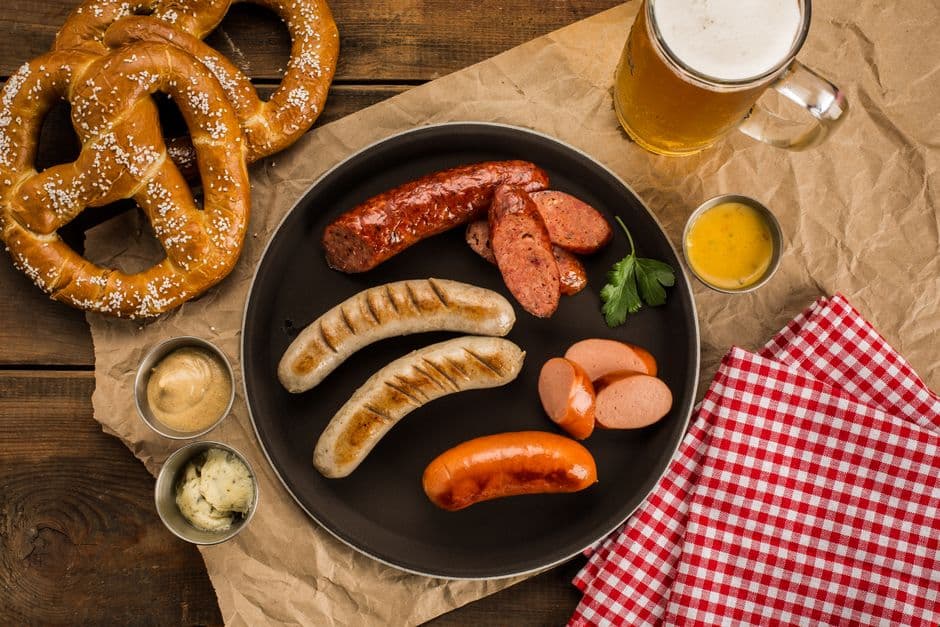
Bavarian Weisswurst with Sweet Mustard and Pretzel
Munich's morning sausage — pale veal-and-bacon wursts gently poached in water (never boiled), served with sweet Bavarian mustard, a soft pretzel and a tankard of weissbier.
About This Recipe
Weisswurst is the most ritualised sausage in Germany — a pale, soft, parsley-flecked veal-and-pork-back-bacon sausage made in Munich since 1857, when the butcher Sepp Moser at the Gasthaus zum Ewigen Licht supposedly ran out of his usual lamb casings and improvised with thicker pork casings, producing a sausage that couldn't be browned because the casing was too thick. The accident became the rule: weisswurst must be poached in barely simmering water, never boiled or grilled, served immediately, and — crucially — eaten before noon. Munich tradition holds that the sausage should never hear the chiming of the Glockenspiel at the Marienplatz town hall at midday, because in the pre-refrigeration era it was made fresh in the morning and would spoil by afternoon. The accompaniments are non-negotiable: süßer senf (sweet Bavarian mustard, made with brown mustard seeds and caramel), a freshly baked laugenbrezel (lye pretzel) with a shattering brown crust and soft chewy interior, and a litre tankard of Weissbier — the cloudy wheat beer of southern Bavaria. The eating method itself is a Bavarian ritual: you can either zuzeln (suck the sausage out of its skin, the proper countryman's way) or cut it lengthways and peel back the casing with a knife and fork (the city manner). Either way the casing is never eaten. It is breakfast as theatre, lubricated with beer, taken slowly at long communal tables in beer halls or family kitchens across Bavaria.
Ingredients
Serves 4
- 8fresh weisswurst sausages (look for Bavarian or proper veal-and-pork weisswurst from a German butcher)
- 1.5 Lwater
- 1 tspfine salt
- 1 smallyellow onion, halved (optional, for fragrance)
- 4 largefreshly baked Bavarian pretzels (laugenbrezeln)
- 1 jarsüßer Hausmacher senf (sweet Bavarian mustard, e.g. Händlmaier's)
- 4tall glasses or tankards of Weissbier (Erdinger, Schneider Weisse or Paulaner)
- 1 small bunchfresh chives, finely chopped (optional, for garnish)
Instructions
- 1
Bring the water to the right temperature
Pour the water into a wide, shallow pot, add the salt and the optional halved onion. Heat over high heat until you see small bubbles forming at the bottom but the surface is not yet rolling — around 70–75°C/160°F. This is the most important step: never let the water reach a proper boil.
- 2
Add the weisswurst
Once the water is at temperature, pull the pot off the heat for 30 seconds to drop the temperature slightly. Carefully slide in the weisswurst — they should sink, then gradually rise to the surface as they warm. Return to very low heat.
- 3
Poach gently — never boil
Hold the water at 70–80°C for 10–12 minutes — barely trembling, with occasional small bubbles rising. If the water boils, the casing will burst and you will have ruined the wurst. Use a thermometer if you are unsure.
A boiled weisswurst is an embarrassment in Bavaria; if it splits, the butcher would say you do not deserve weisswurst.
- 4
Warm the pretzels
While the sausages poach, briefly warm the pretzels in a low oven (150°C/300°F) for 4 minutes to soften and freshen — they should be lukewarm with a glossy, slightly crisp crust.
- 5
Serve in the cooking liquid
Use tongs to lift the weisswurst into deep individual bowls or one large bowl and pour over a ladleful of the hot poaching water to keep them warm at the table. The water should reach about a third of the way up the sausages.
- 6
Dress the table
Place a small ramekin of sweet Bavarian mustard, a warmed pretzel, and a tall glass of Weissbier (poured with a tall, lazy foam crown) at each setting. Provide a small sharp knife and fork.
- 7
Eat traditionally
Use the knife to slice the wurst lengthways down the centre. Peel back the casing with your knife. Cut the bare meat into bite-sized pieces, dip in mustard, and eat alternately with bites of pretzel and sips of beer. Or, properly, hold the wurst and suck (zuzeln) the meat directly out of the casing — the countryman's way.
Did you make this?
Rate it and help other cooks find the recipes that actually work.
One tap to sign in, and we'll save the rating you just picked.
Everything you need to plan your week — free
- Meal calendar
- Grocery list
- AI recipe ideas
Track what you eat
Snap your meal to log calories and macros, run fasting timers and track water in the free SnapCal app.
Pro Tips
- →
Never let the poaching water boil — keep it at 70–80°C throughout. A boiled casing splits and the wurst is ruined.
- →
Sweet Bavarian mustard (süßer Senf) is non-negotiable — the Bavarian Händlmaier's brand is available internationally. Sharp Dijon mustard is wrong for this dish.
- →
Eat weisswurst within 24 hours of buying — the high water and low salt content mean it spoils faster than other sausages. The Munich rule of eating before noon comes from this fact.
- →
The skin is for the dog (or the bin), never the diner. Bavarians peel or suck — they do not eat the casing.
Variations
- •
Late Munich (post-noon) weisswurst — a 21st-century concession in beer halls catering to tourists, served all day. Bavarian purists disapprove.
- •
Weisswurst-with-fried-egg — a modern Munich brunch interpretation, serving the sausage on a plate with a sunny-side-up egg and pretzel.
- •
Mini cocktail weisswurst — small versions served at New Year's Eve parties, eaten with toothpicks and sweet mustard.
- •
Käseweißwurst — variant containing small chunks of melted cheese, popular in Allgäu region of Bavaria.
Storage
Eat the same day. Uncooked weisswurst refrigerates 24 hours; cooked weisswurst should be eaten within 30 minutes of poaching. Do not refrigerate cooked sausages and reheat — the texture and food safety both suffer. Leftover pretzels keep 1 day, refresh in a low oven 3 minutes.
History & Origin
Weisswurst was invented on 22 February 1857 by Munich butcher Sepp Moser at the Gasthaus zum Ewigen Licht near Marienplatz, when he ran out of lamb casings for his usual fried sausages and used thicker pork casings instead, requiring poaching rather than grilling. The midday-only rule originates from the pre-refrigeration era when the fresh sausage would spoil by afternoon if not eaten quickly.
Frequently Asked Questions
Why shouldn't I eat the casing?
Bavarian tradition. The casing is thicker than a normal sausage and chewy rather than tender. More practically, the high temperature inside the cooked sausage means the casing texture never softens. Sucking or peeling are the only acceptable options.
Can I find weisswurst outside Bavaria?
German butchers worldwide (Edward's, Schaller & Weber in the US; German Deli in the UK) sell proper weisswurst. Avoid mass-market American-style 'white bratwurst', which is a different sausage.
What's a proper Weissbier?
A cloudy, top-fermented wheat beer from southern Bavaria with banana-and-clove aromas, served in a tall vase-shaped 0.5 litre glass with a foamy crown. Erdinger, Schneider Weisse, Franziskaner and Paulaner all make classics.
Do I really have to eat it before noon?
Modern refrigeration means you can technically eat weisswurst all day. But Bavarian beer halls and breakfast tables still hold to the tradition out of pride and ritual — the meal is properly a morning one and a 1pm weisswurst feels wrong to anyone raised on it.
Nutrition Facts
Per serving (540g / 19.0 oz) · 4 servings total
Time Summary
Have Questions?
Ask our AI cooking assistant anything about this recipe — substitutions, techniques, scaling.
Chat with AI Chef →More German Recipes
You Might Also Like
Similar dishes from other cuisines around the world.
Browse by Ingredient
More recipes built around the same core ingredients.
Free Kitchen Tools
Calculators and converters that pair with this page — no signup needed.
Put This Into a Plan
Schedule it, shop for it, and track what you already have.
Read Next
Longer reads that go deeper on the ideas behind this dish.
Community
Join the conversation
Sign in to leave a comment and save your favourite recipes