
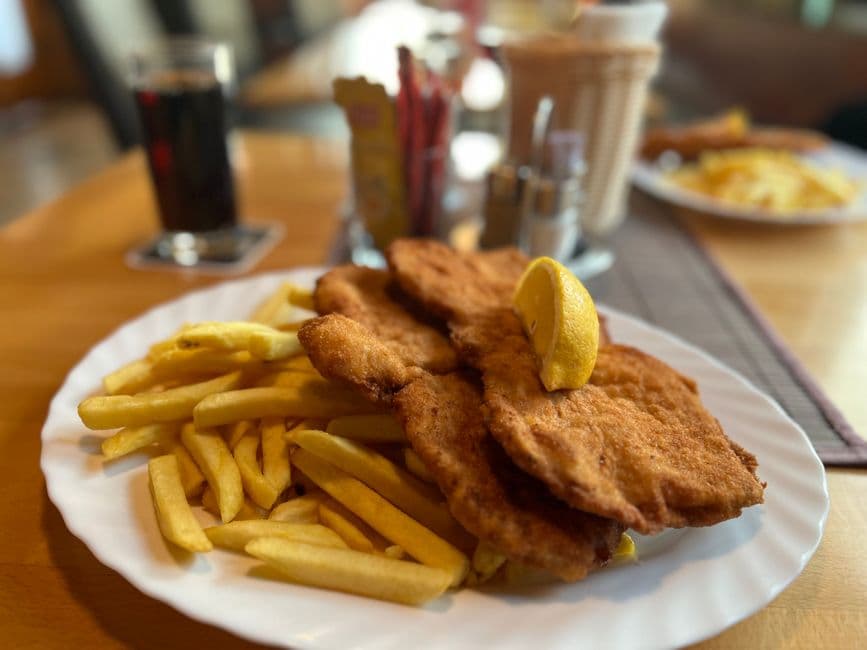
Wiener Schnitzel
Austria's most iconic dish: veal escalope pounded paper-thin, breaded in a soufflé-light coating and fried in clarified butter until golden with the characteristic 'souffle' — served with lemon and lingonberry jam.
About This Recipe
Wiener Schnitzel is Austria's most famous dish and one of the great pan-fried preparations in European cooking: a thin veal escalope pounded until almost translucent, breaded in flour, egg and fine breadcrumbs and fried in a generous amount of clarified butter or lard until the coating soufflés away from the meat in characteristic golden waves. The 'protected' Viennese version must be made with veal — using pork makes Schnitzel Wiener Art (Vienna-style schnitzel), which is delicious but not the same. The coating must not adhere tightly to the meat — the loose, airy soufflé of the breading is what distinguishes a great Wiener Schnitzel from a mere breaded cutlet. Served with a lemon wedge, parsley potato and lingonberry jam, it is Vienna's culinary pride.
Ingredients
Serves 4
- 4veal escalopes(about 150g each)
- 80 gplain flour
- 3eggs(beaten)
- 200 gfine white breadcrumbs
- 200 gclarified butter (ghee) or lard
- 1 teaspoonsalt
- 2lemons(cut into wedges)
- 4 tablespoonslingonberry jam(to serve)
- 800 gpotatoes(for parsley butter potatoes)
- 50 gbutter
- 1 small bunchflat parsley(chopped)
Instructions
- 1
Pound the veal
Place each escalope between two sheets of cling film. Pound with a meat mallet until about 3mm thin and even. Season lightly with salt.
Even thickness is critical — any thick spots will cause uneven cooking. Work from the centre outward.
- 2
Bread the schnitzel
Set up three shallow bowls: flour, beaten egg and breadcrumbs. Coat each schnitzel in flour (shake off excess), then egg, then breadcrumbs. Press the breadcrumbs on loosely — do not press hard. Do not let them sit after breading.
The loose breadcrumb coating is essential for the soufflé effect. If you press the crumbs tightly, the coating will stick flat to the meat.
- 3
Fry
Heat clarified butter to 160–170°C in a wide pan — there should be enough to come halfway up the schnitzel. Fry one at a time for 2–3 minutes per side, moving the pan gently so the butter washes over the schnitzel. The coating should soufflé and turn golden.
- 4
Drain and serve
Drain briefly on paper towels. Serve immediately with lemon wedge, parsley potatoes and lingonberry jam.
Did you make this?
Rate it and help other cooks find the recipes that actually work.
One tap to sign in, and we'll save the rating you just picked.
Everything you need to plan your week — free
- Meal calendar
- Grocery list
- AI recipe ideas
Cook this hands-free
Get AI meal plans, step-by-step cooking mode, and your saved recipes in the free Bento app.
Pro Tips
- →
Clarified butter (ghee) is essential — regular butter burns at the temperature required.
- →
Never press the breadcrumbs — the loose coating is the source of the soufflé effect.
- →
Fry one schnitzel at a time for best results — multiple schnitzel cool the oil.
- →
Taste and adjust salt at the very end — flavors concentrate as liquids reduce, and a final pinch of flaky salt sharpens the whole dish.
Variations
- •
Schnitzel Wiener Art: the same dish made with pork instead of veal — technically not Wiener Schnitzel but equally delicious.
- •
Jägerschnitzel: served with a mushroom cream sauce.
- •
Vegetarian: swap the protein for roasted king oyster mushrooms, smoked tofu or cooked chickpeas — adjust seasoning slightly upward to compensate.
- •
Spicier: add a finely chopped fresh chile or a teaspoon of crushed Aleppo/Urfa pepper to the aromatics for warm, layered heat instead of a single sharp hit.
Storage
Best eaten immediately. Leftover schnitzel can be reheated in a hot oven (200°C) for 8 minutes.
History & Origin
Wiener Schnitzel's origins are disputed — Austrian food historians argue it predates the popular story that it was inspired by Italian cotoletta alla milanese brought to Vienna by Field Marshal Radetzky in the 19th century. Whatever its origin, Wiener Schnitzel became codified as Vienna's signature dish during the Habsburg era and has remained Austria's most internationally recognised food. It is legally protected in Austria — any dish called 'Wiener Schnitzel' must be made with veal.
Frequently Asked Questions
Can I use pork instead of veal?
Yes — pork schnitzel (Schnitzel Wiener Art) is very popular and delicious. Use pork loin escalopes of similar thickness. The technique is identical.
Can I make this ahead of time?
Yes — most of the components can be prepared up to a day in advance and refrigerated separately. Reheat gently and assemble just before serving so textures stay distinct.
What can I substitute if I don't have all the ingredients?
Stay close to the role each ingredient plays: swap aromatics for similar ones (shallot for onion, lime for lemon), and keep the fat-acid-salt balance intact. Spice blends can usually be approximated with what's in the cupboard.
How do I know it's authentic?
Authenticity sits on a spectrum — what matters more is honoring the technique and balance of flavors. If the dish tastes harmonious and respects how cooks in its home region would build it, you're on solid ground.
Nutrition Facts
Per serving (340g / 12.0 oz) · 4 servings total
Time Summary
Have Questions?
Ask our AI cooking assistant anything about this recipe — substitutions, techniques, scaling.
Chat with AI Chef →Featured in Guides
This recipe is featured in the following curated guides:
More Austrian Recipes
You Might Also Like
Similar dishes from other cuisines around the world.
Browse by Ingredient
More recipes built around the same core ingredients.
Free Kitchen Tools
Calculators and converters that pair with this page — no signup needed.
Put This Into a Plan
Schedule it, shop for it, and track what you already have.
Read Next
Longer reads that go deeper on the ideas behind this dish.
Community
Join the conversation
Sign in to leave a comment and save your favourite recipes