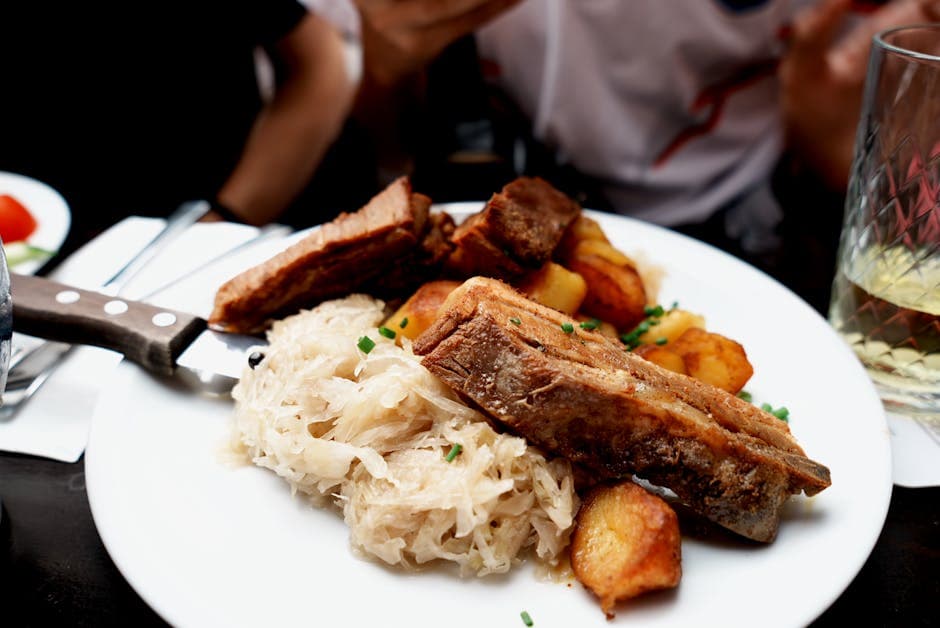
Vienna's icon — milk-fed veal pounded paper-thin, dredged in flour-egg-breadcrumb, swim-fried in foaming butter until golden and crisp.
Wiener Schnitzel is one of those dishes where the word itself is legally protected — by Austrian law and EU regulation, only a breaded fried cutlet made from veal can be called 'Wiener Schnitzel'; the pork version must be called 'Schnitzel Wiener Art' (Vienna-style). The defining moves are precise: a thin slice of milk-fed veal leg (Oberschale or Kalbsnuss), pounded between sheets of cling film with a flat meat hammer until it's a paper-thin oval at least 25 cm across and only 3–4 mm thick; dredged in flour, dipped in beaten egg, then very gently coated in fine, dry, golden Semmelbrösel (Austrian breadcrumbs) without pressing — the loose coating is what gives a real Wiener Schnitzel its famous puffed-up, wave-like, blistered crust that separates from the meat in places. The cooking is the second defining move: 'swim-frying' in a generous bath of clarified butter (or a clarified butter–lard mix) over high heat for just 60–90 seconds per side, with the pan agitated constantly so the bubbling butter washes over the top of the schnitzel and gives the crust its characteristic golden ripple. Properly made, the crust shatters like crisp lace, the veal is just done with a faint pink blush, and the dish is served with nothing but a wedge of lemon, a sprinkle of parsley, and a parsleyed potato salad (Erdäpfelsalat) on the side.
Serves 4
Place each cutlet between two sheets of cling film. Pound gently and evenly with a flat-faced meat hammer (or the smooth side of a meat mallet) until the cutlet is 3–4 mm thick and at least 25 cm across — paper-thin and translucent at the edges. The thinness is non-negotiable.
Salt both sides of each pounded cutlet generously and let stand 5 minutes — this seasons the meat all the way through and helps the breadcrumb stick. Pat dry just before breading.
Line up three wide plates: seasoned flour, beaten egg-milk wash, and breadcrumbs. Keep them in this exact order. Have a clean tray ready for the breaded cutlets, and start heating the butter while you bread.
Dredge a cutlet in flour and shake off ALL excess (any clumps will ruin the puff). Dip into egg and lift out, letting drips fall. Lay in breadcrumbs and turn once, scooping a few crumbs gently over the top — do NOT press the crumbs in. The loose coating is what makes the crust 'soufflé' when fried.
Once breaded, the schnitzel should rest no more than 5 minutes before frying — the egg layer will start to set and the crumbs will absorb moisture.
Melt the clarified butter in a wide heavy skillet (28–30 cm) over medium-high heat until it's bubbling vigorously and reads 170°C (340°F) on a thermometer. The butter must be at least 1 cm deep — this is swim-frying, not pan-frying.
Slide one schnitzel into the bubbling butter. Immediately and continuously agitate the pan with a circular wrist motion so the hot butter washes constantly over the top of the schnitzel — this is the defining technique that creates the puffed, blistered crust. Fry 60–90 seconds per side until golden brown.
If your pan is large enough for two, fry two side-by-side but never crowd. One per pan is the safest bet for perfect results.
Lift each schnitzel onto a wire rack set over a tray (paper towels make the crust soggy). Sprinkle with flaky salt while still hot. Rest just 30 seconds — they're meant to be eaten very fresh.
Plate each schnitzel so it overhangs the rim of a warm dinner plate (Viennese tradition — bigger than the plate). Add a lemon wedge, a scatter of chopped parsley, and a mound of warm parsleyed potato salad alongside. Eat immediately.
Veal is the only meat that can be called Wiener Schnitzel. Pork is delicious too but it's 'Schnitzel Wiener Art' — legally a different dish.
Clarified butter (Butterschmalz) is essential — it has a high smoke point and gives the signature buttery flavour. Whole butter burns at this temperature.
Swim-fry, don't pan-fry. The butter must be deep enough (1 cm) and you must agitate the pan constantly so the bubbling fat washes over the top — that's what creates the puffed crust.
Eat within 5 minutes of frying. Wiener Schnitzel is a fresh-pan dish — it goes soggy faster than almost any other fried food. Hold leftovers in a 200°C oven for max 5 minutes if needed.
Schnitzel Wiener Art — same technique with pork loin cutlets; widely served across Austria and Germany as a cheaper everyday version.
Cordon Bleu — stuff two thin veal cutlets with ham and Emmental cheese before breading; a Swiss-Austrian crossover.
Schnitzel à la Holstein — top the finished schnitzel with a fried egg, anchovy fillets and capers; a hearty 19th-century Berlin variant.
Chicken schnitzel — pounded chicken breast, same breading and frying technique; not authentic but extremely common in Austrian home cooking.
Wiener Schnitzel does NOT keep well — eat the day it's made. Reheating soggies the crust irreparably. If you must reheat, place on a wire rack in a 200°C oven for 5 minutes, no longer. Breaded uncooked schnitzels can be frozen on a tray, then bagged, and fried from frozen at 165°C for 4 minutes per side.
Wiener Schnitzel emerged in 19th-century Vienna and is often (mistakenly) attributed to Field Marshal Radetzky bringing the technique back from Milan after the 1848 Italian campaigns. In fact, breaded fried cutlets had been documented in Austrian cookbooks since the late 18th century, predating the Radetzky legend by decades.
It will be edible but it will not be Wiener Schnitzel — the puffed, blistered crust depends entirely on the swim-frying technique. Bake-from-frozen at 220°C for 15 minutes gives an acceptable weeknight result if frying isn't an option.
Either you pressed the breadcrumbs in (don't!), the butter wasn't hot enough (170°C minimum), or you didn't agitate the pan to wash butter over the top. All three steps are required for the famous wave-pattern puff.
No — panko is too coarse and crispy and produces a totally different, harder, less puffed crust. Use very fine European-style breadcrumbs (Semmelbrösel) — you can pulse stale kaiser rolls or white bread in a food processor and dry the crumbs in a low oven.
Authentic Vienna pairs it with cold Erdäpfelsalat (vinegar-and-mustard potato salad). Cucumber salad (Gurkensalat) is a common second side. Lingonberry jam (Preiselbeeren) is also classic — sweet-sour with the rich crust.
Per serving (320g / 11.3 oz) · 4 servings total
Ask our AI cooking assistant anything about this recipe — substitutions, techniques, scaling.
Chat with AI Chef →Join the conversation
Sign in to leave a comment and save your favourite recipes