
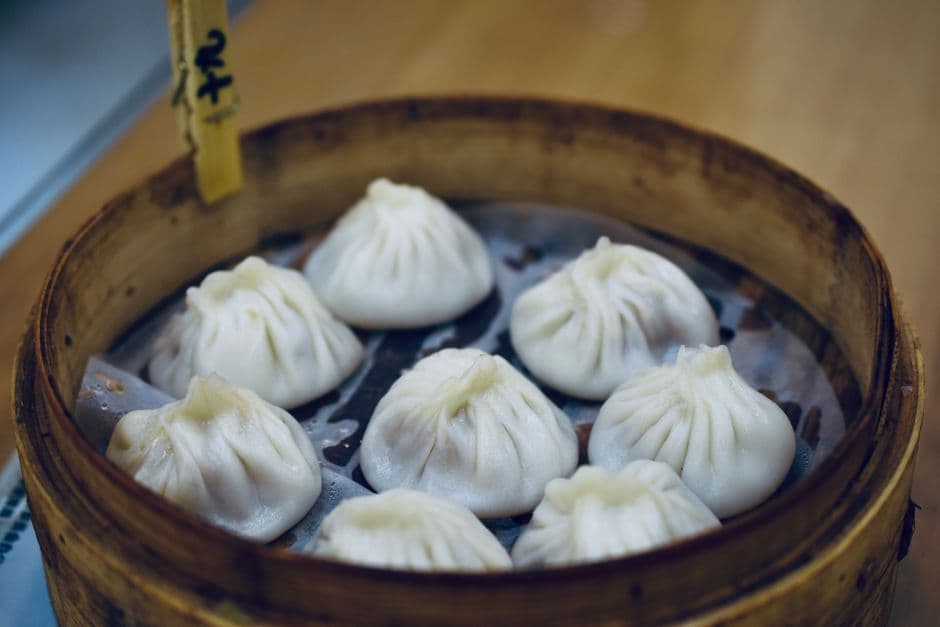
Shanghai Xiaolongbao (Soup Dumplings)
Shanghai's legendary soup dumplings — delicate pleated parcels filled with seasoned pork and a burst of rich aspic-jelly broth that liquefies on steaming.
About This Recipe
Xiaolongbao — literally 'small basket buns' for the bamboo steamers they're served in — are arguably the most technically demanding street food in Chinese cuisine. The genius is the soup: pork stock thickened with pork skin gelatin sets into a firm aspic when cold, gets minced into the filling, and melts back into a scalding broth as the dumplings steam. Each parcel must be sealed with at least 18 pleats (the masters at Din Tai Fung insist on exactly 18) and the skin must be thin enough to see the filling through it yet strong enough not to burst. Eaten properly — gently lift the dumpling by its topknot with chopsticks, place on a soup spoon, nibble a tiny hole, sip the broth, then eat the dumpling with a sliver of fresh ginger in black vinegar — xiaolongbao is one of the great pleasures of Chinese cuisine. Originating in the Shanghai suburb of Nanxiang in the 1870s, they spread across the Jiangnan region and, via Din Tai Fung's global expansion, became Taipei's most famous culinary export. Making them at home requires patience — the aspic must be made a day ahead, and pleating is a skill that develops over dozens of dumplings — but the result is genuinely transcendent.
Ingredients
Serves 6
- 500 gpork skin, hair scraped, cut in strips (for aspic)
- 300 gchicken bones, blanched (for aspic)
- 2 Lwater
- 30 gfresh ginger, sliced
- 2scallions, smashed
- 400 gminced pork belly (30 percent fat)
- 15 mlShaoxing wine
- 12 mllight soy sauce
- 8 gcaster sugar
- 4 gfine salt
- 2 gwhite pepper
- 10 mlsesame oil
- 300 gplain flour
- 165 mljust-boiled water (for hot-water dough)
- 60 mlChinkiang black vinegar (for dipping)
- 20 gfresh ginger, julienned (for dipping)
Instructions
- 1
Make the aspic (day before)
Blanch pork skin and chicken bones in boiling water 3 minutes, drain. Combine with 2 L fresh water, ginger, and scallions in a heavy pot. Simmer 3 hours skimming foam — until liquid reduces to 500 ml and is intensely gelatinous. Strain into a tray and refrigerate overnight until firm aspic forms. Cut into 5 mm dice.
- 2
Mix the filling
Combine minced pork, Shaoxing, soy, sugar, salt, white pepper, and sesame oil in a bowl. Mix vigorously in one direction with chopsticks for 3 minutes until sticky and pale — this is what gives the filling its bouncy texture. Fold in the diced aspic gently to keep cubes intact. Chill 30 minutes.
- 3
Make the dough
Place flour in a bowl, pour in just-boiled water while stirring with chopsticks. Once cool enough to handle, knead 8 minutes into a smooth dough. Cover and rest 30 minutes. Hot-water dough gives translucent, supple wrappers.
- 4
Roll the wrappers
Divide dough into 4 ropes, cut each into 8 pieces (32 total). Roll each into a 9 cm circle, thicker in the center and thinner at the edges — this is essential for proper sealing without bursting at the topknot.
- 5
Fill and pleat
Place a wrapper in your palm, drop a heaped tablespoon of filling in the center (including 2–3 aspic cubes). Pleat the edge with your dominant hand, rotating with the other, making 16–18 small pleats. Twist the top to seal completely.
Don't worry about pleat perfection at first — focus on a complete seal. Pleating is a skill that takes 50 dumplings to acquire.
- 6
Rest before steaming
Place each finished dumpling on a small square of parchment in a bamboo steamer. Space them 2 cm apart — they expand during steaming. Rest 10 minutes.
- 7
Steam over high heat
Bring water to a furious boil. Steam dumplings 8 minutes over high heat (do not lift the lid mid-steam). The wrappers turn translucent and you can see the soup sloshing inside — that's done.
- 8
Serve immediately with ginger-vinegar
Bring the steamer basket directly to the table. Provide each diner with a soup spoon, ginger julienne in black vinegar, and chopsticks. Teach the lift-pierce-sip-eat technique before the first bite — the soup is genuinely scalding.
Did you make this?
Rate it and help other cooks find the recipes that actually work.
One tap to sign in, and we'll save the rating you just picked.
Everything you need to plan your week — free
- Meal calendar
- Grocery list
- AI recipe ideas
Track what you eat
Snap your meal to log calories and macros, run fasting timers and track water in the free SnapCal app.
Pro Tips
- →
Pork skin is sold at Asian butchers — ask in advance. Substitute powdered gelatin (15 g bloomed in water + 500 ml rich pork-chicken stock) if unavailable, though flavor is less complex.
- →
Hot-water dough is non-negotiable — cold-water dough cracks and bursts. The just-boiled water gelatinizes starch and gives elasticity.
- →
Pleating practice: aim for at least 12 pleats your first time, work up to 18. The pleats are partly aesthetic but also distribute stress so the dumpling doesn't burst.
- →
Do not overfill — one heaped tablespoon maximum. Overfilled dumplings split during steaming and lose all their soup.
Variations
- •
Crab and pork (xie fen xiaolongbao) — add 80 g fresh crab meat and a teaspoon of crab roe to the filling; Shanghai autumn specialty.
- •
Truffle xiaolongbao — Din Tai Fung's modern luxury version with a sliver of black truffle on top of each dumpling.
- •
Sheng jian bao — pan-fried, larger soup buns with sesame; same filling, leavened dough, fried with steam in a covered pan.
- •
Chicken xiaolongbao — replace pork with minced chicken thigh and use chicken-only aspic for a halal-friendly version.
Storage
Best eaten fresh from the steamer. Uncooked dumplings freeze 1 month on a tray then bagged — steam from frozen 10 minutes. Once steamed, leftover dumplings refrigerate 24 hours; reheat by steaming 4 minutes (microwave bursts them).
History & Origin
Xiaolongbao were invented in 1871 by Huang Mingxian at the Rixinglou restaurant in Nanxiang, a suburb of Shanghai. The technique of incorporating gelled stock into the filling was revolutionary at the time and spread quickly through the Jiangnan region; Taipei's Din Tai Fung made them globally famous from the 1990s onward.
Frequently Asked Questions
Why did my dumplings have no soup?
Either the aspic wasn't gelatinous enough (simmer pork skin longer next time), the dumplings were sealed poorly (soup leaked during steaming), or you steamed at too low heat (gentle steam doesn't melt the aspic fast enough).
Can I use a regular metal steamer instead of bamboo?
Yes, but bamboo absorbs condensation and prevents water dripping onto the dumplings. If using metal, wrap the lid in a clean tea towel to catch drips.
How do I eat them without burning my mouth?
Lift gently by the topknot with chopsticks, place on a soup spoon, bite a small hole in the side, sip the broth (it's volcanic — be patient), then eat the dumpling with ginger-vinegar.
Can I make the aspic with store-bought stock?
You can — bloom 20 g gelatin in 100 ml cold water, dissolve into 500 ml hot rich stock, chill until firm. Flavor is decent but the texture of the broth is not quite as silky as homemade.
Nutrition Facts
Per serving (180g / 6.3 oz) · 6 servings total
Time Summary
Have Questions?
Ask our AI cooking assistant anything about this recipe — substitutions, techniques, scaling.
Chat with AI Chef →Featured in Guides
This recipe is featured in the following curated guides:
More Chinese Recipes
You Might Also Like
Similar dishes from other cuisines around the world.
Browse by Ingredient
More recipes built around the same core ingredients.
Free Kitchen Tools
Calculators and converters that pair with this page — no signup needed.
Put This Into a Plan
Schedule it, shop for it, and track what you already have.
Read Next
Longer reads that go deeper on the ideas behind this dish.
Community
Join the conversation
Sign in to leave a comment and save your favourite recipes