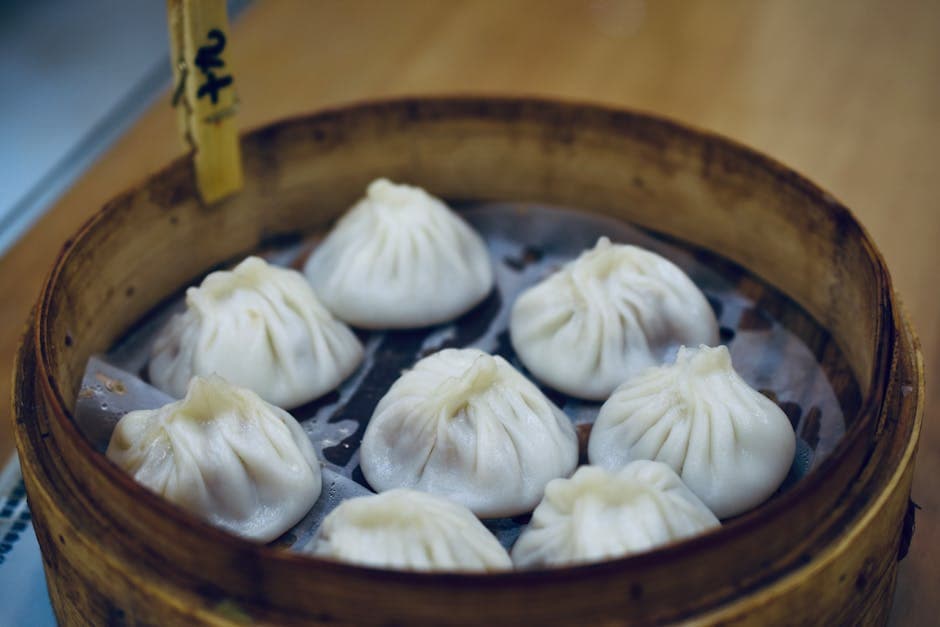
Shanghai's translucent soup dumplings — pleated pouches holding pork, gelled broth, and 18 perfect folds.
Xiaolongbao are Shanghai's most celebrated dumplings — small, exquisitely pleated pouches of unleavened dough containing a marble of seasoned pork and a hidden well of hot broth that floods the mouth on the first bite. The secret is aspic: a rich chicken-and-pork stock set with gelatin to a jiggly cube, diced and folded into the meat filling. When steamed, the cube melts back into liquid, encased by the thin wrapper. Each xiaolongbao should have 18 pleats and weigh exactly 21 grams; in Shanghai's Din Tai Fung this is enforced by daily measurement. Eating them requires technique: lift by the topknot with chopsticks, drop into the soup-spoon, nip a small hole with the teeth, sip the broth, and finally eat the dumpling with a sliver of ginger and black vinegar.
Serves 4
Blanch pork skin and bones in boiling water 5 minutes. Drain and rinse. Return to a clean pot with 1.5 L fresh water, ginger, scallions, Shaoxing wine, and salt. Simmer very gently for 4 hours until the stock is rich and viscous.
Strain the stock through a fine sieve (about 500 ml). Cool, then refrigerate at least 6 hours until set to a firm jelly. Dice into 5 mm cubes.
In a bowl, mix flour, warm water, and salt. Knead 12 minutes until very smooth, elastic, and slightly tacky. Wrap and rest 30 minutes.
In a chilled bowl, combine ground pork, Shaoxing wine, both soy sauces, sugar, salt, white pepper, sesame oil, ginger, and scallions. Mix vigorously in one direction with chopsticks for 3 minutes until pale and sticky. Fold in the diced aspic gently — do not crush the cubes.
Divide dough into 24 pieces. Roll each into a thin disc about 8 cm wide, with the center slightly thicker than the edges.
Hold a wrapper in your non-dominant palm. Place 1 heaping teaspoon of filling in the center. Using your thumb and forefinger, gather the edge of the wrapper into small accordion pleats while rotating in your palm — aim for 16–18 pleats. Twist closed at the top into a tiny topknot.
Line a bamboo steamer with parchment or napa cabbage leaves. Arrange dumplings with 2 cm gaps. Steam over rapidly boiling water for 8 minutes.
Bring the bamboo steamer to the table. Each diner lifts a dumpling carefully into a soup spoon, nips a tiny hole, sips the broth, and eats the dumpling with julienned ginger dipped in black vinegar.
Aspic is the entire trick — without it there's no soup. Don't try to substitute.
Roll the wrapper edges thinner than the center; the topknot needs to be thicker to seal under steam.
Steam over fully boiling water; under-steamed wrappers split and the soup escapes.
Crab xiaolongbao: replace half the pork with picked crab meat and crab roe.
Spicy mala xiaolongbao: add 1 tsp chili crisp and 1/2 tsp Sichuan peppercorn powder to the filling.
Sheng jian bao: same filling, thicker dough, pan-fried (the close cousin).
Freeze raw on a parchment-lined tray. Once solid, bag up to 1 month. Steam from frozen with 2 extra minutes — never thaw first or the soup leaks.
Xiaolongbao were invented in Nanxiang, a Shanghai suburb, in 1871 by chef Huang Mingxian. The original Nanxiang Mantou Dian still operates near Yu Garden. The 18-pleat rule was popularized internationally by Taiwan's Din Tai Fung chain from the 1980s onward.
The wrapper had a hole or the seal at the top wasn't tight. Practice the pleating — too thick a topknot doesn't seal; gaps between pleats leak.
No — they're too thick and don't pleat well. The thin custom wrapper is essential.
Per serving (320g) · 4 servings total
Ask our AI cooking assistant anything about this recipe — substitutions, techniques, scaling.
Chat with AI Chef →Join the conversation
Sign in to leave a comment and save your favourite recipes