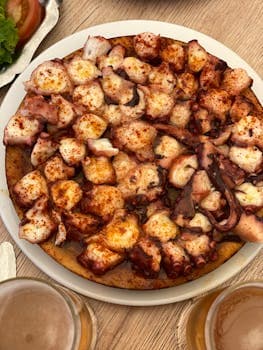
Pulpo pochado lentamente con papas aplastadas, pimentón ahumado dulce y el mejor aceite de oliva que puedas permitir.
⭐Inspired by José Andrés · 🇪🇸 SpainEste plato está inspirado en el campeón de Chef José Andrés de toda la vida de la cultura de tapas española pequeña en América.
Sirve 4
If using fresh octopus, freeze it overnight first — the freeze-thaw cycle breaks down the muscle fibres and ensures tenderness. Bring a large pot of water to a rolling boil with the onion, bay leaves, peppercorns and garlic.
Galician tradition is to dip the octopus into the boiling water 3 times before fully submerging — it 'curls' the tentacles dramatically.
Lower the octopus into the boiling water. Reduce heat to a bare simmer (NOT a boil) and cook for 60–90 minutes depending on size — until a knife slides easily into the thickest part of a tentacle. Turn off heat and let rest in the water for 15 minutes.
While the octopus rests, boil the potatoes whole in well-salted water for 18–20 minutes until tender. Drain and let steam dry.
Lift the octopus from the cooking water. Cut the tentacles into 1.5cm-thick slices on a slight bias, and chop the head into bite-sized pieces. Discard the beak (small hard piece in the centre).
Slice or roughly crush the warm potatoes onto a wooden board or warm plate. Arrange the octopus slices on top. Sprinkle generously with both paprikas and Maldon salt. Drizzle abundantly with olive oil — don't be shy. Serve immediately with lemon wedges.
Frozen octopus is actually preferred over fresh — the freeze-thaw cycle pre-tenderises the meat.
Spanish pimentón (smoked paprika) is essential — Hungarian paprika won't give the same flavour.
Use the best olive oil you have — this dish is essentially showcasing it.
Pulpo a Feira: serve on a wooden board exactly as it's done in Galicia's village fairs.
Grilled Variation: after poaching, brush the octopus with olive oil and char briefly on a hot grill for a smoky finish.
Best eaten immediately. Cooked octopus keeps in the cooking liquid for 2 days refrigerated and can be reheated gently.
Pulpo a la gallega (or pulpo a feira — 'fair-style octopus') is one of the defining dishes of Galicia in northwest Spain, traditionally cooked at village fairs in massive copper pots and served on wooden plates with rough wine. José Andrés has championed this and other regional Spanish dishes through his Jaleo restaurants since the 1990s.
The freeze-thaw cycle breaks down the muscle fibres in the octopus, tenderising the meat without long cooking. It's the secret behind tender Galician octopus and is universally used in Spanish home kitchens.
Pimentón is Spanish smoked paprika, made from peppers slowly smoked over oak wood. Its three varieties — dulce (sweet), agridulce (bittersweet) and picante (hot) — are essential to Spanish cuisine and cannot be substituted with regular paprika.
Octopus muscle is naturally tough; the freeze-thaw cycle ruptures cell walls and tenderises the meat without long cooking. Spanish home cooks have used this technique for decades — it's why Galician octopus is reliably tender.
Albariño from Rías Baixas (Galicia) is the textbook pairing — bright, citrus-driven, mineral. Verdejo or Godello also work. Avoid heavy reds; the smoked paprika and olive oil need a lifting acidity.
Yes — the dish is traditionally boiled, not grilled. The grill finish is optional and adds a smoky note. Boiled-only is fully authentic to the Galician tradition.
Por porción (320g) · 4 porciones totales
Pregúntele a nuestro asistente de cocina con IA cualquier cosa sobre esta receta: sustituciones, técnicas, escalado.
Chatea con AI Chef →Únete a la conversación
Inicia sesión para dejar un comentario y guardar tus recetas favoritas
¿Tienes comentarios o necesitas ayuda?
Leemos todos los correos y respondemos en 1–2 días hábiles.
© 2026 MyCookingCalendar. Todos los derechos reservados.