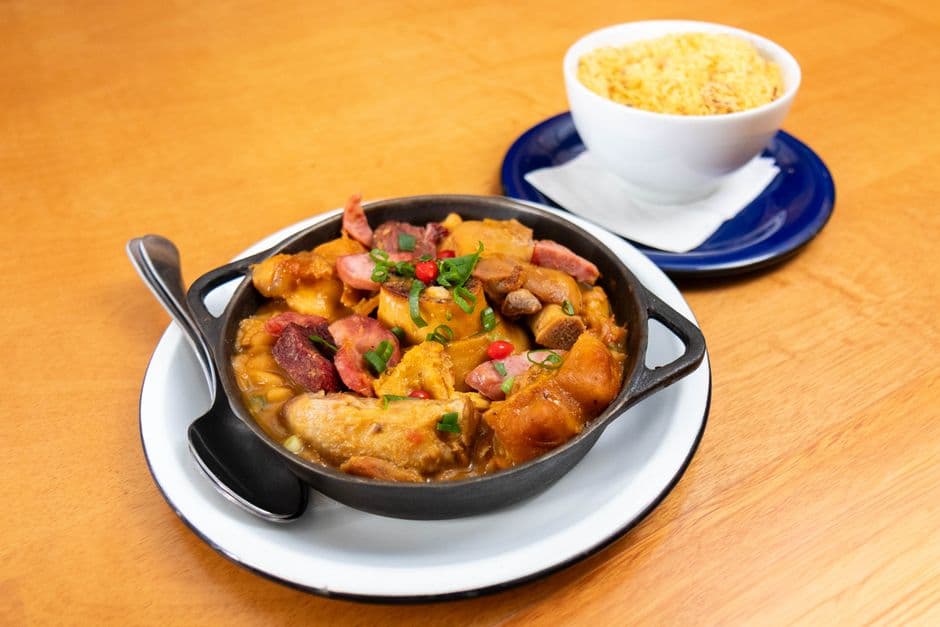
Brazil's national dish — a hearty, smoky black bean stew loaded with pork ribs, sausage, and cured meats, served with white rice, farofa, and orange slices.
Feijoada is the soul of Brazilian cuisine, a dish that crosses all class and racial lines and brings families together every Saturday for the traditional feijoada completa. Born out of the blending of Portuguese cured meat traditions with African culinary knowledge, feijoada originally used discarded pork parts that enslaved people received on plantations. Over centuries it evolved into a celebrated national treasure, now made with premium cuts alongside the traditional ones. The combination of smoky meats, earthy black beans, and the bright acidity of orange is one of gastronomy's perfect flavour marriages.
Sert 4
Soak black beans in cold water overnight (at least 8 hours). Drain and rinse. This reduces cooking time and removes compounds that cause digestive discomfort. Cover beans with fresh water in a large pot and bring to a boil, skimming foam, then reduce to a simmer.
In a large heavy pot or Dutch oven, heat olive oil over medium-high heat. Brown the pork ribs on all sides until deeply caramelised, about 8 minutes. Remove and set aside. Brown the cured pork belly and ham hock briefly. Add sausage and sear until lightly coloured.
This browning step is often skipped in quick recipes but it adds enormous flavour depth to the final stew.
In the same pot, reduce heat to medium. Cook onion until softened, about 5 minutes. Add garlic and cumin and cook 1 minute more. Return all meats to the pot. Add the drained beans, bay leaves, and enough water to cover by about 5 cm.
Bring to a boil, then reduce heat to low. Simmer partially covered for 2 to 2.5 hours until beans are completely tender and the broth has thickened to a rich, dark stew. Stir occasionally and add hot water if the stew becomes too dry. Taste and adjust salt.
Feijoada is ready when a few beans disintegrate when pressed — this natural starch thickens the broth beautifully.
Remove large bones if desired and break up the larger meat pieces into the stew. Serve in deep bowls alongside white rice, farofa, sautéed collard greens, and fresh orange slices. The orange is not just a garnish — it cuts the richness of the stew and aids digestion.
Soaking beans overnight is essential — unsoaked beans can take 4+ hours and the texture suffers.
Add a whole orange peel to the pot while cooking for extra brightness and to reduce gas-causing compounds.
Farofa is toasted cassava flour cooked with butter and onion — the nutty, crunchy texture is essential to the experience.
Feijoada is traditionally a Saturday dish and improves enormously made a day ahead.
Vegetarian feijoada: Replace all meats with smoked paprika, kombu seaweed (for umami), and extra mushrooms.
Pressure cooker feijoada: Use a pressure cooker to reduce the bean cooking time to 40 minutes at high pressure.
Feijoada carioca: The Rio de Janeiro style uses more dried meats (carne seca) for a saltier, more intense flavour.
Spicier: add a finely chopped fresh chile or a teaspoon of crushed Aleppo/Urfa pepper to the aromatics for warm, layered heat instead of a single sharp hit.
Refrigerate for up to 5 days — feijoada improves each day as flavours meld. Freeze in portions for up to 3 months. Reheat gently with a splash of water over low heat, stirring frequently to prevent the thick stew from catching.
Feijoada's origins are contested but passionately debated in Brazil. The popular narrative holds that it was created by enslaved Africans on colonial sugar plantations using discarded pork offcuts and locally grown black beans. Food historians note that Portuguese immigrants also brought a tradition of bean-and-pork stews (similar dishes exist in Portugal and Cape Verde). Whatever its precise origin, feijoada became Brazil's national dish by the 19th century, a unifying culinary symbol that transcends region and class.
Yes, and it dramatically reduces the cook time to about 45 minutes. Use three 400g tins of black beans, drained and rinsed. The trade-off is a slightly thinner broth and less depth of flavour, since dried beans release starches that naturally thicken the stew. To compensate, mash a quarter-cup of the cooked beans against the pot wall and stir them back in.
Orange slices serve a practical and culinary purpose. The acidity and vitamin C in oranges help with the absorption of iron from the black beans — a nutritional tradition that predates modern understanding of iron bioavailability. Flavour-wise, the bright citrus cuts through the intense richness of the pork and bean stew, cleansing the palate between bites. It is an essential part of the full feijoada completa experience.
Farofa is toasted cassava (manioc) flour cooked with butter, garlic, and onion until golden and nutty. To make it: melt 2 tbsp butter in a skillet, cook half a diced onion and 2 garlic cloves until golden, then add 200g of cassava flour and stir constantly over medium heat for 5–7 minutes until evenly toasted. Season with salt. It adds a crucial crunchy, savoury contrast to the soft beans and meat.
Oui — la plupart des composants peuvent être préparés jusqu'à un jour à l'avance et réfrigérés séparément. Réchauffez doucement et assemblez juste avant de servir pour que les textures restent distinctes.
Par portion (520g) · 4 portions totales
Demandez quoi que ce soit à notre assistant culinaire IA sur cette recette : substitutions, techniques, mise à l'échelle.
Discutez avec AI Chef →Rejoignez la conversation
Connectez-vous pour laisser un commentaire et enregistrer vos recettes préférées