
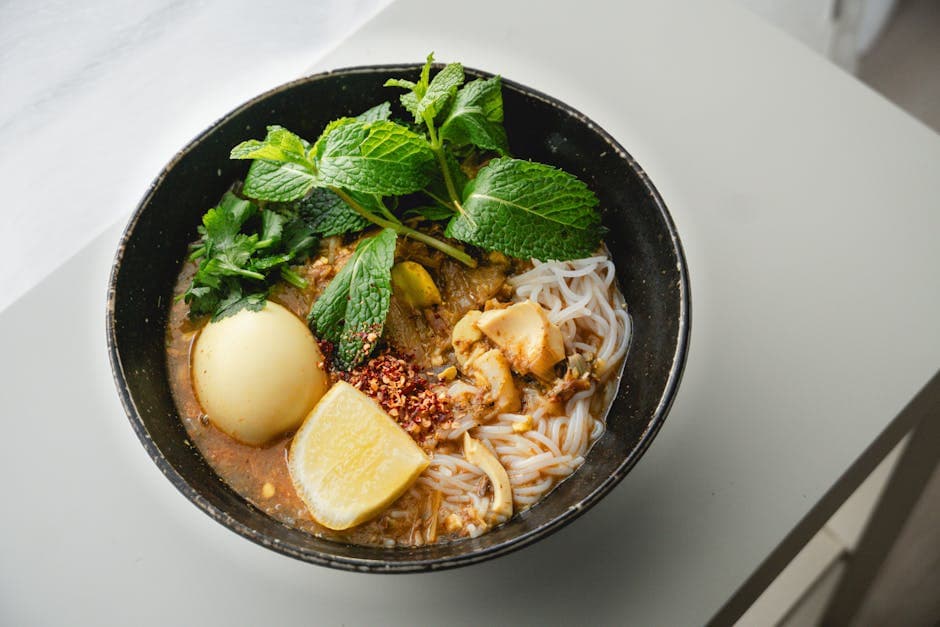
Mohinga (Soupe Nouilles Poisson Birmanie)
Le plat national du Myanmar — un bouillon poisson parfumé épaissi avec farine de pois chiches grillée et tige de banane, versé sur nouilles riz fines et garni de beignets croustillants, œuf et citron vert.
À propos de cette recette
Mohinga est ce que la Birmanie mange au petit-déjeuner. À Yangon et Mandalay, les vendeurs poussent des charrettes en bois avant l'aube avec des chaudrons fumants de bouillon poisson sur des braseros de charbon, versant des bols pour les ouvriers, étudiants et employés de bureau alors que la ville s'éveille. La soupe est construite sur du poisson-chat d'eau douce entier ou de la carpe mijotée jusqu'à ce que la chair s'effiloche et que les os libèrent leur gélatine dans le bouillon. Ce stock est ensuite parfumé à la citronnelle, gingembre, ail, échalote, curcuma et pâte de crevettes, épaissi avec de la farine de pois chiches grillée et traditionnellement terminé avec de fines tranches de tige de banane tendre pour une douceur végétale distinctive. Des vermicelles de riz fin cuisent séparément et vont dans un bol profond ; le bouillon chaud est versé dessus et le mangeur prend en charge les garnitures — beignets de pois cassés croustillants pour le croquant, un œuf dur en quarts, échalote crue tranchée, coriandre frais, piments secs écrasés, sauce poisson et un généreux trait de citron vert. La saveur est stratifiée et un peu funky, avec une chaleur douce qui augmente au fur et à mesure que vous mangez. À un stand de vendeur, cela coûte moins d'un dollar ; fait à la maison, c'est une heure de travail sur la cuisinière qui produit assez de petit-déjeuner pour une petite armée.
Ingrédients
Sert 6
- 800 gpoisson-chat entier nettoyé (ou 600 g de filets de poisson blanc ferme comme le basa ou tilapia)
- 2tiges de citronnelle, écrasées
- 1 poucegingembre, tranché
- 2 Leau
- 5 c. à s.huile neutre
- 3échalotes, finement hachées
- 6gousses d'ail, minced
- 1 c. à s.curcuma moulu
- 1 c. à s.pâte de crevettes birmane (ngapi) ou thaï kapi
- 60 gfarine de pois chiches (besan), grillée à sec dans une poêle jusqu'au tan et parfumée
- 3 c. à s.sauce poisson
- 1 small cantige de banane tranchée en saumure (optionnelle mais traditionnelle) — ou 1 tasse de fleur de banane intérieure finement tranchée ou cœurs de palmier
- 500 gvermicelles de riz fin
- à servir : œufs durs en moitiés, beignets de pois cassés ou crackers écrasés, quartiers de citron vert, piments secs, échalote crue tranchée, coriandre
Étapes
- 1
Mijoter le bouillon poisson
Placez le poisson entier (ou filets), 1 citronnelle écrasée et la moitié du gingembre dans une grande casserole avec l'eau. Portez à un léger frémissement et cuisez 25 minutes jusqu'à ce que le poisson soit complètement cuit. Soulevez le poisson avec une écumoire, laissant le bouillon sur un faible frémissement.
- 2
Effilocher le poisson
Lorsque c'est assez cool, prélevez toute la chair des os, en jetant la peau et les os. Effilochez en petits morceaux et mettez de côté. Passez le bouillon et réservez.
- 3
Construire la base aromatique
Dans une cocotte lourde propre, chauffez l'huile à feu moyen et faites frire les échalotes, ail, gingembre restant et la deuxième citronnelle pendant 5 minutes jusqu'à ce qu'ils soient doux et dorés. Versez le curcuma et la pâte de crevettes et faites frire 1 minute supplémentaire jusqu'à ce que ce soit très parfumé.
- 4
Ajouter le poisson effiloché
Ajoutez le poisson effiloché aux aromatiques et remuez pour enrober, écrasant doucement avec le dos d'une cuillère pour le briser dans la pâte. Cuisez 3 minutes — cela concentre la saveur et tinte tout en jaune profond.
- 5
Épaissir avec la farine de pois chiches
Battez la farine de pois chiches grillée avec 250 ml du bouillon passé jusqu'à homogène (sans grumeaux). Versez dans la casserole avec le reste du bouillon. Portez à un frémissement, en remuant constamment jusqu'à ce que la soupe s'épaississe à une consistance de crème légère — environ 10 minutes.
Grille toujours la farine de pois chiches d'abord — le besan cru a un goût crayeux.
- 6
Assaisonner et finir
Ajoutez la sauce poisson et la tige de banane (si utilisée). Laissez mijoter 10 minutes supplémentaires. Goûtez et ajustez — cela devrait être savoureux, légèrement acidulé de la pâte de crevettes, avec une chaleur douce à venir des garnitures de table. Ajoutez l'eau si cela devient trop épais.
- 7
Cuire les nouilles
Cuisez les vermicelles de riz selon les indications du paquet (généralement 3–4 minutes), égouttez et rincez à l'eau froide. Divisez entre 6 bols profonds. Versez généreusement avec le mohinga chaud.
- 8
Garnir et servir
Couronnez chaque bol avec une moitié d'œuf dur, un beignet écrasé ou quelques crackers, une pincée de coriandre et d'échalote crue, une pincée de piments secs, et un grand trait de citron vert. Servez immédiatement pendant que les nouilles sont encore chaudes.
Vous l'avez cuisinée ?
Notez-la et aidez les autres à trouver les recettes qui fonctionnent vraiment.
Connectez-vous en un geste : nous enregistrons la note que vous venez de choisir.
Tout ce qu'il faut pour planifier votre semaine — gratuit
- Calendrier des repas
- Liste de courses
- Idées de recettes IA
Cuisinez les mains libres
Profitez de plans de repas IA, d'un mode cuisine pas à pas et de vos recettes enregistrées dans l'appli gratuite Bento.
Conseils de pro
- →
Le poisson-chat est traditionnel ; tout poisson d'eau douce ou océan doux et ferme fonctionne. Évitez les poissons gras comme le maquereau — trop fort.
- →
La farine de pois chiches grillée est l'âme de la texture du bouillon. Grille dans une poêle sèche à feu bas pendant 5–7 minutes, en remuant, jusqu'à ce qu'elle sente la noisette.
- →
La pâte de crevettes birmane (ngapi) est plus funky que la thaï kapi mais plus difficile à trouver — les deux fonctionnent. Au besoin, la pâte d'anchois couvre un territoire similaire.
- →
Mohinga s'améliore du jour au lendemain. Faites une journée à l'avance et réchauffez doucement avec un trait d'eau.
Variantes
- •
Mohinga végétarien — utilisez un bouillon de champignons, omettez le poisson, doublez la farine de pois chiches grillée et ajoutez des champignons huîtres rôtis à la place du poisson effiloché.
- •
Mandalay-style plus épicé — ajoutez une cuillère à soupe de piments secs grillés écrasés directement dans le bouillon.
- •
Avec œuf de canard — remplacez les œufs de poule par des œufs de canard durs en moitiés pour des jaunes plus riches (populaire dans les régions du delta).
- •
Mohinga coco — versez 200 ml de lait de coco pour un variant Rakhine plus riche et plus sucré.
Stockage
La soupe se conserve 3 jours au réfrigérateur, congèle 2 mois. Conservez toujours les nouilles séparément. Réchauffez le bouillon sur la cuisinière avec un trait d'eau — le micro-ondes peut casser l'épaississement à la farine de pois chiches.
Histoire et origine
Mohinga précède la Birmanie coloniale et a probablement été originaire des peuples Bamar et Mon du delta de l'Irrawaddy, où le poisson-chat d'eau douce était abondant. Il a été popularisé comme petit-déjeuner signature de Yangon à la fin du 19e siècle par des vendeuses et a été déclaré le plat national officieux du Myanmar par les années 1960.
Foire aux questions
Puis-je utiliser du poisson en conserve ?
Le thon en conserve ou le maquereau à l'eau peuvent fonctionner au besoin — égouttez, effilochez et sautez l'étape du stock (utilisez plutôt un bouillon de poulet ou légume). La saveur sera moins complexe mais acceptable.
Où puis-je trouver la tige de banane ?
Les marchés asiatiques la vendent en conserve en saumure (étiquette vietnamienne 'bap chuoi'). Sans cela, mohinga est toujours délicieux — la tige de banane est texture et douceur subtile, pas la saveur principale.
La soupe est-elle épicée ?
Le bouillon de base est doux — savoureux et aromatique. La chaleur est ajoutée à table via des piments secs afin que chaque mangeur puisse ajuster.
Puis-je faire les beignets à la maison ?
Oui — faites tremper les pois cassés jaunes du jour au lendemain, égouttez, mélangez avec l'ail et le curcuma en une pâte grossière, versez les cuillerées dans l'huile à 180°C et faites frire jusqu'à ce qu'elles soient dorées. Ou émiettez simplement les papadums indiens pour un substitut rapide.
Faits nutritionnels
Par portion (540g) · 6 portions totales
Résumé du temps
Vous avez des questions ?
Demandez quoi que ce soit à notre assistant culinaire IA sur cette recette : substitutions, techniques, mise à l'échelle.
Discutez avec AI Chef →Présenté dans les guides
Cette recette est présentée dans les guides sélectionnés suivants :
Plus de recettes Burmese
Vous Aimerez Aussi
Des plats similaires venus d'autres cuisines du monde.
Outils de Cuisine Gratuits
Calculateurs et convertisseurs qui accompagnent cette page — sans inscription.
Transformer en Plan
Programmez-le, faites les courses et suivez ce que vous avez déjà.
À Lire Ensuite
Des articles de fond sur les idées derrière ce plat.
Les macronutriments expliqués : glucides, protéines et graisses – ce dont vous avez réellement besoin
12 min.
Carence en magnésium : un signe complet que vous êtes faible et les meilleures sources de nourriture
12 min.
Carence en magnésium : signes complets, pourquoi c'est si courant et les meilleures sources de nourriture
12 min.
Communauté
Rejoignez la conversation
Connectez-vous pour laisser un commentaire et enregistrer vos recettes préférées