
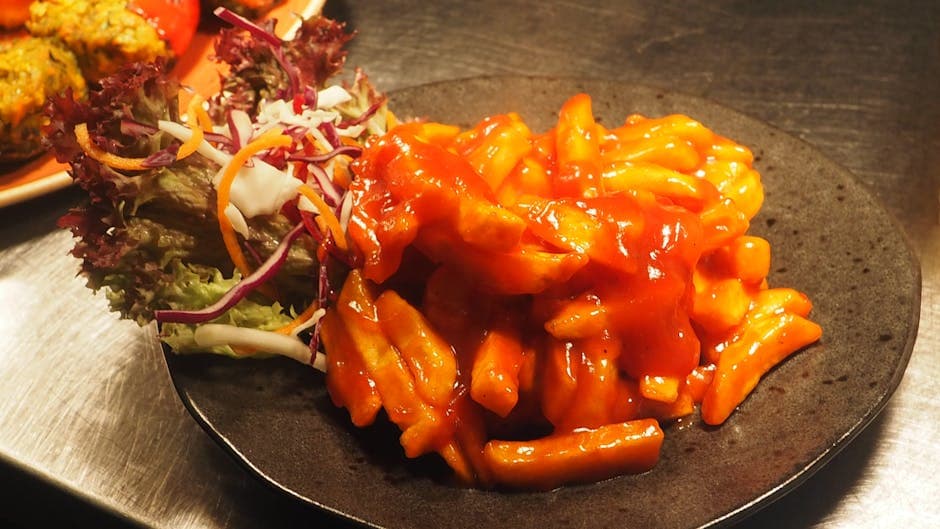
Tteokbokki (Gâteaux de Riz Épicés Coréens)
Collation emblématique coréenne — gâteaux de riz moelleux mijotés dans une sauce gochujang ardente avec gâteaux de poisson, oignons verts et un œuf à la coque mou.
À propos de cette recette
Tteokbokki est la collation que chaque Coréen a grandi en mangeant des vendeurs de portes d'école — cylindriques ou ovales gâteaux de riz (tteok) mijotés jusqu'à devenir mous et moelleux dans une sauce profondément rouge de gochujang, gochugaru, sauce soja, sucre et bouillon d'anchois. Les accompagnements classiques sont odeng (gâteaux de poisson), oignons verts et parfois un œuf à la coque mou ou un œuf dur. La sauce commence mince et se réduit à une glaçure collante recouvrant chaque cylindre moelleux. Chaud, légèrement sucré, profondément épicé et bizarrement addictif — une fois que vous commencez, vous ne pouvez pas arrêter jusqu'à ce que l'assiette soit vide. Va également bien avec les collations après l'école, les sessions de fin de nuit, et les après-midi dimanche en famille. Le plat de 1953 aurait été inventé par Ma Bok-rim dans la ruelle Sindang-dong de Séoul, qui abrite toujours une ruelle 'Tteokbokki Town' dédiée au plat.
Ingrédients
Sert 4
- 500 gtteok frais ou congelé (gâteaux de riz cylindriques), trempés 20 min s'il est congelé
- 200 ggâteaux de poisson coréens (odeng), coupés en bandes
- 1 petiteoignon jaune, tranché
- 4oignons verts, coupés en 5 cm morceaux
- 750 mlbouillon d'anchois-algues (ou eau + 1 cuillère à café de dashida)
- 4 c. à s.gochujang (pâte de chili coréenne)
- 1 c. à s.gochugaru (flocons de poivron rouge coréen)
- 2 c. à s.sucre
- 2 c. à s.sauce soja
- 1 c. à s.ail, émincé
- 4œufs durs (écalés, optionnel)
- 1 c. à c.graines de sésame grillées (garniture)
- 1 c. à c.huile de sésame grillée (garniture)
Étapes
- 1
Faire le bouillon d'anchois
Si vous le faites à partir de zéro: faire mijoter 10 anchois séchés + un morceau de 10 cm d'algues séchées (dashima) dans 1 L d'eau pendant 15 minutes. Tamiser. Ou utiliser 750 ml d'eau avec 1 cuillère à café de bouillon instantanée dashida.
- 2
Tremper les gâteaux de riz
Si vous utilisez le tteok frais, aucun trempage nécessaire. S'il est congelé, tremper dans de l'eau fraîche 20 minutes jusqu'à séparation et malléable.
- 3
Construire la sauce dans la poêle
Dans une large poêle, fouetter ensemble le gochujang, le gochugaru, le sucre, la sauce soja et l'ail émincé avec 750 ml du bouillon d'anchois jusqu'à lisser. Porter à une légère ébullition.
- 4
Ajouter les gâteaux de riz
Laisser tomber le tteok égoutté. Remuer pour enrober. Mijoter à feu moyen pendant 10 minutes, en remuant souvent, jusqu'à ce que les gâteaux de riz soient mous et moelleux. La sauce commencera à réduire.
- 5
Ajouter les gâteaux de poisson et l'oignon
Ajouter les gâteaux de poisson et l'oignon tranché. Mijoter 5 minutes de plus. La sauce devrait réduire à une glaçure rouge épaisse et brillante enrobant chaque morceau.
- 6
Ajouter les oignons verts et les œufs
Remuer dans les oignons verts et les œufs durs (s'il y en a). Cuire 2 minutes de plus pour chauffer les œufs et just ramollir les oignons verts.
- 7
Mettre en assiette et garnir
Entasser dans un large plat peu profond. Verser avec l'huile de sésame. Saupoudrer avec les graines de sésame. La sauce continuera à épaissir en reposant — manger vite.
- 8
Servir immédiatement
Manger avec les baguettes directement de la poêle à la mode coréenne vraie, partageant parmi 2-4 personnes. Bière froide ou makgeolli sur le côté.
Vous l'avez cuisinée ?
Notez-la et aidez les autres à trouver les recettes qui fonctionnent vraiment.
Connectez-vous en un geste : nous enregistrons la note que vous venez de choisir.
Tout ce qu'il faut pour planifier votre semaine — gratuit
- Calendrier des repas
- Liste de courses
- Idées de recettes IA
Suivez ce que vous mangez
Photographiez votre repas pour enregistrer calories et macros, lancez des minuteurs de jeûne et suivez votre hydratation avec l’app gratuite SnapCal.
Conseils de pro
- →
Gochujang est la fondation — ne pas remplacer par sriracha ou huile de chili. Épiceries coréennes ou en ligne.
- →
La sauce se réduit de liquide comme soupe à glaçage au fil de la cuisson. S'il réduit trop vite, ajouter une éclaboussure d'eau.
- →
Manger le moment où c'est fait — les gâteaux de riz deviennent denses et la sauce coagule en refroidissant.
Variantes
- •
Rabokki: ajouter un paquet de nouilles ramen instantanées dans les 4 dernières minutes — les nouilles absorbent la sauce épicée.
- •
Tteokbokki au fromage: garnir d'une couche de mozzarella dans les 2 dernières minutes, couvrir jusqu'à fusion.
- •
Gungjung tteokbokki (version cour royale): non épicée. Sauce soja + sucre + sésame, pas de gochujang. Remuée avec les légumes et le bœuf. Plus ancienne que la version épicée.
Stockage
Meilleur frais. Les restes réfrigérés durcissent — les gâteaux de riz deviennent solides comme le roc au réfrigérateur. Réchauffer avec une éclaboussure d'eau dans une poêle pour assouplir.
Histoire et origine
Le tteokbokki épicé a été inventé en 1953 par Ma Bok-rim à Sindang-dong de Séoul, qui a accidentellement laissé tomber des gâteaux de riz dans un bac de jajangmyeon sauce de haricot noir qui avait été épicée avec du gochujang. La combinaison est devenue un phénomène national d'ici les années 1980. Le tteokbokki pré-1953 était la version sauce soja-sucre mangée dans les palais royaux.
Foire aux questions
Où puis-je trouver du tteok?
Épiceries coréennes, frais dans la section réfrigérée ou congelé. Le 'rabboki tteok' cylindrique est le standard. Les packs sous vide se gardent 6 mois réfrigérés.
Puis-je rendre cela moins épicé?
Réduire gochujang à 2 cuillères à soupe et sauter le gochugaru. La saveur sera toujours coréenne et reconnaissable, juste moins agressive.
Faits nutritionnels
Par portion (320g) · 4 portions totales
Résumé du temps
Vous avez des questions ?
Demandez quoi que ce soit à notre assistant culinaire IA sur cette recette : substitutions, techniques, mise à l'échelle.
Discutez avec AI Chef →Présenté dans les guides
Cette recette est présentée dans les guides sélectionnés suivants :
Plus de recettes coréennes
Vous Aimerez Aussi
Des plats similaires venus d'autres cuisines du monde.
Parcourir par Ingrédient
D'autres recettes construites autour des mêmes ingrédients principaux.
Outils de Cuisine Gratuits
Calculateurs et convertisseurs qui accompagnent cette page — sans inscription.
Calculateur de proportions
Divisez par deux ou doublez chaque quantité de cette recette sans calcul mental.
Convertisseur de mesures
Convertissez tasses, grammes, onces et millilitres dans les deux sens.
Calculateur de calories et de portions
Calculez les calories et les macros de la portion que vous mangez vraiment.
Transformer en Plan
Programmez-le, faites les courses et suivez ce que vous avez déjà.
Calendrier de planification des repas
Placez cette recette sur un jour et organisez la semaine autour.
Appli de liste de courses
Transformez cette liste d’ingrédients en liste de courses regroupée par rayon.
Importateur de recettes
Enregistrez cette recette — et n’importe quelle URL de recette — dans une bibliothèque organisée.
À Lire Ensuite
Des articles de fond sur les idées derrière ce plat.
Communauté
Rejoignez la conversation
Connectez-vous pour laisser un commentaire et enregistrer vos recettes préférées