
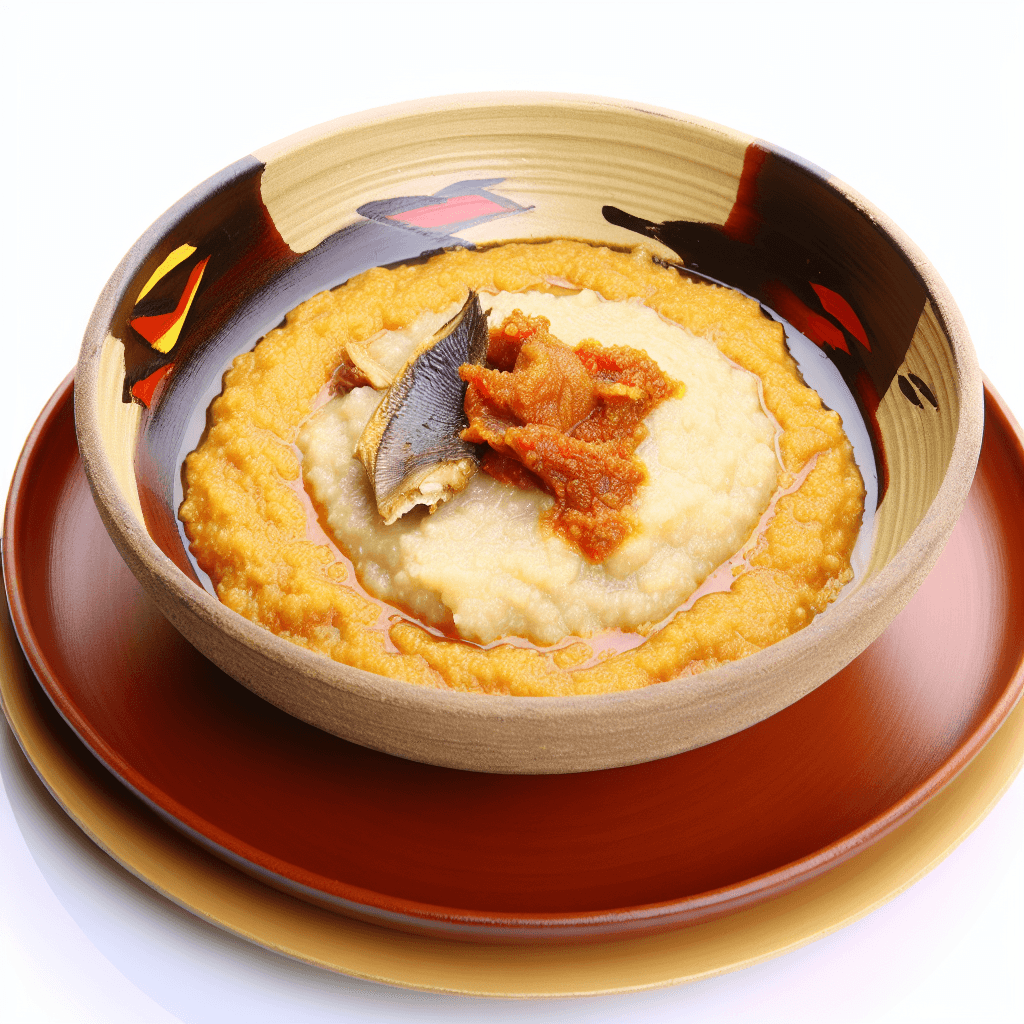
Akpan
Togo's answer to oatmeal — a smooth, gently sour porridge from fermented corn flour, eaten sweet at breakfast or savoury alongside grilled fish and pepper sauce.
About This Recipe
Akpan is one of the foundational foods of Togo's coastal communities — a smooth, creamy porridge made from fermented maize flour that occupies the same essential place in Togolese daily life that oatmeal holds in Scotland or congee in East Asia. What distinguishes akpan from a simple corn porridge is the gentle, yogurt-like sourness that comes from a brief fermentation process: white corn flour is soaked in water for 2–3 days at room temperature, during which naturally present lactobacillus bacteria convert some of the starches to lactic acid. This mild acidity is not sharp or off-putting — it is the defining flavour note, giving the porridge a complex, slightly tangy character that plain cornmeal porridge entirely lacks. In Togo, akpan is consumed across the full range of sweet and savoury contexts, which is part of what makes it so central to the cuisine. At breakfast, it is thinned to a drinkable consistency, sweetened with sugar, and enriched with evaporated milk or fresh coconut milk — a nourishing, warming start to the day sold by street vendors in cups and small calabashes. In its savoury form, it is thickened to a porridge consistency and served alongside grilled or smoked fish and a spicy pepper sauce, where the sourness of the akpan cuts through the richness of the fish and the heat of the pepper. The cooking technique is straightforward but requires constant attention: the fermented flour is first slaked in cold water (this prevents lumps), then streamed slowly into boiling water while stirring continuously. Once all the flour is incorporated, the heat is reduced and the porridge is stirred for a further 8–10 minutes until it thickens to a smooth, flowing consistency that coats the back of a spoon.
Ingredients
Serves 4
- 1 cupfermented corn flour (or white corn flour)
- 4 cupswater
- 1/2 tspsalt
- 2 tbspsugar (optional, to serve sweet)
- 4 tbspevaporated milk (optional)
Instructions
- 1
Slake the flour
Place the fermented corn flour in a medium bowl. Pour 1 cup of cold water over it and whisk vigorously for 60–90 seconds until completely smooth and free of lumps — the mixture should look like a thin, milky liquid. Work out any clumps with the back of a spoon before proceeding.
Always mix corn flour with cold water first, never with hot — adding dry flour directly to boiling water creates instant lumps that are almost impossible to dissolve.
- 2
Bring water to boil
Pour the remaining 3 cups of water into a medium saucepan, add the salt, and bring to a full rolling boil over high heat. Have a wooden spoon or silicone spatula ready — you will need to stir continuously from the moment the flour is added.
- 3
Stream in the flour mixture
Reduce the heat to medium. Stir the boiling water in a circular motion with one hand, and with the other, slowly pour the slaked flour mixture in a thin, steady stream into the centre of the swirling water. Pour slowly over 30–40 seconds — rushing causes lumps. Keep stirring throughout.
If lumps do form, switch to a whisk and beat vigorously for 30 seconds; most lumps will dissolve if caught early. A fine-mesh strainer held over the pot and used to filter the flour mixture before adding is a foolproof prevention method.
- 4
Simmer and thicken
Once all the flour is incorporated, reduce heat to low. Continue stirring steadily — reaching into the corners and along the bottom of the pan — for 10–12 minutes as the porridge thickens. It is ready when it coats the back of the spoon in a thick layer and a line drawn through it holds for 2–3 seconds before filling in.
- 5
Serve sweet or savoury
For sweet akpan: ladle into bowls and drizzle with 2 tablespoons of evaporated milk and 1–2 teaspoons of sugar per serving. For savoury akpan: serve immediately alongside grilled or smoked fish, a small bowl of pepper sauce, and sliced fresh tomatoes.
Did you make this?
Rate it and help other cooks find the recipes that actually work.
One tap to sign in, and we'll save the rating you just picked.
Everything you need to plan your week — free
- Meal calendar
- Grocery list
- AI recipe ideas
Cook this hands-free
Get AI meal plans, step-by-step cooking mode, and your saved recipes in the free Bento app.
Pro Tips
- →
For the most authentic sourness, soak white corn flour (not yellow, which has a different flavour) in cold water for 2–3 days at room temperature, changing the water once daily. Strain through a fine cloth or sieve before using.
- →
Never stop stirring once the flour hits the boiling water — 10 seconds of neglect is enough for the bottom to scorch. A flat-bottomed silicone spatula that reaches the corners of the pan is better than a round wooden spoon for preventing sticking.
- →
Adjust the consistency by adding water (to thin) or simmering longer (to thicken) — the sweet breakfast version should flow like a thick smoothie, while the savoury accompaniment version should hold a soft mound shape in the bowl.
- →
If using commercial fermented corn flour from an African grocery store (often labelled 'fermented corn starch' or 'akpan flour'), taste a pinch raw — it should have a subtle tang. If it tastes neutral, add a teaspoon of plain yogurt to the slake water to approximate the fermentation character.
- →
A pinch of ground ginger added to the savoury version adds warmth and helps the porridge pair well with rich, oily fish stews.
Variations
- •
Coconut akpan: substitute 2 cups of the water with unsweetened coconut milk for a richer, subtly sweet porridge that pairs especially well with fried plantains.
- •
Peanut-enriched savoury akpan: stir 2 tablespoons of smooth natural peanut butter into the finished porridge for a protein-rich, nutty version served with pepper sauce.
- •
Nutmeg-spiced sweet version: add a pinch of freshly grated nutmeg and a half-teaspoon of vanilla extract when serving sweet — the combination gives the breakfast version a warmth reminiscent of rice pudding.
- •
Thickened ogi (Nigerian cousin): cook the porridge an additional 5 minutes to a very thick consistency, then pour into individual cups and allow to set at room temperature for 20 minutes — it becomes firm enough to cut, similar to the Nigerian ogi solid eaten with a spoon.
Storage
Akpan thickens significantly as it cools, absorbing residual liquid. Refrigerate leftovers in a covered container for up to 2 days. To reheat, place in a small saucepan over low heat with 2–4 tablespoons of water per portion, stirring constantly until warmed through and the desired consistency is restored. Microwave reheating works but requires a splash of water and frequent stirring.
History & Origin
Akpan is a cornerstone of Ewe and Mina food culture in coastal Togo and Benin, closely related to Nigerian ogi, Ghanaian koko, and Beninese kpete — all fermented grain porridges from the same culinary tradition spanning coastal West Africa. Maize became a staple crop in West Africa after its introduction from the Americas by Portuguese traders in the late 15th and 16th centuries, and West African cooks rapidly incorporated it into existing fermented grain traditions that had previously used millet and sorghum. By the 18th century, fermented maize porridges had become daily staples across coastal communities from Senegal to Nigeria.
Frequently Asked Questions
Where do I find fermented corn flour?
West African and Caribbean grocery stores typically carry it, labelled as 'fermented corn flour,' 'akpan flour,' or 'fermented corn starch.' If unavailable, soak regular white fine-ground cornmeal or corn flour in cold water for 2–3 days at room temperature, changing the water once daily, then drain through a fine cloth before using. The result closely approximates commercially fermented flour.
Is akpan the same as ogi or koko?
They are closely related — all are fermented maize porridges from the same West African culinary tradition. Ogi is the Yoruba (Nigerian) name, koko is the Ghanaian name, and akpan is the Ewe (Togolese/Beninese) term. The preparation method is essentially identical, though regional variations exist in consistency, sweeteners used, and what is served alongside.
Can I make akpan without fermented flour — will it taste right?
Plain (unfermented) corn flour makes a perfectly smooth and nourishing porridge, but it will taste noticeably sweeter and blander without the lactic acid tang. To approximate the fermented flavour, add 1–2 teaspoons of plain unsweetened yogurt to the cold water slake before cooking — it is not identical but gives the porridge the right background acidity.
How do I know when the porridge is thick enough?
Draw a line across the back of the spoon with your finger — if the line holds for 3–4 seconds before the porridge flows back to fill it, the consistency is correct for a savoury serving. For sweet breakfast akpan, cook 2 minutes less so it remains pourable enough to drink from a cup.
Is akpan nutritious enough as a complete breakfast?
On its own, akpan is primarily a source of complex carbohydrates and provides moderate fiber from the maize. For a more complete breakfast, add evaporated milk or cowpea (black-eyed pea) porridge on the side for protein, or pair the savoury version with a boiled egg and smoked fish, which is the traditional breakfast combination in Ewe fishing communities.
Nutrition Facts
Per serving (220g / 7.8 oz) · 4 servings total
Time Summary
Have Questions?
Ask our AI cooking assistant anything about this recipe — substitutions, techniques, scaling.
Chat with AI Chef →Featured in Guides
This recipe is featured in the following curated guides:
More Togolese Recipes
You Might Also Like
Similar dishes from other cuisines around the world.
Free Kitchen Tools
Calculators and converters that pair with this page — no signup needed.
Put This Into a Plan
Schedule it, shop for it, and track what you already have.
Read Next
Longer reads that go deeper on the ideas behind this dish.
Community
Join the conversation
Sign in to leave a comment and save your favourite recipes