russiansoup🔥 Trending
Russian Borscht – Hearty Beetroot and Beef Soup
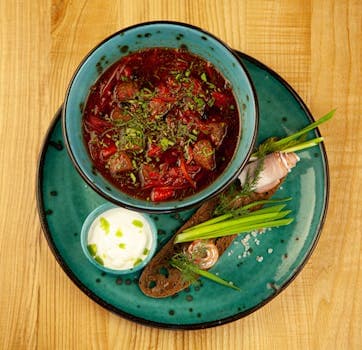
Deep crimson beet soup with tender beef, cabbage and root vegetables, topped with sour cream and fresh dill.
Prep
30 min
Cook
120 min
Servings
8
Difficulty
Medium
★★★★★
4.8(2,876 ratings)#borscht#soup#russian#beet#beef#comfort food
About This Recipe
Borscht is Eastern Europe's most iconic soup — a deep, garnet-red broth built on slow-cooked beef, earthy beetroot, cabbage, carrots and potatoes, finished with a spoonful of smetana (sour cream) and fresh dill. It is a soup of extraordinary depth, balancing the natural sweetness of beets against the richness of beef stock, brightened at the end with a splash of vinegar to keep the colour vivid and add sharpness. Although borscht is claimed by Ukraine (where it is a UNESCO-protected cultural heritage item), it has been eaten across Russia, Belarus, Poland and the broader Slavic world for centuries. There are dozens of regional variants — cold summer borscht, green borscht made with sorrel, clear borscht, Jewish Passover borscht — but the classic Ukrainian-Russian hot borscht with beef and beetroot is the version that has captured the world's imagination. The key to a great borscht is layers of flavour: a proper beef and bone stock as the base, the beets grated raw and added late to preserve colour (not boiled in the pot from the start), and the final acid adjustment — a tablespoon of cider vinegar — which both brightens the colour from purple to crimson and adds essential tartness.
Ingredients
Serves 8
- 500 gbeef short rib or brisket
- 3large beetroot(peeled and grated)
- 300 gwhite cabbage(finely shredded)
- 2medium potatoes(diced)
- 2carrots(grated)
- 1large onion(diced)
- 3 tbsptomato paste
- 2 tbspcider vinegar
- 2 Lbeef stock or water
- 4 clovesgarlic(minced)
- sour cream and fresh dill(to serve)
Instructions
- 1
Make the beef stock
Cover beef with cold water (or stock). Bring to a boil, skim foam. Add 1 bay leaf, 5 peppercorns, half the onion. Simmer 1.5 hours until meat is very tender. Remove meat and shred. Strain stock.
- 2
Sauté the vegetables
In a large pot, heat oil over medium heat. Sauté remaining onion and carrots 5 minutes. Add tomato paste and cook 2 minutes. Add grated beetroot and cook 10 minutes, stirring occasionally.
- 3
Build the soup
Pour beef stock into the pot. Add potatoes and cabbage. Bring to a boil and simmer 20 minutes until potatoes are tender. Add shredded beef.
- 4
Season and finish
Add vinegar, garlic, salt and pepper. Taste — the soup should be slightly sour and sweet. Add more vinegar if needed.
Add the vinegar at the end, not the start — it keeps the beetroot colour brilliant red rather than muddy purple.
- 5
Serve
Ladle into deep bowls. Top with a generous spoonful of sour cream, a shower of fresh dill and optional pumpernickel bread alongside.
Pro Tips
- →
Adding vinegar at the end preserves the vivid red colour — without acid, borscht turns dull purple.
- →
The soup improves dramatically overnight — make it a day ahead for the best flavour.
- →
A marrow bone added to the stock adds gelatinous body and depth.
Variations
- •
Cold summer borscht (svekolnik): chilled, topped with sour cream, egg and cucumber
- •
Green borscht: made with sorrel and spinach instead of beetroot — bright green and sharp
- •
Vegetarian borscht: omit beef, use vegetable stock and add kidney beans
Storage
Refrigerate for up to 4 days — flavour improves with time. Freeze for up to 3 months.
History & Origin
Borscht has been eaten in Eastern Europe for at least 500 years, originally made without beetroot (early versions used hogweed). Beetroot became the central ingredient by the 17th century. In 2022, UNESCO added Ukrainian borscht-making to its list of intangible cultural heritage in need of urgent safeguarding. The dish is a symbol of identity for millions of people across the Slavic world.
Frequently Asked Questions
Should borscht be sweet or sour?
Both — the defining character of borscht is the balance of sweet (beetroot, carrot) and sour (vinegar). Some recipes also add a pinch of sugar to amplify the sweetness. The final taste should be complex, tangy-sweet, and deeply savoury from the beef stock.
Nutrition Facts
Per serving (250g / 8.8 oz) · 8 servings total
Calories320kcal
Protein22g
Carbohydrates28g
Fat12g
Fiber5g
Protein22g
Carbs28g
Fat12g
Time Summary
Prep time30 min
Cook time120 min
Total time150 min
Have Questions?
Ask our AI cooking assistant anything about this recipe — substitutions, techniques, scaling.
Chat with AI Chef →More Russian Recipes
Community
Join the conversation
Sign in to leave a comment and save your favourite recipes