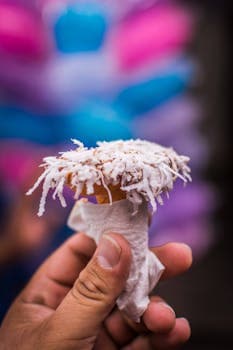
Coconut Fingers are one of the most nostalgic baked goods in Saint Helena's culinary heritage — found at every school fete, church tea, community gathering and family celebration on the island. The recipe is beautifully economical: desiccated coconut (which ships well and stores for months in Saint Helena's warm climate), sugar, egg, a touch of butter and vanilla are mixed into a sticky, fragrant dough, pressed into a tray, baked golden and cut into finger-shaped strips while still warm. They are crunchy at the edges, chewy at the centre, and deeply satisfying in the way that only the simplest confections can be. The recipe reflects Saint Helena's history as a trading island on the route between Europe, India and the Far East: coconut, though not grown on the island, arrived as a regular cargo item from the Indian Ocean, and baking traditions influenced by British, South Asian and East African cultures all converged in Saint Helena's kitchens. Coconut biscuits and fingers appear in similar forms across the British colonial world — from the Caribbean to East Africa to the Pacific — but the Saint Helena version has its own character, with a particular emphasis on a thick, substantial finger that holds together firmly rather than crumbling. The critical technique point is cutting the fingers while still warm; once the mixture cools fully it becomes too firm to cut cleanly without cracking. A drizzle of dark chocolate over the cooled fingers is a popular modern addition at island cafes and bakeries.
Serves 12
Preheat oven to 170°C (150°C fan). Grease a 20 x 25 cm baking tin (or similar) generously with butter and line with parchment paper, leaving a 2 cm overhang on the long sides to help lift the baked slab out.
A shallower tin gives crispier fingers; a deeper tin gives chewier, thicker ones.
In a large bowl, combine desiccated coconut, caster sugar, flour and salt. Add the beaten eggs, melted butter and vanilla extract. Stir with a wooden spoon until all the dry ingredients are thoroughly moistened and the mixture forms a thick, sticky, cohesive mass.
Tip the mixture into the prepared tin and press it down firmly and evenly with the back of a wet spoon or damp fingers, to a uniform depth of about 1.5 cm. Press firmly into the corners and ensure the surface is level — uneven thickness means uneven baking.
Wetting your hand prevents the sticky mixture from pulling up when you press it.
Bake in the preheated oven for 20–25 minutes until the top is uniformly pale golden — not deep brown. The edges will colour slightly faster than the centre, which is normal. The surface should feel set and dry to the touch. Do not overbake; the fingers continue to crisp as they cool.
Remove from the oven and immediately, while still hot, score the slab into finger shapes using a sharp knife — cut into strips approximately 3 cm wide and 8 cm long. Do not wait for it to cool before cutting; the mixture sets hard as it cools and will crack rather than cut cleanly.
Score all the way through to the base; a partial score will make clean removal difficult once cooled.
Leave the cut fingers to cool completely in the tin before lifting them out using the parchment overhang. Once fully cooled, they will be firm and can be gently separated along the scored lines. If adding a chocolate drizzle, melt 50 g of dark chocolate and drizzle over the cooled fingers; allow to set before serving.
Do not overbake — pale golden is the correct colour; the coconut continues to toast and the fingers firm up significantly as they cool in the tin.
Cut the slab while still hot from the oven — once fully cooled, the mixture becomes very firm and will crack rather than cut cleanly.
Press the mixture very firmly into the tin for a cohesive slab; loosely packed mixture produces crumbly fingers that fall apart when you pick them up.
A drizzle of dark chocolate (50 g melted) over the cooled fingers is a popular island variation and elevates the recipe considerably.
Use good-quality desiccated coconut — medium-grade gives a better texture than very fine, which can make the fingers too dense.
Lime coconut fingers: add the finely grated zest of 2 limes to the dough for a bright citrus note that cuts the richness beautifully.
Toasted coconut fingers: toast the desiccated coconut in a dry pan for 3–4 minutes until lightly golden before mixing — this deepens the coconut flavour from sweet to nutty.
Chocolate-dipped: dip the cooled fingers halfway into melted dark chocolate and set on parchment for an elegant teatime treat.
Gluten-free version: substitute the plain flour with rice flour or ground almonds in equal weight — the result is slightly crumblier but equally delicious and completely gluten-free.
Store in an airtight tin or container at room temperature for up to 5 days — they actually improve in texture over the first 2 days as the moisture redistributes. Do not refrigerate, as this softens the crisp texture. If adding chocolate drizzle, refrigerate briefly to set the chocolate but return to room temperature before serving.
Coconut biscuits and finger biscuits have been part of Saint Helena's baking tradition since at least the mid-19th century, when desiccated coconut — processed and shelf-stabilised — became a standard cargo item in the British colonial trade network that supplied the island. The influence of British naval and colonial baking traditions is clear in the recipe's simplicity and its place at church teas and school events. Similar coconut biscuit traditions exist across the British colonial world, reflecting the empire's global coconut trade routes that all passed through or near Saint Helena.
They were likely cut after cooling rather than while still hot from the oven. The mixture sets hard as it cools, and a fully cooled slab cracks rather than cuts cleanly. Always score the fingers immediately upon removing from the oven, then allow to cool completely in the tin before separating.
Yes — substitute the 50 g plain flour with rice flour or ground almonds in equal weight. Rice flour gives a closer result to the original; ground almonds make a slightly richer, more crumbly finger. Both versions are excellent and the swap is simple.
Yes — they freeze well for up to 2 months in an airtight container with parchment between layers. Thaw at room temperature for 30–60 minutes. The texture remains excellent after freezing.
The oven temperature may be lower than indicated — ovens vary significantly. The fingers should be pale golden on top with slightly darker edges. If they are still pale and soft at 25 minutes, increase temperature by 10°C and check every 3 minutes. Also ensure the tin is in the middle of the oven rather than on a low shelf.
Coconut fingers contain flour and butter, giving them a more biscuit-like structure that holds its shape and can be picked up without crumbling. Macaroons are typically egg-white based only, which creates a chewier, more meringue-like texture. The Saint Helena finger is firmer, more substantial, and suited to the island's baking culture where food needed to survive in a tin for days.
Per serving · 12 servings total
Ask our AI cooking assistant anything about this recipe — substitutions, techniques, scaling.
Chat with AI Chef →Join the conversation
Sign in to leave a comment and save your favourite recipes
Have feedback or need help?
We read every email and reply within 1–2 business days.
© 2026 MyCookingCalendar. All rights reserved.