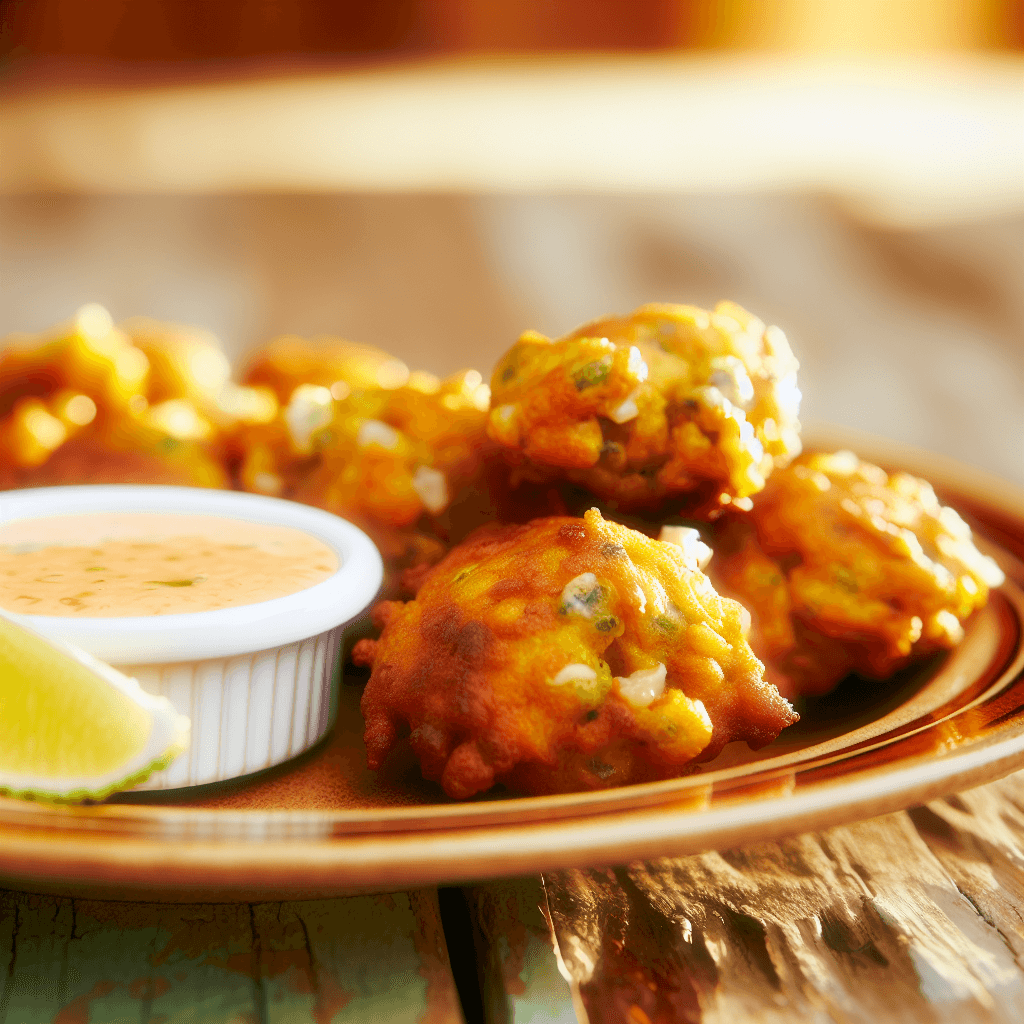
Conch fritters are the Cayman Islands' most beloved snack food — crispy, golden, irregularly shaped puffs of seasoned batter packed with tender morsels of conch, served from beach bars, roadside stands, and seafood restaurants across all three islands. The queen conch (Strombus gigas), with its speckled pink-lipped shell and firm, ivory-white flesh, is among the Caribbean's most prized molluscs and has been a cornerstone of Caymanian diet for centuries. Fritters are its most democratic expression: affordable, fast to eat, and utterly addictive. The technique is disarmingly simple but the details matter enormously. Conch must be tenderised aggressively before dicing — the muscle fibres are tight and dense, and a fritter made from unpounded conch will be unpleasantly chewy regardless of how perfectly the batter is fried. The tenderised meat is diced small and folded into a flour batter enriched with baking powder (for lift), seasoned with onion, scotch bonnet, and salt, then thinned with cold water to a thick, dropping consistency. Keeping the batter cold is important for the same reason it matters in tempura: cold batter hitting hot oil creates maximum steam expansion, producing a crunchy exterior over a soft interior. The dipping sauce that accompanies conch fritters varies by cook and venue — some prefer a garlicky aioli, others a sharp lime-hot-sauce combination, and some simply a bottle of Pickapeppa sauce on the table. Whatever the accompaniment, the fritters themselves are best eaten immediately, while the shell is crackle-crisp and the interior still steaming.
Serves 4
Place the conch meat between two sheets of cling film or in a resealable bag. Beat firmly all over with a meat mallet or the bottom of a heavy pan, working in overlapping blows until the meat has flattened to about half its original thickness and the fibres are visibly broken. This step is not optional — unpounded conch remains chewy and unpleasant in fritters regardless of fry time.
Don't have a mallet? Use a rolling pin or a full wine bottle — anything heavy and smooth with a flat or curved face.
Cut the tenderised conch into small, 1 cm dice. Season lightly with a pinch of salt and set aside. Finely dice the onion and mince the seeded scotch bonnet half as small as possible.
In a large mixing bowl, whisk together the flour, baking powder, and 0.5 tsp of salt until evenly combined. Add the cold water gradually, whisking constantly, until the batter is smooth, thick, and drops reluctantly from the whisk — similar to a thick pancake batter. Stop adding water when you reach this consistency; a thin batter produces flat, greasy fritters.
Use water straight from the refrigerator, or add a few ice cubes to it. Cold batter hitting hot oil produces maximum steam and a crunchier result.
Add the diced conch, onion, and scotch bonnet to the batter. Fold together gently with a rubber spatula until the fillings are evenly distributed throughout without deflating the batter. Do not overmix — a few turns of the spatula are sufficient.
Pour vegetable oil to a depth of at least 6 cm in a deep, heavy saucepan or a deep fryer. Heat to 180 °C (350 °F) — verify with a thermometer. Using two tablespoons, scoop generous portions of batter and carefully lower into the hot oil, frying 4–5 fritters at a time maximum. Fry for 3–4 minutes until the underside is deep golden, then flip and fry for a further 2–3 minutes until golden all over.
Maintain the oil temperature at 180 °C between batches. If the oil drops below 160 °C, the fritters absorb oil rather than frying. Use a thermometer and allow the oil to recover between batches.
Remove the fritters with a slotted spoon and drain on a wire rack set over paper towels — a rack keeps the bottom crispy whereas paper towels alone allow steam to soften it. Season with a light pinch of flaky salt while still hot. Serve within 5 minutes with lime wedges and a dipping sauce of lime juice mixed with mayonnaise and hot sauce.
Tenderise the conch by pounding — this is the single most important preparation step. Conch muscle fibres are dense and will remain tough through any amount of frying without physical tenderising.
Keep the batter cold until the moment it hits the oil. Rest the bowl in an ice bath if your kitchen is warm. Cold batter creates more steam upon contact with hot fat, producing a crisper shell.
Fry in small batches of 4–5 fritters maximum. Adding more cools the oil rapidly, leading to greasy, heavy fritters that absorb fat rather than crisping up.
A wire rack over paper towels is better than paper towels alone for draining. Wire racks keep the bottom of the fritter exposed to air, preventing steam from softening the crust.
For a lime-mayo dipping sauce, whisk together 3 tbsp mayonnaise, 1 tbsp fresh lime juice, 1 tsp hot sauce, and a pinch of salt. Make it 30 minutes before serving so the flavours meld.
Bell pepper version: add 0.5 small finely diced red bell pepper to the batter alongside the onion for colour, sweetness, and visual appeal.
Shrimp substitute: replace conch with raw peeled shrimp pounded and diced the same way. Shrimp fritters are slightly less dense and more widely replicable outside the Caribbean.
Cheese-stuffed version: push a small cube of pepper jack cheese into the centre of each fritter before frying for a molten-cheese interior that pairs brilliantly with the spiced conch batter.
Baked version: for a lower-fat alternative, drop batter onto a well-oiled baking sheet and bake at 220 °C for 15–18 minutes, turning halfway. The texture is less crispy but flavour is preserved.
Conch fritters are at their best within 10 minutes of coming out of the oil. Leftovers can be stored in the refrigerator for up to 1 day and reheated in an air fryer at 180 °C for 5–6 minutes, or in an oven at 200 °C for 8–10 minutes on a wire rack. Microwaving makes them soft and unpleasant. Do not freeze cooked fritters.
Queen conch (Strombus gigas) has been harvested in Caribbean waters by indigenous peoples for at least 5,000 years, evidenced by shell middens found throughout the island chain including the Cayman Islands. During the colonial period, conch became a dietary staple for enslaved and free people across the Caribbean due to its abundance and accessibility from shallow reef waters. Fritter preparations using flour batters introduced by European colonists merged with existing traditions of spiced shellfish preparations to create the conch fritters found across the region today. The dish remains central to Caymanian food culture and is celebrated at festivals including Pirates Week.
Frozen conch meat is available at Caribbean, Latin American, and some Asian fish markets — call ahead to check stock. Online seafood suppliers ship frozen conch. In the United States, Florida is the most accessible source for fresh or frozen queen conch from legal harvest. Avoid conch from unlabelled sources as it may be illegally harvested from protected populations.
Place the conch meat in a resealable bag and beat firmly all over with a meat mallet or heavy rolling pin, using overlapping blows until the meat has flattened to about half its original thickness and the surface looks somewhat shredded rather than smooth. It should feel noticeably less resistant when pressed. This takes about 2–3 minutes of firm pounding.
The oil temperature dropped too low while frying — most commonly from adding too many fritters at once. When oil is below 170 °C, batter absorbs fat rather than forming a steam-sealed crust. Use a thermometer, fry in smaller batches of 3–4, and wait for the oil to fully recover between batches. Too-thin batter also causes greasiness.
Pounded, diced raw shrimp is the most successful substitute — tenderise it by pressing rather than pounding, then proceed as with conch. Cleaned squid rings also work well. Both produce fritters with a distinctly different flavour but the same satisfying crispy-soft texture.
Per serving · 4 servings total
Ask our AI cooking assistant anything about this recipe — substitutions, techniques, scaling.
Chat with AI Chef →Join the conversation
Sign in to leave a comment and save your favourite recipes
Have feedback or need help?
We read every email and reply within 1–2 business days.
© 2026 MyCookingCalendar. All rights reserved.