
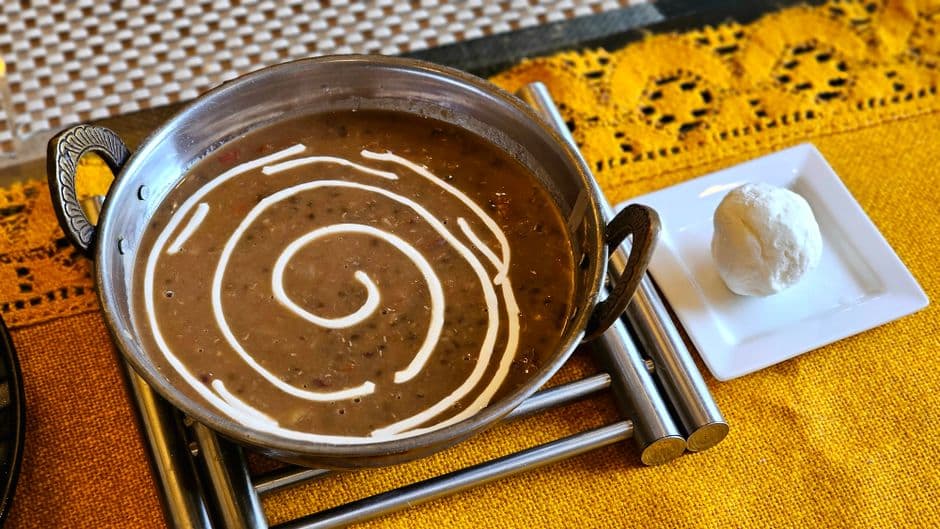
Dal Makhani (Slow-Cooked Black Lentils with Butter and Cream)
The royal Punjabi dal — whole urad lentils and kidney beans simmered overnight on low heat with tomatoes, ginger and a final, lavish enrichment of butter and cream.
About This Recipe
Dal makhani is the slow-cooked velvet of North Indian cuisine — a dish that the late Kundan Lal Gujral of Delhi's legendary Moti Mahal is widely credited with inventing in the late 1940s when he was already busy popularizing butter chicken from the same kitchen. At its heart it is little more than whole black urad lentils and a small handful of red kidney beans cooked with onion, ginger, garlic, tomato and chili — but what transforms it from peasant dal to white-tablecloth dinner is time and fat. Traditional restaurant versions simmer the dal in a deg over charcoal embers for 18 to 24 hours, the long, low heat breaking down the lentil hulls into a deeply creamy, mineral-rich pulp without ever mashing them. Toward the end of cooking, a thick slab of fresh butter and a generous pour of cream are folded in, along with a hot tadka of ghee, garlic and dried Kashmiri chili that hisses on the surface and gives the finished dal its signature smoky-buttery aroma. The result is dark, glossy, almost meaty in texture — a dal so rich it eats more like a stew than a soup — and impossibly comforting served with hot tandoori roti, butter naan or steamed basmati rice, along with a wedge of lemon and a sliver of raw onion to cut the richness. Home cooks cannot replicate the charcoal smoke perfectly, but a long overnight stovetop simmer and a finishing dhungar (charcoal infusion) come remarkably close.
Ingredients
Serves 6
- 250 gwhole black urad dal (sabut urad), soaked overnight
- 50 gred kidney beans (rajma), soaked overnight
- 2 tbspginger-garlic paste, divided
- 1 largeyellow onion, finely chopped
- 3 mediumtomatoes, pureed (about 350 g)
- 2green chilies, slit
- 1 tspKashmiri chili powder
- 1 tspground cumin
- 100 gunsalted butter, divided, plus extra to serve
- 120 mlheavy cream
- 2 tbspghee, for the tadka
- 1small piece of natural charcoal (optional, for dhungar smoke)
- 1 tbspkasuri methi, crushed
- 1 tspgaram masala, to finish
- salt to taste
Instructions
- 1
Pressure-cook the legumes
Drain the soaked urad and rajma, rinse well. Place in a pressure cooker with 1.5 liters water, 1 tablespoon ginger-garlic paste and 1 teaspoon salt. Pressure-cook on high for 8 whistles (about 35 minutes), then let pressure release naturally. The lentils should be very soft and the beans squashable between fingers. Do not drain.
- 2
Build the masala
In a heavy-bottomed pot, melt 60 g butter over medium. Add the chopped onion and cook 8 minutes until golden. Add the remaining ginger-garlic paste and slit chilies; cook 2 minutes more. Stir in the tomato puree, Kashmiri chili and cumin; simmer 10 minutes until the masala is thick, dark and the oil separates around the edges.
- 3
Combine and begin the slow simmer
Tip in the cooked dal with all its liquid. Bring to a boil, then reduce to the lowest possible simmer. Cook uncovered 2 to 3 hours, stirring every 20 minutes to keep the bottom from catching. The dal will deepen in color from light brown to nearly black, thicken substantially, and develop a glossy sheen.
If it gets too thick before fully cooked, add hot water 100 ml at a time. The right consistency is a thick, slow-pouring stew.
- 4
Smash to thicken naturally
After 2 hours, use the back of a ladle to mash some of the dal against the side of the pot — about a third of the contents. This releases starch and gives the signature creamy body without the need to puree. Continue simmering another 30 minutes.
- 5
Enrich with butter and cream
Stir in the remaining 40 g butter and 100 ml of the cream. Simmer gently another 15 minutes — the fat should fully integrate and the dal should look glossy and almost lacquered. Taste and adjust salt; rich dishes need more than you think.
- 6
Optional dhungar (charcoal smoke)
Heat the piece of charcoal directly over a flame until red-hot. Place a small metal bowl on top of the dal, drop the hot charcoal in, pour 1 teaspoon ghee over the charcoal — it will smoke violently. Cover the pot immediately and let smoke for 3 minutes. Remove the bowl. This step replicates the tandoor smoke of restaurant versions.
- 7
Make the finishing tadka
In a small pan, heat 2 tablespoons ghee until shimmering. Add 1 teaspoon Kashmiri chili powder off heat — it should sizzle and turn the ghee deep red. Pour the tadka over the dal. Sprinkle in crushed kasuri methi and garam masala; stir gently.
- 8
Rest and serve
Cover the pot and let the dal rest 10 minutes off heat — the flavors marry and the texture settles. Ladle into warm bowls, swirl the remaining cream on top, finish with a thin slice of cold butter, and serve with hot tandoori roti or butter naan and steamed basmati rice.
Did you make this?
Rate it and help other cooks find the recipes that actually work.
One tap to sign in, and we'll save the rating you just picked.
Everything you need to plan your week — free
- Meal calendar
- Grocery list
- AI recipe ideas
Track what you eat
Snap your meal to log calories and macros, run fasting timers and track water in the free SnapCal app.
Pro Tips
- →
Time is the most important ingredient. A quick dal makhani is a contradiction in terms — plan to start the actual cooking 4 hours before you want to eat, and ideally the soaking the night before.
- →
Use real butter and real cream, not substitutes. The dish is named 'makhani' (buttery) for a reason; low-fat versions taste like a different recipe.
- →
Stir from the bottom every time — urad burns at the base and a scorched spot will haunt the entire pot.
- →
If you cannot do the charcoal dhungar, a pinch of smoked paprika in the final tadka mimics the smoky note convincingly.
Variations
- •
Restaurant-style: after the slow simmer, blend half the dal smooth with an immersion blender for an even more velvety texture before adding the cream.
- •
Vegan dal makhani: replace butter with cold-pressed coconut oil and cream with cashew cream blended from 80 g soaked cashews and 120 ml water.
- •
Add 100 g of charred tomatoes blended into the masala for a smokier, sharper version popular in Delhi homes.
- •
Dal Bukhara: skip the rajma entirely and use only whole urad with extra cream — the version made famous by ITC Maurya's Bukhara restaurant.
Storage
Refrigerate up to 5 days in a sealed container; the dal genuinely improves on day two and three as the flavors deepen. Reheat gently with a splash of water and a pat of fresh butter. Freezes well for 3 months — freeze without the final cream and add fresh on reheating.
History & Origin
Dal makhani is the creation of Kundan Lal Gujral, the Punjabi cook who fled Peshawar during Partition in 1947 and opened Moti Mahal in Daryaganj, Delhi. He invented butter chicken to use up leftover tandoori chicken; dal makhani was the vegetarian companion dish, an enrichment of the rustic Punjabi mah ki dal with butter, cream and tomato — ingredients that made the humble lentil suitable for the new wealthy clientele of post-Partition Delhi. The dish became synonymous with North Indian restaurant cuisine and is now a fixture of Indian menus worldwide.
Frequently Asked Questions
Can I make dal makhani in a slow cooker?
Excellent for this dish. After pressure-cooking the legumes and building the masala separately, combine in a slow cooker on low for 8 hours overnight. Finish with butter, cream and tadka in the morning.
Why is my dal thin and pale?
It needs more time, not more cream. The dal must simmer long enough for the urad skins to break down and release starch. Plan for at least 2.5 hours total simmer plus 30 minutes of mashing — shortcuts produce a watery, brown soup instead of a glossy black stew.
Can I skip the kidney beans?
Many traditional Punjabi recipes do. Pure urad makes a more delicate dal; the rajma adds chew and a sweeter note. Try both versions and pick a side.
What is kasuri methi and can I substitute?
Dried fenugreek leaves with a hay-like, slightly bitter aroma that defines North Indian cooking. Nothing truly substitutes — celery leaves crushed dry come closest. Buy a jar; it keeps a year and is essential for palak paneer, butter chicken and dal makhani.
Nutrition Facts
Per serving (380g / 13.4 oz) · 6 servings total
Time Summary
Have Questions?
Ask our AI cooking assistant anything about this recipe — substitutions, techniques, scaling.
Chat with AI Chef →Featured in Guides
This recipe is featured in the following curated guides:
More Indian Recipes
You Might Also Like
Similar dishes from other cuisines around the world.
Browse by Ingredient
More recipes built around the same core ingredients.
Free Kitchen Tools
Calculators and converters that pair with this page — no signup needed.
Put This Into a Plan
Schedule it, shop for it, and track what you already have.
Read Next
Longer reads that go deeper on the ideas behind this dish.
Community
Join the conversation
Sign in to leave a comment and save your favourite recipes