
indonesiansalad
Gado-Gado
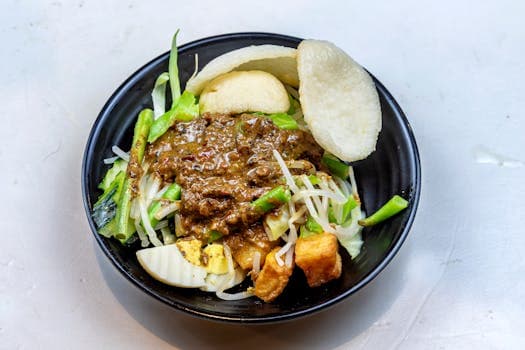
Indonesian mixed vegetable salad with peanut dressing — vibrant, textured, satisfying.
Prep
30 min
Cook
20 min
Servings
4
Difficulty
Medium
4.9
Sign in to rate#indonesian#vegetable#peanut sauce#salad#vegetarian
Indonesian mixed vegetable salad with peanut dressing — vibrant, textured, satisfying.
Gado-Gado — literally 'mix-mix' in Betawi slang — is Jakarta's great vegetable dish: blanched cabbage, green beans, and spinach, raw bean sprouts, boiled potatoes, fried tofu, and hard-boiled eggs, all bound together by a thick, tamarind-sharpened peanut sauce. Unlike a Western salad where dressing is an accent, here the bumbu kacang is the point — vegetables are really a vehicle for it. Street vendors in Jakarta still grind the sauce to order on a giant stone mortar (ulekan), adjusting chili to each customer. With protein from tofu and egg, starch from potato and rice cakes, and a rainbow of vegetables, it's genuinely a complete meal in one plate, beloved by office workers and vegetarians alike.
Serves 4
Blanch the cabbage, carrots, and green beans in well-salted boiling water for 2–3 minutes until tender-crisp, then shock them in ice water to stop the cooking and lock in color. Blanch the spinach for 30 seconds and squeeze dry; leave the sprouts raw or dip them for 10 seconds. Fry the tofu cubes in hot oil until golden on all sides.
Drain everything thoroughly — watery vegetables dilute the peanut sauce and make the plate soupy.
Fry the garlic in oil over medium heat until fragrant, add the chili paste and cook 1 minute, then stir in the ground peanuts, tamarind, and sugar. Pour in the coconut milk and simmer 5–8 minutes, stirring constantly, until the sauce is thick enough to coat a spoon but still pourable.
Taste and balance at the end: it should hit sweet, sour, salty, and spicy in roughly equal measure — adjust with sugar, tamarind, or salt.
Arrange the vegetables, tofu, quartered eggs, and rice cakes in distinct groups on a large platter so every texture stays visible. Pour the warm peanut sauce generously over everything just before serving, and top with crispy crackers (krupuk) or fried shallots if available.
Everything you need to plan your week — free
Cook this hands-free
Get AI meal plans, step-by-step cooking mode, and your saved recipes in the free Bento app.
Shock blanched vegetables in ice water so they stay bright and tender-crisp rather than dull and soft.
Make the peanut sauce slightly thicker than you think — the moisture in the vegetables will loosen it on the plate.
Serve the sauce warm; cold peanut sauce stiffens and clings unevenly.
Add krupuk (prawn or melinjo crackers) on top — the crunch is traditional and transforms the dish.
Grind the peanuts yourself from roasted unsalted peanuts for the best texture; pre-ground loses fragrance quickly.
Lotek (West Java): a similar dish where the sauce is ground fresh with kencur (aromatic ginger) for each serving.
Add lontong (compressed rice cakes) or steamed rice to make it a heartier full meal.
Karedok-style: use all raw vegetables — long beans, cucumber, sprouts — for maximum crunch.
Add grilled tempeh alongside the tofu for a double dose of plant protein.
Keep blanched vegetables, eggs, and sauce in separate containers in the refrigerator for up to 3 days; assemble and dress only just before eating. Reheat the sauce gently with a splash of water to restore pourability.
Gado-gado comes from the Betawi people, the native ethnic group of Jakarta, and likely took shape in the 17th–19th centuries as the port city mixed Javanese, Chinese, and European foodways. The peanut itself arrived via Portuguese and Spanish trade from the Americas, making the dish a true colonial-era fusion. In 2018 the Indonesian government named gado-gado one of the country's five official national dishes.
Tamarind paste is the sour pulp of tamarind pods, dissolved into a dark, tangy concentrate — it gives the peanut sauce its essential sour backbone. Find it in Asian or Latin grocers. In a pinch, substitute equal parts lime juice with a tiny pinch of brown sugar, though the flavor will be brighter and less fruity.
Almost — the classic version includes hard-boiled eggs, and some vendors add shrimp paste (terasi) to the sauce. Skip the eggs and confirm your sauce has no terasi and it's fully vegan: tofu, tempeh, vegetables, and peanut sauce. The dish loses nothing essential, which is why it's a favorite among plant-based eaters.
All three are Indonesian vegetables-with-peanut-sauce dishes. Gado-gado (Jakarta) uses mostly blanched vegetables plus tofu, egg, and potato; pecel (East/Central Java) uses blanched greens with a spicier, kencur-scented sauce; karedok (West Java) is entirely raw vegetables. The sauces also differ in chili level and aromatics.
Per serving (550g / 19.4 oz) · 4 servings total
Ask our AI cooking assistant anything about this recipe — substitutions, techniques, scaling.
Chat with AI Chef →This recipe is featured in the following curated guides:
Join the conversation
Sign in to leave a comment and save your favourite recipes
Everything you need to plan your week — free
Have feedback or need help?
We read every email and reply within 1–2 business days.
© 2026 MyCookingCalendar. All rights reserved.