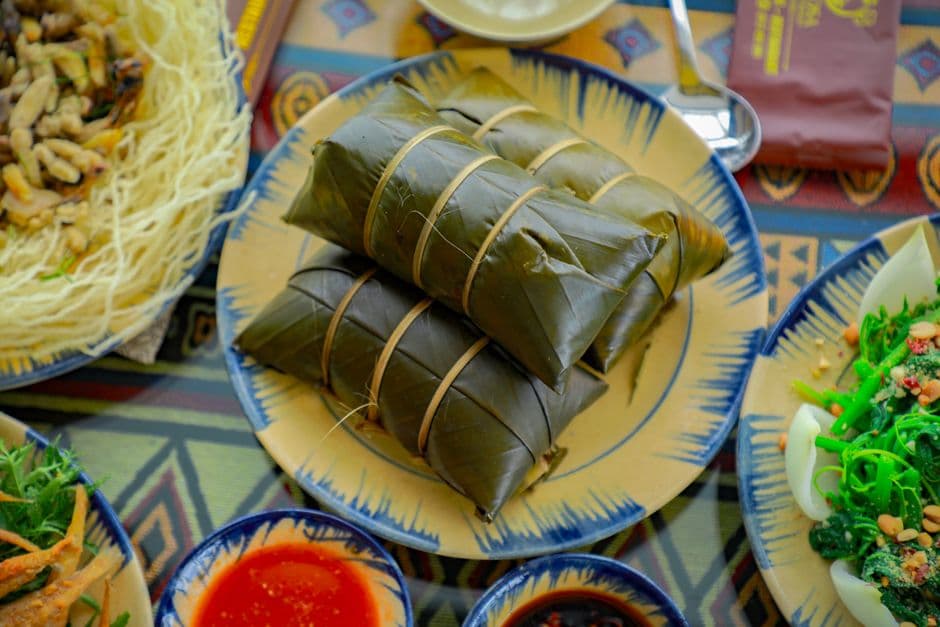
Venezuela's Christmas treasure — corn dough filled with a rich stew of beef, pork, and chicken with olives, capers, and raisins, wrapped in banana leaves and steamed.
Hallacas are Venezuela's most culturally significant food and the country's defining Christmas dish, prepared in a multi-day family ritual called 'the day of the hallacas.' Every Venezuelan family has its own guiso (filling) recipe passed down through generations, with regional variations across the country. The dish is a perfect symbol of Venezuelan mestizo culture — the corn dough (masa) comes from indigenous tradition, the wheat-thickened guiso from Spanish cooking, and the olives, capers, and raisins from Mediterranean and Middle Eastern influences brought by immigrants. Making hallacas is a communal activity: families divide tasks and prepare hundreds of them to share with neighbors and give as gifts.
Serves 12
Sauté onions and tomatoes until soft. Add all three meats and cook 20 minutes. Add cumin, olives, capers, and raisins. Simmer 15 minutes. Cool.
Mix corn flour with warm broth, annatto oil, and salt until a soft, smooth dough forms.
Spread a layer of masa in the center of each banana leaf. Add a spoonful of guiso. Fold the leaf around the filling, tucking the masa over the filling.
Tie each hallaca with kitchen string. Steam for 45–60 minutes in a large pot with a steamer basket.
Soften banana leaves over a gas flame to make them pliable and fragrant
The guiso should be cooled completely before assembling
Taste and adjust salt at the very end — flavors concentrate as liquids reduce, and a final pinch of flaky salt sharpens the whole dish.
Mise en place pays for itself: chop, measure and pre-mix everything before the heat goes on, especially for any step that moves fast.
Make vegetarian hallacas with mushrooms and chickpeas
Add hard-boiled egg slices to each hallaca
Vegetarian: swap the protein for roasted king oyster mushrooms, smoked tofu or cooked chickpeas — adjust seasoning slightly upward to compensate.
Spicier: add a finely chopped fresh chile or a teaspoon of crushed Aleppo/Urfa pepper to the aromatics for warm, layered heat instead of a single sharp hit.
Keeps 5 days refrigerated. Freeze uncooked up to 3 months. Reheat by steaming 15 minutes.
Hallacas date to the colonial period of Venezuela, representing a fusion of indigenous, Spanish, and African culinary traditions. The dish became specifically associated with Christmas in the 18th-19th century.
Both are masa-based and wrapped in leaves, but hallacas use a refined stew filling with olives and capers, and the banana leaf gives a distinct flavor. Hallacas are associated with Christmas only.
Yes — most of the components can be prepared up to a day in advance and refrigerated separately. Reheat gently and assemble just before serving so textures stay distinct.
Stay close to the role each ingredient plays: swap aromatics for similar ones (shallot for onion, lime for lemon), and keep the fat-acid-salt balance intact. Spice blends can usually be approximated with what's in the cupboard.
Authenticity sits on a spectrum — what matters more is honoring the technique and balance of flavors. If the dish tastes harmonious and respects how cooks in its home region would build it, you're on solid ground.
Per serving · 12 servings total
Ask our AI cooking assistant anything about this recipe — substitutions, techniques, scaling.
Chat with AI Chef →Join the conversation
Sign in to leave a comment and save your favourite recipes
Have feedback or need help?
We read every email and reply within 1–2 business days.
© 2026 MyCookingCalendar. All rights reserved.