
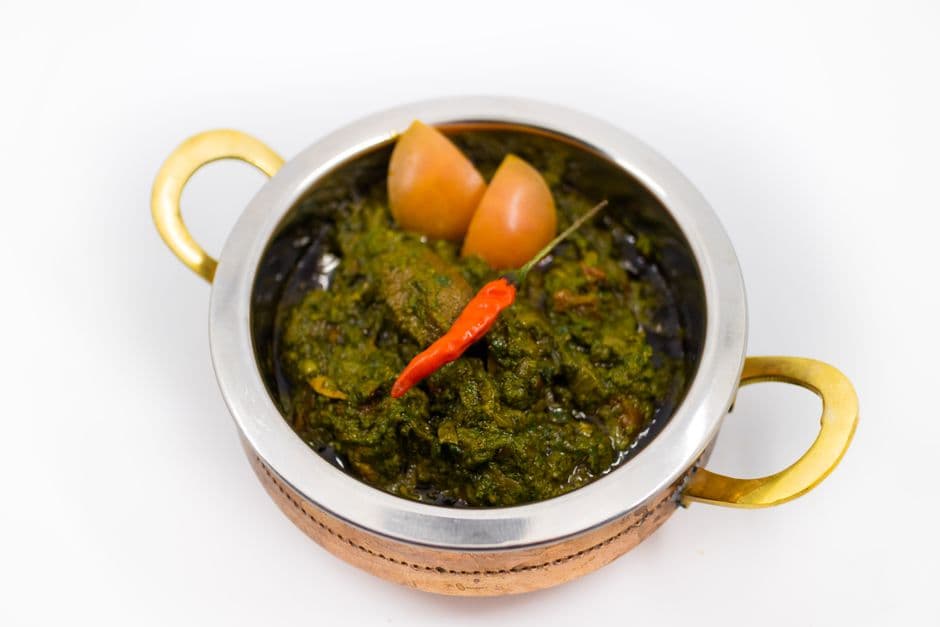
Kashmiri Haak Saag (Collard Greens Stew)
Kashmir Valley's everyday greens — collard or kale leaves simmered with mustard oil, asafoetida, and dried red chili into a brothy, peppery side served with rice.
About This Recipe
Haak saag is the daily green of Kashmir's Pandit and Muslim households alike — a deceptively simple dish of collard leaves (haak in Kashmiri) cooked in pure mustard oil with whole dried Kashmiri red chilies, a pinch of asafoetida (hing), and salt. No onion, no garlic, no tomato; just the pungent backbone of mustard oil and the smoky-sweet warmth of Kashmiri red chili coloring the broth a brilliant orange. Unlike North Indian saag (which is typically puréed and rich with cream), haak is left whole-leaf and brothy — eaten by tearing the soft leaves with steamed rice and sipping the spicy-clear cooking liquor like a clear soup. The technique is critical: mustard oil must be heated until smoking before any other ingredient touches it (this tames its bitterness), the asafoetida is added off-heat to bloom without burning, and the leaves are added at the end so they retain bite. It accompanies the lavish wazwan banquet feasts of weddings — alongside rogan josh, gushtaba and yakhni — but is also the modest, daily green that locals say defines Kashmiri cooking better than any rich meat dish. Done well, it's astonishingly fragrant and exactly the antidote to a heavy meal.
Ingredients
Serves 4
- 600 gcollard greens or kale (haak), tough stems removed, leaves torn in large pieces
- 40 mlpure mustard oil (kachi ghani / cold-pressed)
- 0.5 tspasafoetida (hing)
- 6dried whole Kashmiri red chilies
- 8 gsalt (rock salt traditional, sea salt fine)
- 600 mlwater
- 1 tspKashmiri red chili powder (optional, for color)
Instructions
- 1
Wash and prepare greens
Wash collard leaves twice in cold water to remove grit. Trim away the thick central rib (it's too fibrous), tear leaves into 8 cm pieces. Do not chop fine — haak is eaten leaf-style.
- 2
Smoke the mustard oil
Heat mustard oil in a heavy pot over high heat until it begins to smoke and turn from yellow to pale clear — about 90 seconds. This is essential to remove the raw bitterness of pungent mustard oil. Reduce heat to medium.
- 3
Add asafoetida and chilies
Remove pot briefly from heat. Add asafoetida — it should sizzle and bloom (don't let it burn). Return to heat and add whole dried Kashmiri chilies; fry 30 seconds until they puff slightly and turn a deeper red.
Asafoetida burns easily and turns bitter — keep the heat moderate.
- 4
Add water and salt
Pour in the water and add salt and optional chili powder. Bring to a strong rolling boil. The water should be a brilliant orange-red from the chili.
- 5
Cook the greens
Add the torn collard leaves and stir to submerge. They'll wilt rapidly. Cook uncovered over high heat 8 minutes — Kashmiri haak is cooked uncovered to preserve the bright green color.
- 6
Reduce and concentrate
Reduce heat to medium and continue cooking 6–8 more minutes until leaves are tender but still hold their structure. The cooking liquid should reduce to a brothy, spicy 'shorba' covering the leaves.
- 7
Rest before serving
Remove from heat and rest covered 5 minutes so flavors settle. Taste and adjust salt — Kashmiris like it slightly under-salted to highlight the mustard-oil character.
- 8
Serve with rice
Ladle haak with plenty of its broth over a mound of steamed basmati rice in a wide bowl. Eat by tearing leaves and rice together with the fingers; sip the orange broth like a clear soup.
Did you make this?
Rate it and help other cooks find the recipes that actually work.
One tap to sign in, and we'll save the rating you just picked.
Everything you need to plan your week — free
- Meal calendar
- Grocery list
- AI recipe ideas
Track what you eat
Snap your meal to log calories and macros, run fasting timers and track water in the free SnapCal app.
Pro Tips
- →
Mustard oil must be heated to smoking — undercooked mustard oil is acrid and bitter. This is the most common mistake non-Kashmiri cooks make.
- →
Use pure cold-pressed mustard oil (look for 'kachi ghani' on the label). Some Western countries label mustard oil as 'for external use only' — culinary-grade is available at Indian groceries.
- →
Do not cover while cooking the greens — covered cooking turns them olive-grey. Uncovered preserves the bright green.
- →
Asafoetida (hing) is non-negotiable — there's no real substitute. A tiny pinch goes a long way; it provides the savory depth that onion and garlic would in other cuisines.
Variations
- •
Haak with paneer — add cubes of fried paneer in the last 5 minutes for a richer winter version.
- •
Haak with kohlrabi (mooli haak) — add julienned kohlrabi or white radish with the leaves for crunch.
- •
Haak with nadru (lotus stem) — popular Pandit version with sliced lotus stem simmered until tender.
- •
Spicier version — add 2 finely chopped fresh green chilies along with the leaves for more direct heat.
Storage
Best fresh — refrigerates 2 days. Greens lose color and broth absorbs flavor unevenly on storage. Reheat gently with a splash of water. Does not freeze well.
History & Origin
Haak has been a daily staple in Kashmir for centuries — both Kashmiri Pandit (Hindu) and Kashmiri Muslim cuisines feature it almost identically, suggesting deep regional roots predating religious divisions. The dish appears in 14th-century Kashmiri texts and remains central to home cooking despite the rise of more elaborate wazwan banquet dishes.
Frequently Asked Questions
Can I use regular kale or spinach?
Kale is a good substitute (similar texture and slight bitterness). Spinach cooks too fast and breaks down; use it only if collards or kale are unavailable, and reduce cook time to 5 minutes.
Why no onion or garlic?
Traditional Kashmiri cooking — especially Pandit cuisine — avoids onion and garlic in many dishes, using asafoetida instead to provide depth. Haak is the classic example.
What if I can't find asafoetida?
There's no real substitute. A pinch of garlic powder + a pinch of onion powder + a drop of fish sauce approximates the umami punch but doesn't taste authentically Kashmiri.
Is haak supposed to be brothy or dry?
Brothy — the cooking liquor (called 'haak shorba') is half the point. Drain only if serving as a side to a multi-dish thali; for a single-bowl meal keep all the broth.
Nutrition Facts
Per serving (220g / 7.8 oz) · 4 servings total
Time Summary
Have Questions?
Ask our AI cooking assistant anything about this recipe — substitutions, techniques, scaling.
Chat with AI Chef →More Indian Recipes
You Might Also Like
Similar dishes from other cuisines around the world.
Free Kitchen Tools
Calculators and converters that pair with this page — no signup needed.
Put This Into a Plan
Schedule it, shop for it, and track what you already have.
Read Next
Longer reads that go deeper on the ideas behind this dish.
Community
Join the conversation
Sign in to leave a comment and save your favourite recipes