
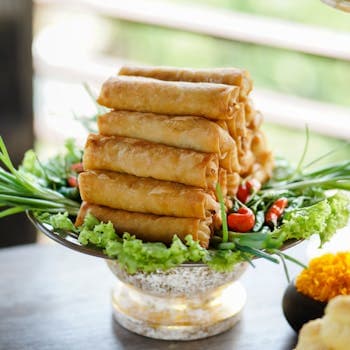
Lumpia
Indonesian spring rolls with pork and vegetables — crispy, savory, addictive.
About This Recipe
Lumpia are Indonesia's spring rolls, a direct legacy of Chinese immigrants who settled the north coast of Java — the most famous version, lumpia Semarang, was reportedly born of a 19th-century marriage between a Chinese trader and a Javanese woman who merged their two recipes. Thin wheat wrappers are rolled tightly around a savory filling of pork, shrimp, and vegetables, then deep-fried until the skin blisters into a golden, shattering crust around a juicy interior. In Semarang the filling stars bamboo shoots; elsewhere cabbage and carrot dominate. Eaten with sweet chili sauce, a fresh bird's-eye chili, or thick garlic-tauco sauce, lumpia bridge street snack and party platter effortlessly.
Ingredients
Serves 20
- 20lumpia wrappers or thin wheat wrappers
- 300 gground pork
- 150 gshrimp, minced
- 2 cupscabbage, finely shredded
- 2 mediumcarrots, grated
- 3 stalksgreen onion, chopped
- 3 clovesgarlic, minced
- 1 tspsalt
- 1/2 tspwhite pepper
- 1 tbspsoy sauce
- oil for frying
Instructions
- 1
Cook filling
Fry the garlic in a little oil until fragrant, add the pork and shrimp, and cook, breaking up clumps, until no longer pink. Stir in the cabbage, carrot, and green onion and cook just 3 minutes — the vegetables should wilt but keep some bite. Season with soy, salt, and white pepper, then spread on a tray to cool completely.
A hot or wet filling will steam the wrapper from inside and tear it — cool it fully and drain off any liquid before wrapping.
- 2
Wrap
Lay a wrapper in a diamond orientation, place about 2 tablespoons of filling in a log across the lower third, fold the bottom corner over snugly, fold in the sides, and roll tightly toward the top corner. Seal the tip with a dab of water or flour paste so the roll doesn't unfurl in the oil.
- 3
Fry
Heat oil to 170°C — a cube of bread should brown in about 30 seconds — and fry the rolls in batches of 4–5, turning occasionally, until evenly deep golden, 3–4 minutes. Lift out with a spider and drain on paper towels or a wire rack.
Let the oil recover its temperature between batches; rolls fried in cooling oil absorb grease instead of crisping.
- 4
Serve
Serve hot while the crust still shatters, with sweet chili sauce, kecap manis, or the traditional accompaniments of whole bird's-eye chilies and crisp scallion batons for biting between mouthfuls.
Did you make this?
Rate it and help other cooks find the recipes that actually work.
One tap to sign in, and we'll save the rating you just picked.
Everything you need to plan your week — free
- Meal calendar
- Grocery list
- AI recipe ideas
Track what you eat
Snap your meal to log calories and macros, run fasting timers and track water in the free SnapCal app.
Pro Tips
- →
Cool the filling completely before wrapping — heat and moisture are the two main causes of torn, soggy rolls.
- →
Keep unused wrappers under a damp towel so they stay pliable while you work.
- →
Roll tightly with no air pockets; trapped air expands in hot oil and bursts the seam.
- →
Don't exceed 2 tablespoons of filling per roll, however tempting.
- →
Double-fry for extra crunch: fry once until pale gold, rest 10 minutes, then refry 1 minute at 180°C.
Variations
- •
Lumpia Semarang: fill with bamboo shoots, egg, and shrimp, and serve with a thick sweet garlic sauce.
- •
Lumpia basah: skip the frying entirely for the fresh, soft 'wet' version popular in Bandung.
- •
Vegetarian: replace pork and shrimp with crumbled firm tofu, shiitake mushrooms, and extra cabbage.
- •
Chicken lumpia: use ground chicken thigh for a lighter but still juicy filling.
Storage
Freeze uncooked rolls in a single layer, then bag them; fry straight from frozen, adding about 1 minute. Fried lumpia keep 2 days refrigerated and re-crisp well in a 190°C oven for 8 minutes.
History & Origin
Lumpia descend from Chinese spring rolls (lunpia in Hokkien) brought by Fujianese immigrants to Java's port cities. The celebrated lumpia Semarang is traced to the 1870s union of Chinese vendor Tjoa Thay Joe and Javanese cook Wasi, whose families still run rival lumpia dynasties in the city. The snack also traveled with migrants to the Philippines, where lumpia became a national favorite in its own right.
Frequently Asked Questions
What if my lumpia break or tear while rolling?
Wrappers must be at room temperature and slightly moist — cold or dry wrappers crack. Cover the stack with a damp towel, work one at a time, and patch small tears with a second wrapper layer. Also check your filling isn't wet; pooled liquid weakens the wrapper within seconds.
Can I use Vietnamese rice paper or Chinese egg roll wrappers?
Chinese spring roll wrappers (the thin, wheat-based frozen kind) are the closest match and fry up identically. Egg roll wrappers are thicker and blister into a bubbly crust — usable, but different. Vietnamese rice paper behaves completely differently in hot oil and isn't a good substitute for fried lumpia.
Can I bake or air-fry lumpia instead?
Yes. Brush the rolls generously with oil and bake at 200°C for 15–18 minutes, turning halfway, or air-fry at 190°C for 10–12 minutes. The crust will be crisp but drier and less blistered than deep-fried. For a party, baking lets you cook 20 rolls in one batch.
Nutrition Facts
Per serving (75g / 2.6 oz) · 20 servings total
Time Summary
Have Questions?
Ask our AI cooking assistant anything about this recipe — substitutions, techniques, scaling.
Chat with AI Chef →More Indonesian Recipes
You Might Also Like
Similar dishes from other cuisines around the world.
Browse by Ingredient
More recipes built around the same core ingredients.
Free Kitchen Tools
Calculators and converters that pair with this page — no signup needed.
Put This Into a Plan
Schedule it, shop for it, and track what you already have.
Read Next
Longer reads that go deeper on the ideas behind this dish.
Community
Join the conversation
Sign in to leave a comment and save your favourite recipes