
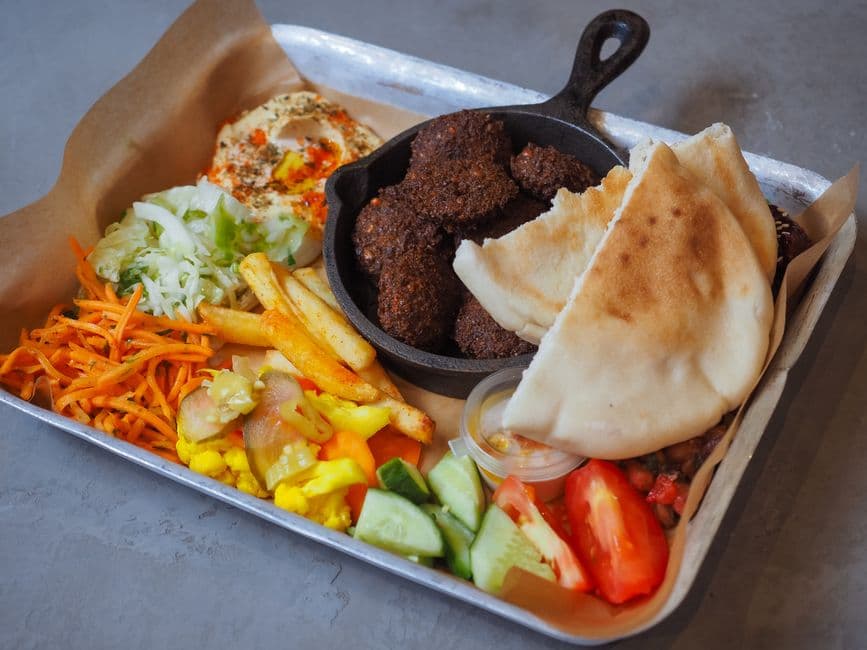
Sabich (Iraqi-Israeli Pita with Fried Eggplant, Egg & Amba)
Tel Aviv's other great pita sandwich — pillowy bread stuffed with golden fried eggplant, a soft-boiled egg, hummus, Israeli salad and a generous drizzle of tangy mango amba.
About This Recipe
Sabich began as a Shabbat morning breakfast in the Iraqi Jewish community — eggplant, hard-cooked eggs, potato and amba laid out cold on Saturday after the Friday-night cooking — and was repackaged in 1960s Ramat Gan, near Tel Aviv, into a street pita that now rivals falafel as Israel's defining sandwich. The name itself is debated; the most common theory is that 'sabich' is an Iraqi-Arabic mash-up of the morning ingredients (salat, beitza, yogurt, chips) or simply a contraction of the Iraqi-Jewish breakfast name. What is not debated is the architecture. A fluffy fresh pita is split, smeared generously with hummus, then layered with thick slices of eggplant fried in olive oil until almost custardy at the center and deeply caramelized at the edges. A jammy six-minute egg gets sliced and tucked in alongside. Then come the Israeli salad of finely diced cucumber, tomato and parsley; a hot, sour pickled-cabbage slaw; a spoonful of bright pink tahini; and the non-negotiable finisher — amba, a fermented green-mango pickle relish brought by Iraqi Jews from Baghdad, warm with turmeric and fenugreek, that ties every flavor together with its electric sour-sweet-funky lift. Eaten standing up, leaning forward, it is one of the most architecturally satisfying vegetarian sandwiches on earth: cold and hot, soft and crisp, rich and sharp, in every single bite.
Ingredients
Serves 4
- 2 mediumglobe eggplants (about 800 g), sliced 1 cm thick rounds
- salt for purging
- 120 mlolive oil for frying
- 4 largeeggs
- 4fresh fluffy pita breads, slit but not split
- 300 ggood hummus (homemade or quality store-bought)
- 120 mltahini sauce (tahini + lemon + garlic + water, whipped)
- 6 tbspamba sauce(Iraqi fermented green-mango relish; find at Middle Eastern shops)
- 2 mediumcucumbers (preferably Persian), 5 mm dice
- 3 mediumtomatoes, 5 mm dice and drained briefly
- 1 smallred onion, finely chopped
- 1 small bunchflat-leaf parsley, chopped
- 1lemon, juiced
- 200 gpickled red cabbage or fermented turnips, drained
- schug or harissa (optional, for heat)
Instructions
- 1
Purge the eggplant
Lay the eggplant rounds on a wire rack, salt generously on both sides and let sit 30 minutes. Beads of water will rise to the surface — this draws out bitterness and prevents the eggplant from drinking too much oil. Pat completely dry with paper towels before frying.
- 2
Fry the eggplant
Heat a thick film of olive oil in a wide skillet over medium-high until shimmering. Add the eggplant rounds in a single layer; do not crowd. Fry 3 to 4 minutes per side until deeply golden and the centers are very tender — almost custardy. Drain on a rack and season lightly with flaky salt. Continue in batches, adding oil as needed.
- 3
Cook the jammy eggs
Bring a small pot of water to a boil. Lower the eggs in gently and set a timer for exactly 6 minutes 30 seconds for medium-large eggs. Immediately transfer to ice water. Peel and set aside. The yolk should be jammy and bright, not chalky.
- 4
Make the salad
Combine the diced cucumber, tomato, red onion and parsley in a bowl. Dress with the lemon juice, a tablespoon of olive oil and a generous pinch of salt. Toss only just before serving — the salad weeps quickly.
- 5
Warm the pita
Heat the pita breads on a dry skillet or directly over a low flame for 15 seconds per side — just long enough to make them pliable and warm without drying them out. Slit each one along one edge to create a deep pocket without splitting the pita in half (a half-moon, not two flat circles).
- 6
Build the base layer
Smear the inside of each pita generously with hummus — at least 3 tablespoons per sandwich, on both inner walls. This is the structural glue of the sandwich and a stingy hand here will result in a dry sabich. Top with a small spoon of tahini sauce.
- 7
Layer the hot and cold
Tuck 3 to 4 slices of fried eggplant into each pita, then slide in slices of the jammy egg. Spoon over a heaping portion of the Israeli salad and a tangle of pickled cabbage. The pita should be almost overflowing.
- 8
Finish with amba and serve
Drizzle each sandwich with a tablespoon of amba and a final stream of tahini sauce. Add a small spoon of schug or harissa if you like heat. Hand directly to whoever is eating — sabich does not survive sitting, and the pita softens within five minutes. Eat over a plate, leaning forward.
Did you make this?
Rate it and help other cooks find the recipes that actually work.
One tap to sign in, and we'll save the rating you just picked.
Everything you need to plan your week — free
- Meal calendar
- Grocery list
- AI recipe ideas
Track what you eat
Snap your meal to log calories and macros, run fasting timers and track water in the free SnapCal app.
Pro Tips
- →
Amba is the soul of the sandwich. Do not skip it and do not substitute mango chutney — it is a different beast entirely. Look for Galil or Pereg brand in Middle Eastern shops, or order online.
- →
Fry the eggplant until almost too dark — pale eggplant is the most common home-cook mistake. You want deep caramelization for sweetness and structural integrity.
- →
A truly fresh pita matters; day-old pita rips when you stuff it. If your pita is stiff, wrap in damp paper towel and microwave 10 seconds before warming.
- →
Keep components ready to go on a single tray and assemble each sandwich just before eating — sabich is a build-to-order dish.
Variations
- •
Add thin slices of boiled potato — this was part of the original Iraqi Shabbat breakfast and many older Tel Aviv stands still include it.
- •
Vegan sabich: skip the egg and add extra slices of roasted potato plus a spoonful of zhug for protein and heat.
- •
Open-faced sabich plate: arrange all components on a plate around a mound of hummus and serve with pita on the side — popular at sit-down restaurants.
- •
Sabich bowl: serve everything over warm couscous or rice for a fork-and-knife version that travels better for lunch.
Storage
Sabich does not store assembled — components must be kept separate. Fried eggplant keeps refrigerated 3 days and reheats well in a 180°C oven for 5 minutes. Eggs, salad and tahini are best made the day of serving. Amba lasts months in the fridge once opened.
History & Origin
Sabich originated as a Shabbat morning breakfast in Iraqi Jewish homes, where Jewish dietary law forbids cooking on the Sabbath; the components were prepared Friday afternoon and eaten cold or room-temperature Saturday morning. Iraqi Jews who emigrated to Israel in the early 1950s brought the tradition with them, and in the early 1960s a kiosk owner in Ramat Gan named Sabich Halabi began assembling the components into a single pita to sell to commuters. The sandwich exploded in popularity in the 1990s when Tel Aviv stands like Sabich Tchernichovsky elevated it to street-food icon status alongside falafel and shawarma.
Frequently Asked Questions
Where do I buy amba?
Any Middle Eastern grocer should carry it; common brands are Galil, Pereg and Sabra. Online sources ship internationally. In a true emergency, a thin mango chutney whisked with extra turmeric, fenugreek and white vinegar is a passable substitute — but not the real thing.
Can I bake the eggplant instead of frying?
Yes, though you lose some richness. Brush slices generously with olive oil and roast at 220°C for 25 minutes, flipping halfway. The texture will be less custardy but still good.
How is sabich different from falafel?
Both are stuffed-pita street sandwiches, but falafel is built around fried chickpea fritters and sabich is built around fried eggplant and egg. Sabich is also generally more vegetable-heavy and richer with amba; falafel leans crunchier and more austere.
What is the right pita?
Fresh, fluffy, pocket-style Middle Eastern pita — not Greek-style pocketless flatbread. Bakery-fresh same-day is dramatically better than supermarket packaged. If you can find Israeli-style 'lafa' or oversize pita, even better.
Nutrition Facts
Per serving (440g / 15.5 oz) · 4 servings total
Time Summary
Have Questions?
Ask our AI cooking assistant anything about this recipe — substitutions, techniques, scaling.
Chat with AI Chef →More Israeli Recipes
You Might Also Like
Similar dishes from other cuisines around the world.
Browse by Ingredient
More recipes built around the same core ingredients.
Free Kitchen Tools
Calculators and converters that pair with this page — no signup needed.
Put This Into a Plan
Schedule it, shop for it, and track what you already have.
Read Next
Longer reads that go deeper on the ideas behind this dish.
Community
Join the conversation
Sign in to leave a comment and save your favourite recipes