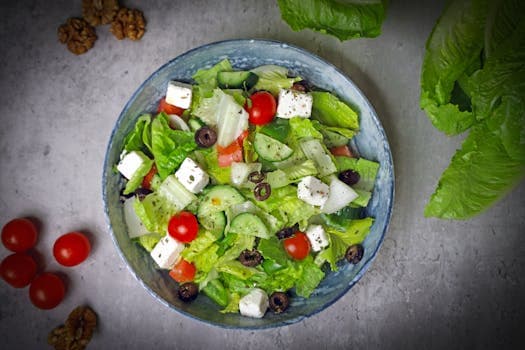
greeksalad
Classic Greek Salad – Horiatiki with Feta, Olives and Oregano
Chunky tomatoes, cucumber, red onion, Kalamata olives and a slab of feta — the definitive Mediterranean salad.
Prep
10 min
Cook
0 min
Servings
4
Difficulty
Easy
★★★★★
4.8(31,200 ratings)#greek#salad#feta#vegetarian#gluten-free#no-cook
About This Recipe
Greek salad (horiatiki, meaning 'village salad') is one of the world's great salads — and one of the most misunderstood outside Greece. The authentic version contains no lettuce: it is a robust, chunky assembly of ripe tomatoes, cucumber, red onion, green peppers, and Kalamata olives, crowned with a thick slab (not crumbled) of barrel-aged feta, drizzled with excellent olive oil, and scattered with dried Greek oregano. No dressing, no vinegar — just olive oil, the vegetables' own juices, and the brine from the olives and feta. The key to horiatiki is the quality of the tomatoes — they must be fully ripe, flavourful, and sweet. The feta should be Greek PDO feta, made from sheep and goat milk, with a crumbly, slightly grainy texture and a creamy, tangy flavour that is entirely unlike mass-produced white cheese called 'feta.' The olive oil must be Greek extra-virgin, fruity and peppery. Greek salad is served as a starter or side dish throughout Greece, eaten with crusty bread to soak up the pooled juices and olive oil at the bottom of the bowl. It is the definitive expression of Greek summer produce.
Ingredients
Serves 4
- 4ripe tomatoes(cut into wedges)
- 1cucumber(halved lengthways, thickly sliced)
- 1small red onion(thinly sliced)
- 1green pepper(thinly sliced)
- 100 gKalamata olives
- 200 gGreek PDO feta(as a whole slab)
- 4 tbspGreek extra-virgin olive oil
- 1 tspdried Greek oregano
- flaky salt and black pepper
Instructions
- 1
Assemble the vegetables
Arrange tomatoes, cucumber, onion, and green pepper in a wide shallow bowl or platter.
- 2
Add olives
Scatter Kalamata olives over the vegetables.
- 3
Add feta
Place the whole slab of feta on top — do not crumble it. In Greece, the feta slab is a point of pride.
A whole slab of feta is the traditional presentation. Crumbled feta is acceptable at home but lacks the visual drama.
- 4
Dress
Drizzle generously with olive oil. Scatter oregano over everything, especially on the feta. Add flaky salt and black pepper. No other dressing is needed.
Pro Tips
- →
The vegetables should be at room temperature, not cold from the fridge — the flavour is dramatically better.
- →
Use only proper Greek feta (PDO) — it is protected by EU law and is made from sheep and goat milk.
- →
Good olive oil is the dressing. Don't use bland supermarket olive oil here.
Variations
- •
Add capers for a tangier, more complex version.
- •
Include sliced avocado for a modern, creamier interpretation.
Storage
Dress and eat immediately. Undressed vegetables and feta keep separately for 2 days.
History & Origin
Horiatiki (village salad) has been eaten in Greece since ancient times in various forms, with olives, cheese and vegetables forming the backbone of Greek peasant diet for millennia. The specific combination of tomatoes, cucumbers, feta and Kalamata olives solidified into the classic horiatiki in the 20th century as tourism made Greek cuisine internationally famous. Greek feta has been produced in Greece since at least 1494, mentioned in travellers' accounts of the period.
Frequently Asked Questions
Why is there no lettuce in authentic Greek salad?
Traditional Greek village salad (horiatiki) never contains lettuce — it is a robust assembly of sturdy vegetables that stand up to the olive oil dressing without wilting. The 'Greek salad' with iceberg lettuce found at international restaurants is a westernised version. In Greece, lettuce appears in a separate salad called 'maroulosalata,' which is a simple romaine and dill salad.
Nutrition Facts
Per serving (250g) · 4 servings total
Calories280kcal
Protein9g
Carbohydrates12g
Fat22g
Fiber3g
Protein9g
Carbs12g
Fat22g
Time Summary
Prep time10 min
Cook time0 min
Total time10 min
Have Questions?
Ask our AI cooking assistant anything about this recipe — substitutions, techniques, scaling.
Chat with AI Chef →More Greek Recipes
Community
Join the conversation
Sign in to leave a comment and save your favourite recipes