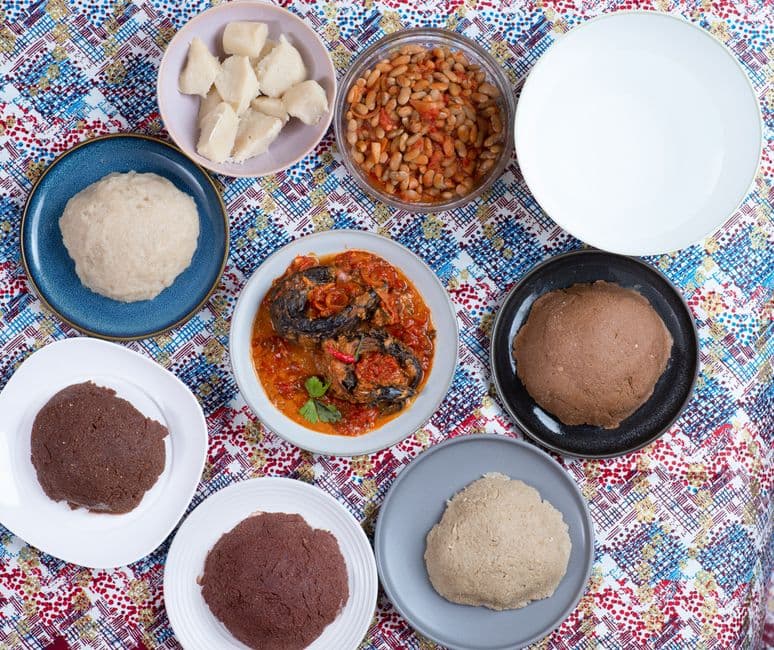
A firm, smooth maize flour porridge that is the foundational staple of Rwandan cuisine, served alongside stews and vegetables.
Known as ugali in Rwanda (and as sadza, nsima, or pap in neighbouring countries), this dense maize porridge is eaten at virtually every meal across East and Central Africa. The preparation demands constant stirring and confidence — the correct texture is thick enough to mould with one hand, forming a ball that is dipped into accompanying stews. In Rwanda it is central to communal eating, where family members gather around a shared dish of ugali and isombe, ibiharage (beans), or grilled brochettes.
Sirve 4
Bring 1 litre of salted water to a rolling boil in a heavy-bottomed pot.
Reduce heat to medium. Pour in roughly half the maize flour in a steady stream while stirring vigorously with a wooden spoon or spatula to prevent lumps from forming.
Continue stirring constantly as the mixture thickens, about 5 minutes. The ugali will begin to pull away from the sides of the pot.
Add the remaining flour in small amounts, stirring vigorously after each addition. The dough should become very thick and stiff.
Reduce heat to low and cover the pot. Allow to steam for 5 minutes, then stir again. Repeat once more. The ugali is ready when it comes away cleanly from the pot.
Turn the ugali out onto a damp plate and shape into a mound with wet hands or a wet wooden spoon. Serve immediately alongside stews, beans, or grilled meats.
Use fine-ground white maize flour — coarse polenta will not give the right texture.
Do not stop stirring or lumps will form.
Wet your hands before handling the ugali to prevent sticking.
Pruebe y ajuste la sal al final — los sabores se concentran a medida que los líquidos se reducen, y un pellizco final de sal escamosa agudiza todo el plato.
Use sorghum flour for a darker, nuttier ugali.
Mix half cassava flour and half maize flour for a lighter texture.
Some cooks add a tablespoon of butter for richness.
Vegetariano: reemplace la proteína con champiñones ostra rey asados, tofu ahumado o garbanzos cocidos — ajuste el sazón ligeramente hacia arriba para compensar.
Best eaten fresh. Leftovers can be refrigerated for up to 2 days and reheated in a damp cloth in the microwave.
Maize arrived in Africa with Portuguese traders in the 16th century and rapidly became a dietary staple. In Rwanda, ugali evolved alongside the nation's agricultural practices and remains a daily constant, consumed by people of all backgrounds and economic levels.
It should be stiff enough to hold a thumbprint without collapsing. If it is runny, continue cooking and stirring.
Sí — la mayoría de los componentes se pueden preparar hasta un día antes y refrigerar por separado. Recaliente suavemente y ensamble justo antes de servir para que las texturas se mantengan distintas.
Manténgase cerca del papel que juega cada ingrediente: intercambie aromáticos por otros similares (chalota por cebolla, limón por limón), y mantenga el equilibrio grasa-ácido-sal intacto. Las mezclas de especias generalmente se pueden aproximar con lo que hay en la alacena.
Authenticity sits on a spectrum — what matters more is honoring the technique and balance of flavors. If the dish tastes harmonious and respects how cooks in its home region would build it, you're on solid ground.
Por porción (220g) · 4 porciones totales
Pregúntele a nuestro asistente de cocina con IA cualquier cosa sobre esta receta: sustituciones, técnicas, escalado.
Chatea con AI Chef →Únete a la conversación
Inicia sesión para dejar un comentario y guardar tus recetas favoritas
¿Tienes comentarios o necesitas ayuda?
Leemos todos los correos y respondemos en 1–2 días hábiles.
© 2026 MyCookingCalendar. Todos los derechos reservados.