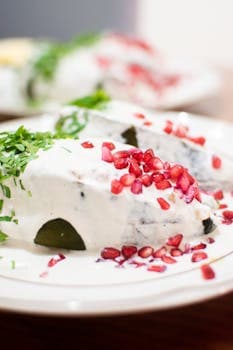
Chiles en Nogada is among Mexico's most elegant and symbolic dishes — fire-roasted poblano peppers filled with picadillo, a sweet-savory mixture of ground meat, fruit, and nuts, then blanketed in nogada, a delicate cream of fresh walnuts, and finished with ruby pomegranate seeds and bright parsley. The green chile, white sauce, and red seeds deliberately echo the colors of the Mexican flag. It is fundamentally a seasonal dish, tied to late summer and early autumn when fresh walnuts, pomegranates, and the stone fruits in the filling all overlap, and it appears most often around the September independence celebrations. Labor-intensive and quietly luxurious, it balances warm spice, fruity sweetness, and the gentle richness of the walnut sauce in a way few dishes attempt.
Serves 6
Char the poblanos directly over a flame or under the broiler until blackened all over, then steam them in a covered bowl or bag 10 minutes. Peel away the loosened skin, keeping the stems intact, make a lengthwise slit, and carefully remove the seeds.
Steaming after charring is what makes the skins slip off cleanly without tearing the delicate flesh.
Brown the ground pork in a wide pan, breaking it up well, then add the onion and garlic and cook about 5 minutes until softened and aromatic. A good sear on the meat builds the savory backbone of the filling.
Stir in the tomatoes, apple, pear, peach, raisins, almonds, pine nuts, cinnamon, cloves, and salt and cook about 15 minutes until thick, glossy, and sweet-savory. The fruit should soften into the meat without turning to mush.
Cut the fruit in small, even dice so it melds into the picadillo rather than standing out in chunks.
Gently fill each poblano with the warm picadillo through its slit, easing it in without overstuffing so the pepper still closes around the filling and holds its shape on the plate.
Soak the peeled walnuts in milk 30 minutes to soften them, then drain and blend with the crema, queso fresco, fresh milk, sugar, and a pinch of salt until completely smooth and pourable. It should be cream-colored, faintly sweet, and silky.
Peeling the thin walnut skins keeps the sauce pale and removes any bitter, tannic edge.
Set each stuffed pepper on a plate and ladle the nogada generously over the top so it coats the chile completely. The sauce is meant to drape and pool slightly, not just garnish.
Scatter pomegranate seeds and chopped parsley over the white sauce to complete the green, white, and red of the flag. Serve at room temperature, as is traditional, so the flavors are at their fullest.
Peel fresh walnuts for the smoothest, palest nogada; the skins are bitter and tannic.
Serve at room temperature — it's traditional and lets the flavors bloom.
Steam the charred peppers so the skins slip off without tearing the flesh.
Dice the picadillo fruit finely so it melds into the meat.
Make the nogada close to serving, as it can separate if it sits too long.
Vegetarian: stuff with sautéed vegetables, beans, and the same fruit-and-nut mix.
Use ground beef, or a classic pork-and-beef blend, in the picadillo.
Battered (capeado) version: dip the stuffed peppers in egg batter and fry before saucing.
Add a splash of sherry or a little candied citron (acitrón substitute) to the filling for depth.
The nogada tends to separate and the assembled dish doesn't hold well, so it's best made and eaten the same day. You can prepare the picadillo and roast the peppers a day ahead, refrigerate them, then make the sauce fresh and assemble just before serving.
Chiles en nogada is traditionally said to have been created in Puebla in 1821, often attributed to local nuns, to honor Agustín de Iturbide and Mexico's independence with a dish in the colors of the new flag. The legend is widely repeated, though the precise details are debated by historians.
It is closely tied to the late-summer and early-autumn season, roughly August through September, which coincides with Mexico's independence celebrations. That timing is practical as well as patriotic: fresh walnuts, pomegranates, and the stone fruits used in the filling are all at their peak then.
Most traditionally it is served at room temperature, with the cool nogada poured over peppers that are warm or at room temperature rather than piping hot. Some cooks gently warm the stuffed peppers first, but the walnut sauce itself is never heated, as it can break and lose its delicate texture.
Fresh (wet) walnuts give the creamiest, palest sauce, but they're seasonal. Out of season, soak good-quality dried walnuts in milk and, if you have the patience, peel off the thin skins to reduce bitterness. The sauce will be slightly less delicate but still rich and authentic in spirit.
Per serving (400g / 14.1 oz) · 6 servings total
Ask our AI cooking assistant anything about this recipe — substitutions, techniques, scaling.
Chat with AI Chef →Join the conversation
Sign in to leave a comment and save your favourite recipes
Have feedback or need help?
We read every email and reply within 1–2 business days.
© 2026 MyCookingCalendar. All rights reserved.