
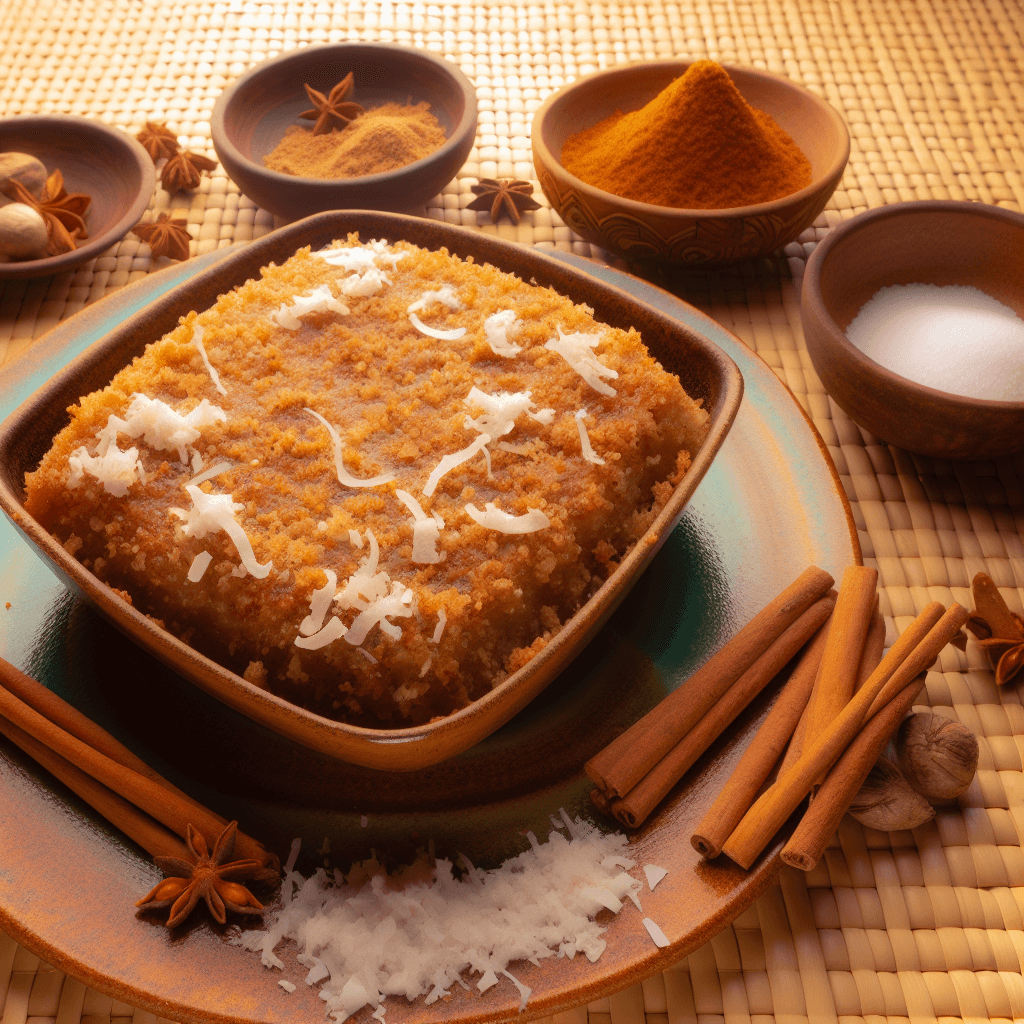
Caymanian Heavy Cake
Dense, sweet cassava and coconut cake flavoured with cinnamon and brown sugar — a Caymanian celebration staple.
About This Recipe
Heavy Cake — and it earns that name completely — is the national dessert of the Cayman Islands: a dense, moist, deeply fragrant square made from finely grated cassava, desiccated coconut, brown sugar, and warm spice, baked until its surface turns deep amber and its interior sets to a cohesive, slightly chewy mass. There is nothing airy or refined about it. It is the product of a cuisine shaped by limited pantry ingredients and the demand for sustaining, satisfying food, and it is magnificent. Cassava is the key ingredient, and its preparation is what separates a good heavy cake from a great one. Fresh cassava, peeled and grated as finely as possible on a box grater or a dedicated cassava grater, must be squeezed firmly to remove its excess starchy liquid before being mixed with the other ingredients. This moisture control is the most critical step: too much moisture produces a cake that never fully sets; too little produces one that is dry and crumbly. The grated cassava combines with desiccated coconut (which adds sweetness, fat, and chew), brown sugar (for molasses depth), and coconut milk (for tropical richness and moisture), with cinnamon and nutmeg tying the warm-spice aromatics together. Heavy cake is baked in a rectangular dish at moderate heat for nearly an hour, emerging with a caramelised crust that crinkles slightly as it cools. It must be allowed to cool completely before cutting — the interior firms from a loose, almost pudding-like consistency in the oven into a sliceable, dense cake at room temperature. Served in small squares (a little goes a long way), it is the dessert most likely to bring Caymanians immediately home in memory and feeling.
Ingredients
Serves 12
- 1 kgcassava(peeled and finely grated)
- 2 cupsdesiccated coconut
- 1.5 cupsbrown sugar
- 1 tspcinnamon
- 0.5 tspnutmeg
- 1 cancoconut milk(400 ml)
Instructions
- 1
Preheat oven and prepare pan
Preheat the oven to 180 °C (350 °F) conventional, or 165 °C fan-forced. Grease a 23 × 33 cm (9 × 13 inch) baking dish generously with butter or coconut oil, then line the base with parchment paper. The cassava batter is very dense and will stick to an unprepared pan.
- 2
Prepare the cassava
Peel the cassava completely, removing both the outer bark and the pinkish inner layer beneath it. Grate finely on the smallest holes of a box grater, or pulse briefly in a food processor until it resembles fine, moist sawdust. Transfer the grated cassava to a clean tea towel, gather the corners, and twist firmly over the sink, squeezing out as much starchy liquid as possible. You should extract a surprising amount of moisture.
Squeezing out the cassava liquid is the single most important step. Measure the squeezed cassava by weight rather than volume — 1 kg net weight after squeezing is the target.
- 3
Combine dry ingredients
Tip the squeezed grated cassava into a large mixing bowl. Add the desiccated coconut, brown sugar, ground cinnamon, and nutmeg. Mix thoroughly with your hands or a large spoon until the ingredients are evenly distributed throughout the cassava — no pockets of dry sugar or coconut should remain.
- 4
Add coconut milk and mix
Pour the coconut milk over the dry mixture and stir vigorously until fully incorporated. The batter should be very thick — heavier and stiffer than a cake batter but looser than a dough. If it seems dry, add a splash more coconut milk. If too wet and sloppy, squeeze the cassava again and discard the additional liquid.
- 5
Spread and smooth
Transfer the batter into the prepared baking dish. Using the back of a wet spoon or a palette knife, press and smooth the batter into an even layer, reaching into the corners. The surface should be level and about 3–4 cm deep.
Wet the back of the spoon to prevent the sticky batter from pulling as you smooth it.
- 6
Bake until golden and set
Bake for 55–65 minutes until the surface is a deep golden brown, the edges have pulled slightly away from the sides of the pan, and a wooden skewer inserted into the centre comes out without wet batter clinging to it. The centre will still look slightly soft but will firm as the cake cools.
- 7
Cool completely before cutting
Remove from the oven and allow to cool in the pan at room temperature for at least 2 hours. Do not rush this — the cassava continues to set as it cools, and cutting while warm produces crumbly, un-clean squares. Once fully cooled, cut into 5 cm squares with a sharp knife wiped clean between cuts.
Did you make this?
Rate it and help other cooks find the recipes that actually work.
One tap to sign in, and we'll save the rating you just picked.
Everything you need to plan your week — free
- Meal calendar
- Grocery list
- AI recipe ideas
Cook this hands-free
Get AI meal plans, step-by-step cooking mode, and your saved recipes in the free Bento app.
Pro Tips
- →
Squeeze the grated cassava as aggressively as possible in a tea towel — this is the difference between a cake that sets into clean-cutting squares and one that stays wet and loose in the centre.
- →
The cake genuinely improves after a day. Make it the evening before serving; the spices deepen and the texture firms to a perfect, dense chewiness overnight.
- →
Weigh the cassava rather than measuring by volume — grated cassava compresses inconsistently and a volume measurement can easily be 20% off. Aim for 1 kg squeezed weight.
- →
Use dark brown muscovado sugar if available for a deeper, more complex molasses flavour than standard brown sugar provides.
- →
Frozen pre-grated cassava (widely available in Caribbean and Latin American grocery stores) works very well — thaw overnight in a sieve in the refrigerator so excess moisture drains away before squeezing.
Variations
- •
Fruit version: fold 100 g of raisins, mixed dried fruit, or finely chopped dried mango into the batter before baking — common at Christmas time and for special occasions.
- •
Condensed milk version: reduce the brown sugar by half and replace the coconut milk with an equal volume of sweetened condensed milk for a richer, denser, more intensely sweet cake.
- •
Pumpkin version: substitute 300 g of the grated cassava with finely grated Kabocha or butternut squash for a slightly softer, more orange-hued cake with a gentler flavour.
- •
Layered version: some Caymanian bakers split the mixture in half, adding a layer of sweetened shredded coconut in the middle before spreading the second half of batter and baking — creates a distinct coconut centre.
Storage
Store in an airtight container at room temperature for up to 3 days. The cake actively improves over the first 24 hours as the texture firms and the spices deepen. Refrigerate for up to 1 week — bring to room temperature for 30 minutes before serving as chilling firms the texture considerably. Heavy cake can be frozen for up to 1 month; wrap individual squares tightly in cling film and thaw at room temperature.
History & Origin
Cassava-based dense cakes are found throughout the Caribbean and the West African coastal regions from which much of the islands' population was displaced during the Atlantic slave trade. The technique of baking sweetened, grated cassava with coconut appears in various forms across Guyana, Trinidad, Barbados, and Jamaica under different names — 'pone' in many islands, 'heavy cake' in the Cayman Islands. The Caymanian version's particular affinity for cinnamon and nutmeg reflects the spice trade routes that connected the Eastern Caribbean to the larger colonial economy. Heavy cake was prepared for generations at community celebrations, church gatherings, and Christmas, cementing its status as the national dessert.
Frequently Asked Questions
Can I use frozen grated cassava for heavy cake?
Yes — frozen pre-grated cassava, sold in Caribbean and Latin American grocery stores, works very well. Thaw completely (overnight in a sieve in the refrigerator is ideal so moisture drains naturally), then squeeze in a tea towel to remove remaining water before measuring. The squeezing step is equally important with frozen cassava.
Why is my heavy cake still soft or wet in the centre after an hour of baking?
The cassava wasn't squeezed thoroughly enough before mixing, leaving too much moisture in the batter. Next time, squeeze more aggressively and consider patting the grated cassava with dry towels after twisting. If the outside is browning too fast while the centre stays wet, cover loosely with foil and reduce heat to 165 °C for the remaining time.
How dense should heavy cake be?
Very — it earns its name. A properly made heavy cake is denser than a brownie, with a tight, chewy crumb that requires a sharp knife to cut cleanly. It should not feel wet or stodgy in the mouth; rather, it should be firm and satisfying with a slight chewiness from the cassava. If yours is lighter than expected, that is actually a sign of under-squeezed cassava.
Can I substitute sweet potato or yam for the cassava?
You can experiment, but the result won't be heavy cake — it will be a different pone-style cake. Cassava has a unique starchy, chewy quality when baked that sweet potato and yam do not replicate. Sweet potato substitution produces a softer, moister, more yielding cake that is pleasant but distinctly different in character.
Nutrition Facts
Per serving · 12 servings total
Time Summary
Have Questions?
Ask our AI cooking assistant anything about this recipe — substitutions, techniques, scaling.
Chat with AI Chef →Featured in Guides
This recipe is featured in the following curated guides:
More Caymanian Recipes
You Might Also Like
Similar dishes from other cuisines around the world.
Free Kitchen Tools
Calculators and converters that pair with this page — no signup needed.
Put This Into a Plan
Schedule it, shop for it, and track what you already have.
Read Next
Longer reads that go deeper on the ideas behind this dish.
Community
Join the conversation
Sign in to leave a comment and save your favourite recipes