
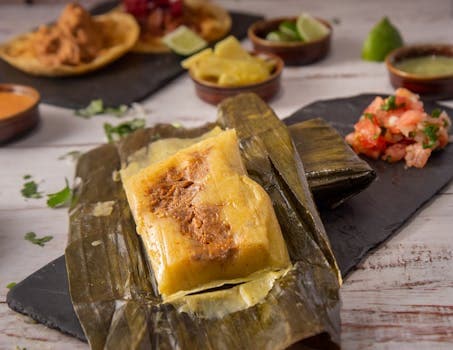
Traditional Pork Tamales
Masa-wrapped pork in red chile sauce, steamed in corn husks — the soul of Mexican holiday cooking.
About This Recipe
Tamales are one of the most ancient and sacred foods of Mesoamerica — masa dough spread on corn husks, filled with pork in red mole, folded and steamed until the masa transforms from sticky and soft to a tender, slightly springy parcel that peels away from the husk cleanly. They have been made across Mexico and Central America for at least 8,000 years, prepared for Aztec ceremonies, Spanish colonial feasts and every Christmas season (Navidad) in a tradition called 'tamalada' where families gather to make hundreds together. The tamalada is as much social ritual as cooking exercise — making tamales alone is punishingly slow, but with a dozen family members spreading masa, spooning filling, folding husks and stacking the steamer pot, the work becomes a celebration. The masa must be beaten until light and airy, tested by floating a small ball in cold water. The pork filling is a slow-braise in guajillo and ancho chile sauce that develops into a deeply savory, brick-red mixture. Getting the masa right is the most critical skill. Steaming tamales is a 90-minute wait during which the kitchen fills with an irresistible corn-and-pork aroma. When the husks peel back cleanly, revealing a perfectly formed, slightly glossy tamal, it is one of the most satisfying moments in all of Mexican cooking. Serve with Mexican crema, salsa roja and a cold Mexican beer.
Ingredients
Serves 24
- 30dried corn husks(soaked in hot water 1 hour)
- 4 cupsmasa harina (Maseca)
- 1 tspbaking powder
- 2 tspsalt
- 2⅔ cupswarm pork or chicken broth
- 1 cuplard or vegetable shortening(beaten until fluffy)
- 2 lbspork shoulder(cooked and shredded)
- 5guajillo chiles(toasted and soaked)
- 3ancho chiles(toasted and soaked)
- 4 clovesgarlic
- ½white onion
- 1 tspcumin
- 1 tspMexican oregano
- 2 cupspork cooking broth(for the chile sauce)
Instructions
- 1
Make the chile sauce
Blend rehydrated guajillo and ancho chiles with garlic, onion, cumin, oregano and 1 cup broth until smooth. Strain through a sieve. Fry in 1 tablespoon oil 3 minutes until darkened. Add pork broth and shredded pork. Simmer 15 minutes. Season.
- 2
Make the masa
Beat lard until very fluffy, about 5 minutes. Mix masa harina, baking powder and salt. Gradually add warm broth to masa mix, then beat into the lard until combined. Beat 10 minutes until light. Test: a small ball should float in cold water.
The float test is the traditional way to confirm the masa has enough air beaten in for a light texture.
- 3
Spread the masa
Lay a soaked corn husk flat, pointed end away from you. Spread ¼ cup masa across the lower two-thirds in a 4×5-inch rectangle, about ¼-inch thick. Leave a 1-inch border on the sides and a 2-inch border at the bottom.
- 4
Fill and fold
Spoon 2 tablespoons filling down the center. Fold one long side of the husk over to cover the filling, then fold the other side over. Fold up the pointed bottom flap.
Don't overfill — the masa expands during steaming.
- 5
Steam
Stand tamales upright, open ends up, in a steamer basket over boiling water. Steam 80–90 minutes, adding water as needed. Tamales are done when the masa pulls cleanly away from the husk.
Did you make this?
Rate it and help other cooks find the recipes that actually work.
One tap to sign in, and we'll save the rating you just picked.
Everything you need to plan your week — free
- Meal calendar
- Grocery list
- AI recipe ideas
Track what you eat
Snap your meal to log calories and macros, run fasting timers and track water in the free SnapCal app.
Pro Tips
- →
Corn husks must be soaked at least 1 hour until pliable — stiff husks tear when folding.
- →
Beat the lard until very fluffy (white and airy) — this is what makes the masa light rather than dense.
- →
Make tamales in batches with friends — the process is designed to be communal.
- →
Frozen tamales reheat perfectly in the microwave (still in the husk) for 2–3 minutes.
Variations
- •
Rajas con Queso Tamales: roasted poblano strips and Oaxacan cheese filling — vegetarian.
- •
Sweet Tamales: masa sweetened with sugar, cinnamon and raisins, colored pink with red food coloring.
- •
Oaxacan Black Bean Tamales: black bean paste with Oaxacan cheese wrapped in banana leaves.
Storage
Refrigerate up to 5 days. Freeze up to 6 months. Reheat in the husk: steam 15 minutes from cold, or microwave 2–3 minutes.
History & Origin
Tamales date back at least 8,000–10,000 years to Mesoamerica, making them among the oldest prepared foods still made in their original form. Aztec soldiers carried tamales as field rations. Spanish colonists documented them in the 16th century. The Christmas tamalada (tamale-making gathering) tradition solidified in Mexico in the 18th–19th centuries and remains the most important holiday food preparation in Mexican culture.
Frequently Asked Questions
Why are my tamales too dense?
The lard wasn't beaten enough (should be very fluffy), the masa was overmixed after combining, or too little liquid was used. The float test is your guide.
Can I use butter instead of lard?
Yes, but lard produces the most authentic, tender masa. Vegetable shortening is the most common substitute. Butter produces good results but a slightly different flavor.
How do I know when tamales are done?
After 80 minutes, remove one tamal, let it rest 5 minutes, then peel back the husk. If the masa comes away cleanly and is no longer sticky, they're done. If it sticks, steam 15 more minutes.
Nutrition Facts
Per serving (250g / 8.8 oz) · 24 servings total
Time Summary
Have Questions?
Ask our AI cooking assistant anything about this recipe — substitutions, techniques, scaling.
Chat with AI Chef →Featured in Guides
This recipe is featured in the following curated guides:
More Mexican Recipes
You Might Also Like
Similar dishes from other cuisines around the world.
Browse by Ingredient
More recipes built around the same core ingredients.
Free Kitchen Tools
Calculators and converters that pair with this page — no signup needed.
Put This Into a Plan
Schedule it, shop for it, and track what you already have.
Read Next
Longer reads that go deeper on the ideas behind this dish.
Community
Join the conversation
Sign in to leave a comment and save your favourite recipes