
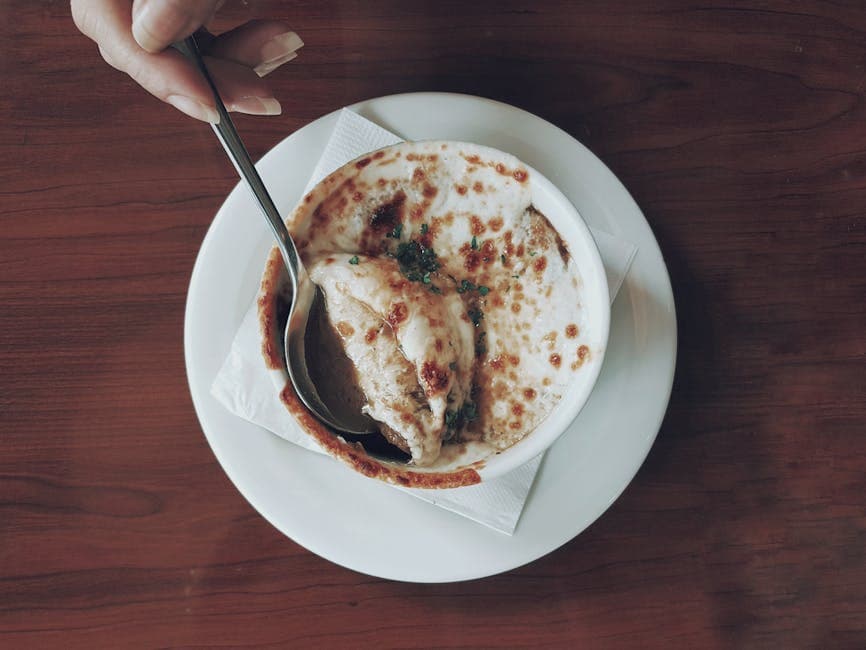
Soupe à l'Oignon Gratinée (französische Zwiebel-Suppe)
Paris' Nacht-Klassiker – tiefgoldene Zwiebeln in Rindfleisch-Brühe, gekrönt mit geröstetem Baguette und blubberndem Gruyère.
Über dieses Rezept
Soupe à l'Oignon ist die Suppe, die die Pariser Frühmorgenbistros definierte – das Gericht, das die Träger von Les Halles um 4 Uhr morgens aßen. Es ist eine einfache Suppe, die durch Geduld zur Größe wird: Zwiebeln, dünn geschnitten und in Butter 45 bis 75 Minuten gekocht, bis sie zu einer dunklen Karamell-Marmelade zusammenbrechen, dann mit trockener weißer Wein oder Cognac entglast und mit reicher Rindfleisch-Brühe aufgefüllt. Die Transformation im Ofen ist das Gericht's Unterschrift: jede Schüssel wird mit einem Baguette-Scheibe gekrönt und mit dickem Gruyère oder Comté-Käse, dann unter dem Grill, bis der Käse schmilzt und knusprig wird.
Zutaten
Dient 4
- 1.5 kggelbe Zwiebeln (ca. 6 große), geschält und in 4 mm dicke Scheiben geschnitten
- 60 gungesalzene Butter
- 2 ELextra natives Olivenöl
- 1 TLfeines Meersalz
- 1 TLKristallzucker
- 3 ZehenKnoblauch, gehackt
- 2 EL00 Mehl
- 200 mltrockener Weißwein (Sauvignon Blanc oder trockener Wermut)
- 2 ELCognac oder Brandy
- 1.5 Lreichhaltige Rinderbrühe (vorzugsweise hausgemacht)
- 2 Zweigefrischer Thymian
- 1Lorbeerblatt
- 1 ELWorcestershire-Sauce
- frisch gemahlener schwarzer Pfeffer
- 1Baguette (vorzugsweise eintags), in 1,5 cm dicke Scheiben schneiden
- 250 gGruyère oder Comté, frisch gerieben
Anleitung
- 1
Die Zwiebeln in Scheiben schneiden
Die Zwiebeln von der Wurzel bis zur Spitze halbieren, schälen und entlang der Faserrichtung in 4 mm dicke Scheiben schneiden (nicht quer – das Schneiden mit der Faserrichtung behält die Form bei langem Garen besser). Sie sollten etwa 1,2 kg geschnittene Zwiebeln haben.
Tragen Sie beim Schneiden eine Schutzbrille oder kauen Sie Kaugummi – beides reduziert tatsächlich das Brennen in den Augen.
- 2
Beginnen Sie mit der Karamellisierung
Die Butter mit dem Olivenöl in einem schweren 5-Liter-Topf bei mittlerer Hitze schmelzen. Zwiebeln, Salz und Zucker hinzufügen. Zum Überziehen umrühren. In den ersten 15 Minuten ohne Deckel unter Rühren alle 5 Minuten garen – die Zwiebeln geben Wasser ab und werden weich.
- 3
Lange, langsame Karamellisierung
Reduzieren Sie die Hitze auf mittel-niedrig. Weiter kochen, dabei alle 5–8 Minuten umrühren und den braunen Fond vom Boden des Topfes abkratzen, weitere 45–60 Minuten. Die Farben der Zwiebeln reichen von weiß → durchscheinend → strohgelb → golden → mahagonifarben. Beeilen Sie sich nicht.
Wenn der Topf zu sehr austrocknet, fügen Sie einen Esslöffel Wasser hinzu und kratzen Sie es aus – der Fond ist aromatisch.
- 4
Add aromatics
Wenn die Zwiebeln tief mahagonifarben und marmeladenartig sind (schmecken – sie sollten süß und fast gummiartig sein), den Knoblauch hinzufügen und 1 Minute kochen lassen. Streuen Sie das Mehl hinein und kochen Sie es weitere 2 Minuten unter ständigem Rühren, um den Geschmack des rohen Mehls herauszukochen.
- 5
Deglaze
Mit Weißwein und Cognac aufgießen. Kratzen Sie den Boden und die Seiten des Topfes ab. 3 Minuten lang kräftig kochen lassen, bis der Alkoholgeruch weicher wird und sich die Flüssigkeit auf die Hälfte reduziert.
- 6
Build the soup
Rinderbrühe, Thymian, Lorbeerblatt und Worcestershire dazugeben. Lassen Sie es gleichmäßig köcheln und lassen Sie es 30 Minuten lang ohne Deckel kochen, damit die Brühe einkochen und sich intensivieren kann. Schmecken Sie nach Salz – die Qualität der Brühe variiert, also passen Sie sich an. Geben Sie großzügig schwarzen Pfeffer hinzu.
- 7
Toast the bread
Während die Suppe köchelt, Baguettescheiben auf ein Blech legen und unter einem heißen Grill 90 Sekunden pro Seite rösten, bis sie goldbraun und knusprig sind. Reiben Sie jede Scheibe nach Belieben mit einer halben Knoblauchzehe ein.
- 8
Gratinée
Schöpfen Sie die Suppe in 4 ofenfeste Zwiebelsuppenschüsseln (traditionell sind Keramikschüsseln mit Löwenköpfen). Legen Sie 1–2 geröstete Brotscheiben darauf – sie sollten die Oberfläche bedecken. Über jede Schüssel 50–60 g geriebenen Käse häufen und leicht über den Rand hängen lassen.
- 9
Broil
Stellen Sie die Schüsseln auf ein Blech und grillen Sie sie 8–10 cm vom Heizelement entfernt, bis der Käse Blasen bildet, stellenweise gebräunt ist und am Rand knusprig wird – etwa 4 Minuten. Beobachten Sie genau; Der Käse verwandelt sich in Sekundenschnelle von perfekt zu verbrannt.
- 10
Serve hot
Tragen Sie die Schüsseln auf Tellern zum Tisch – sie brennen. Jeder Gast bricht mit einem Löffel die Käsekruste auf, um an die darunter liegende Suppe zu gelangen. Ein Glas trockener Weißwein und nichts anderes ist die richtige Mahlzeit.
Haben Sie das gekocht?
Bewerte es und hilf anderen, die Rezepte zu finden, die wirklich funktionieren.
Einmal anmelden, und wir speichern die Bewertung, die Sie gerade gewählt haben.
Alles, was Sie für Ihre Wochenplanung brauchen — kostenlos
- Essensplaner
- Einkaufsliste
- KI-Rezeptideen
Behalten Sie im Blick, was Sie essen
Fotografieren Sie Ihre Mahlzeit, um Kalorien und Makros zu erfassen, nutzen Sie Fasten-Timer und tracken Sie Ihr Wasser – in der kostenlosen SnapCal-App.
Profi-Tipps
- →
Machen Sie das Karamellisieren von Zwiebeln nicht zu kurz – „karamellisierte Zwiebeln“ aus Rezeptblogs, die in weniger als 30 Minuten zubereitet werden, sind nicht dasselbe Gericht. Eine echte Suppe à l'oignon benötigt mindestens 60 Minuten geduldiges Rühren.
- →
Die Qualität der Rinderbrühe ist alles. Verwenden Sie hausgemachte oder hochwertige Knochenbrühe (Aneto, Bonafide). Brühwürfel ergeben eine dünne, salzige, flache Suppe – machen Sie sich keine Mühe.
- →
Comté ist für französische Zwiebelsuppe authentischer als Gruyère, aber Gruyère aus dem Supermarkt eignet sich gut. Vermeiden Sie „Schweizer Käse“ aus dem Feinkostladen – er schmilzt nicht auf die gleiche Weise.
- →
Eintägiges Baguette hält besser als frisches – frisches Brot löst sich in der Suppe auf. Wenn Sie es frisch verwenden, rösten Sie es etwas dunkler.
Variationen
- •
Soupe à l'oignon gratinée à la Lyonnaise – fügt ein Eigelb und einen Schuss Portwein hinzu und rührt sie in jede Schüssel, bevor sie mit Brot und Käse belegt wird. Dekadent.
- •
Vegetarisch – verwenden Sie eine reichhaltige Pilz- oder Gemüsebrühe und verdoppeln Sie die Menge an Worcestershire (oder verwenden Sie eine vegane Version). Lass das Rindfleisch weg.
- •
Fügen Sie bei Schritt 5 anstelle von Cognac einen Schluck trockenen Sherry oder Madeira hinzu, um einen tieferen, nussigeren Geschmack zu erhalten.
- •
Zwiebeln im Schnellkochtopf – 10 Minuten anbraten, dann 25 Minuten auf höchster Stufe unter Druck kochen; Beendet die Karamellisierung in kürzerer Zeit mit ähnlichen Ergebnissen.
Lagerung
Die Suppenbasis (vor Brot und Käse) bis zu 5 Tage im Kühlschrank lagern; friert 3 Monate ein. Toasten Sie Brot immer erst kurz vor dem Servieren und fügen Sie Käse hinzu – Suppe mit Brot hält sich nicht, sie wird matschig.
Geschichte und Herkunft
Soupe à l'oignon war jahrhundertelang ein französisches Bauerngericht, das aus billigen Zwiebeln und altbackenem Brot zubereitet wurde. Im 19. Jahrhundert wurde es auf dem zentralen Großmarkt Les Halles zu einer Pariser Ikone erhoben, wo es von Trägern und Metzgern nach der Nachtschicht verspeist wurde. Die mit Käse überbackene Variante ist in Auguste Escoffiers „Le Guide Culinaire“ (1903) dokumentiert.
Häufig gestellte Fragen
Warum brennen meine Zwiebeln, anstatt zu karamellisieren?
Die Hitze ist zu hoch. Nach den ersten 15 Minuten auf mittel-niedrig absinken. Karamellisierung ist eine langsame Maillard-Reaktion, kein Anbraten – Geduld ist die wichtigste Zutat.
Kann ich Gemüsebrühe verwenden, um es vegetarisch zu machen?
Ja – verwenden Sie eine reichhaltige, dunkle Pilz-Gemüse-Brühe (oder eine vegane Brühe nach „Rindfleischart“ von einer Marke wie Better Than Bouillon). Die Tiefe passt nicht ganz zu Rindfleisch, aber die Suppe bleibt ausgezeichnet.
Welche Schüssel eignet sich am besten?
Traditionelle französische Zwiebelsuppe wird in Keramikschalen mit „Löwenkopf“ (ca. 350 ml) und Henkeln serviert – sie vertragen den Grill. Jede ofenfeste Auflaufform aus Keramik funktioniert. Vermeiden Sie dünne Glasschüsseln; sie knacken.
Kann ich das ohne Alkohol machen?
Ja – ersetzen Sie Wein und Cognac bei Schritt 5 durch eine 1:1-Mischung aus Apfelessig und Wasser, plus einem zusätzlichen Schuss Worcestershire für mehr Tiefe. Der Charakter ändert sich leicht, aber die Suppe ist immer noch gut.
Nährwertangaben
Pro Portion (480g) · 4 Portionen insgesamt
Zeitzusammenfassung
Haben Sie Fragen?
Fragen Sie unseren KI-Kochassistenten zu diesem Rezept – Ersetzungen, Techniken, Skalierung.
Chatten Sie mit AI Chef →In Reiseführern vorgestellt
Dieses Rezept ist in den folgenden kuratierten Leitfäden enthalten:
Weitere Französische Rezepte
Ratatouille Provençal (langsam gekochter Sommergemüseeintopf)
90 Min. · Einfach
Cassoulet Toulousain (Toulouse-Art Cassoulet)
330 Min. · Schwer
Bouillabaisse Marseillaise (Marseille Fischeintopf)
150 Min. · Schwer
Croque Madame (Französischer Toast mit Schinken, Käse & Béchamel und Spiegelei)
35 Min. · Mittel
Das könnte Ihnen auch gefallen
Ähnliche Gerichte aus anderen Küchen der Welt.
Nach Zutat stöbern
Weitere Rezepte rund um dieselben Hauptzutaten.
Kostenlose Küchen-Tools
Rechner und Umrechner, die zu dieser Seite passen — ohne Anmeldung.
Rezept-Umrechner
Halbieren oder verdoppeln Sie jede Menge in diesem Rezept – ganz ohne Kopfrechnen.
Maßeinheiten-Umrechner
Rechnen Sie Cups, Gramm, Unzen und Milliliter in beide Richtungen um.
Heißluftfritteusen-Umrechner
Rechnen Sie Backofenzeit und -temperatur in Einstellungen für die Heißluftfritteuse um.
Daraus einen Plan machen
Einplanen, einkaufen und im Blick behalten, was schon da ist.
Weiterlesen
Ausführliche Artikel zu den Ideen hinter diesem Gericht.
Französische Küche: Eine komplette Bistro-Klassik, Muttersaucen und die Techniken, die jeder Koch kennen sollte
14 Min.
Ballaststoffe: Der am meisten unterschätzte Nährstoff und wie man mehr davon bekommt
10 Min.
Flexitarische Diät für Anfänger: Eine vollständige, überwiegend pflanzliche Ernährung mit Platz für Fleisch
11 Min.
Gemeinschaft
Beteiligen Sie sich an der Unterhaltung
Melden Sie sich an, um einen Kommentar zu hinterlassen und Ihre Lieblingsrezepte zu speichern