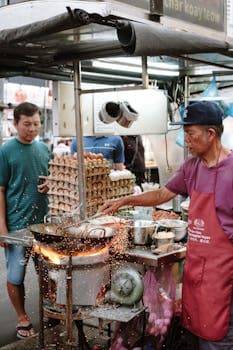
Malaysian wok-fried flat rice noodles with prawns, Chinese sausage, bean sprouts and soy — street food perfection.
Char kway teow (stir-fried flat noodles) is one of Malaysia's most beloved street foods — flat rice noodles (kway teow) stir-fried at ferocious heat in a screaming-hot wok with prawns, Chinese lap cheong sausage, egg, bean sprouts, chives, and a dark, smoky soy sauce mixture. The hallmark of great char kway teow is wok hei — the 'breath of the wok' — a smoky, slightly charred character that can only be achieved at extremely high temperatures. It is a dish of Penang, where the Teochew hawkers who created it still run generational stalls.
Sirve 2
Mix together dark soy, light soy, oyster sauce, fish sauce and sugar. Set aside.
Heat wok over the highest possible flame until smoking. Add lard or oil.
Add garlic and sausage slices. Fry 30 seconds until fragrant.
Add prawns. Fry 1 minute until beginning to turn pink.
Add noodles and pour sauce over. Toss aggressively, pressing noodles against the wok surface to get some char. 1–2 minutes.
Push noodles to one side. Crack eggs into the cleared space. Scramble briefly, then fold into noodles. Add bean sprouts and chives. Toss 30 seconds. Serve immediately.
High heat is everything — a domestic burner limits wok hei. Open the windows and cook on the highest flame possible.
Cook only 1–2 portions at a time — adding too much to the wok drops the temperature and kills the char.
Lard gives authentic flavour and higher smoke point than vegetable oil — use it if you have it.
Prueba y ajusta la sal al final — los sabores se concentran cuando los líquidos se reducen.
The traditional Penang version adds cockles (blood cockles/kerang) — available at Asian fish markets.
Omit sausage and use tofu puffs instead for a vegetarian version.
Vegetariano: cambia la proteína por champiñones de ostra rey asados, tofu ahumado o garbanzos cocidos.
Más picante: agrega un chile fresco finamente picado o una cucharadita de pimienta de Alepo/Urfa molida.
Cannot be stored — char kway teow must be eaten immediately from the wok.
Char kway teow was created by Teochew and Hokkien Chinese immigrants in Penang in the 19th century as a cheap, filling street food for labourers and fishermen. The use of lard, pork sausage, and cockles reflected the Chinese cooking tradition transplanted to Malaya. Today, Penang's legendary hawker stalls still serve it from the same family recipes for up to a century.
Wok hei ('breath of the wok') is the smoky, caramelised character from very high-temperature cooking in a well-seasoned wok. At home: use a carbon steel wok, preheat until smoking, cook small portions, and work quickly. The results won't match a gas-fired hawker stall but will be significantly better than cooking at lower heat.
Sí — la mayoría de los componentes se pueden preparar hasta un día de anticipación. Recalienta suavemente y monta justo antes de servir.
Mantente cerca del rol de cada ingrediente: cambia los aromáticos por similares, y mantén intacto el equilibrio.
La autenticidad está en un espectro — lo que importa más es honrar la técnica y el equilibrio de sabores.
Por porción · 2 porciones totales
Pregúntele a nuestro asistente de cocina con IA cualquier cosa sobre esta receta: sustituciones, técnicas, escalado.
Chatea con AI Chef →Únete a la conversación
Inicia sesión para dejar un comentario y guardar tus recetas favoritas
¿Tienes comentarios o necesitas ayuda?
Leemos todos los correos y respondemos en 1–2 días hábiles.
© 2026 MyCookingCalendar. Todos los derechos reservados.