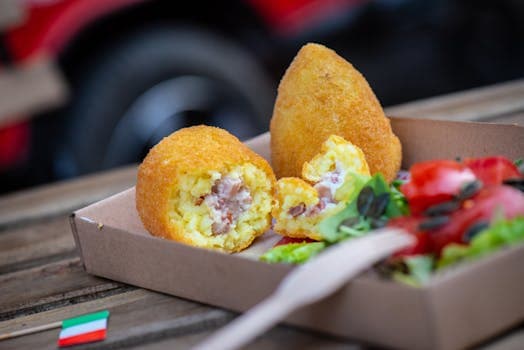
Sicily's iconic golden fried rice balls stuffed with ragù, peas and melting mozzarella — crispy outside, rich and gooey inside.
Arancini (singular: arancino or arancina, a subject of fierce debate in Sicily) are one of the island's greatest contributions to world street food. A ball of cooked saffron-tinted risotto rice is stuffed with a ragù filling of minced beef, peas and tomato, wrapped around a cube of mozzarella, then breaded and deep-fried until deeply golden. The result is spectacular: a crispy, golden crust giving way to savoury rice, rich ragù and a molten cheese centre. In Palermo they are called arancina and are cone-shaped; in Catania they are arancino and round. They are sold at every Sicilian bar from breakfast onwards. Arancini are also the perfect solution for leftover risotto.
Serves 6
Cook Arborio rice in salted water with saffron (steep saffron in 2 tbsp warm water first) until just tender. Drain, stir in Parmesan and beaten egg. Spread on a tray to cool completely.
Sauté onion in olive oil until soft. Add beef mince, brown well, then add tomatoes and peas. Season and simmer for 20 minutes until thick. Cool completely.
Wet your hands. Take a handful of rice (about 80 g) and flatten in your palm. Place a spoonful of ragù and a cube of mozzarella in the centre. Close your hand around the filling and press firmly into a ball or cone shape.
Roll each ball in flour, dip in beaten egg, then coat generously in breadcrumbs. Press the breadcrumbs on firmly.
Heat oil to 175°C (347°F). Fry arancini in batches for 4–5 minutes, turning, until evenly deep golden. Drain on kitchen paper.
Serve hot — the mozzarella inside should still be melting.
The rice and filling must be completely cold before shaping — warm rice falls apart.
Double-breading (flour → egg → breadcrumbs → egg → breadcrumbs) gives a thicker, crunchier crust.
Leftover risotto alla Milanese makes an excellent base for arancini.
Taste and adjust salt at the very end — flavors concentrate as liquids reduce, and a final pinch of flaky salt sharpens the whole dish.
Arancini al burro: filled with béchamel and ham instead of ragù.
Vegetarian arancini: fill with spinach and ricotta or mushroom ragù.
Spicier: add a finely chopped fresh chile or a teaspoon of crushed Aleppo/Urfa pepper to the aromatics for warm, layered heat instead of a single sharp hit.
Lighter: reduce the fat by a third and finish with a squeeze of citrus or a splash of vinegar to keep brightness without losing body.
Shaped, unbaked arancini freeze well. Fry from frozen, adding 2 minutes to the cooking time.
Arancini trace their origins to Arab rule in Sicily (9th–11th centuries), when saffron rice was a staple. The breading and frying technique was added later. They became the canonical Sicilian street food and are now found across Italy and the world.
Yes — brush with olive oil and bake at 200°C (390°F) for 20–25 minutes. The crust won't be as golden and crunchy but is a reasonable alternative.
The rice was too warm when shaping, or the filling was too wet. Cool everything thoroughly and drain the ragù well.
Yes — most of the components can be prepared up to a day in advance and refrigerated separately. Reheat gently and assemble just before serving so textures stay distinct.
Stay close to the role each ingredient plays: swap aromatics for similar ones (shallot for onion, lime for lemon), and keep the fat-acid-salt balance intact. Spice blends can usually be approximated with what's in the cupboard.
Per serving · 6 servings total
Ask our AI cooking assistant anything about this recipe — substitutions, techniques, scaling.
Chat with AI Chef →Join the conversation
Sign in to leave a comment and save your favourite recipes