
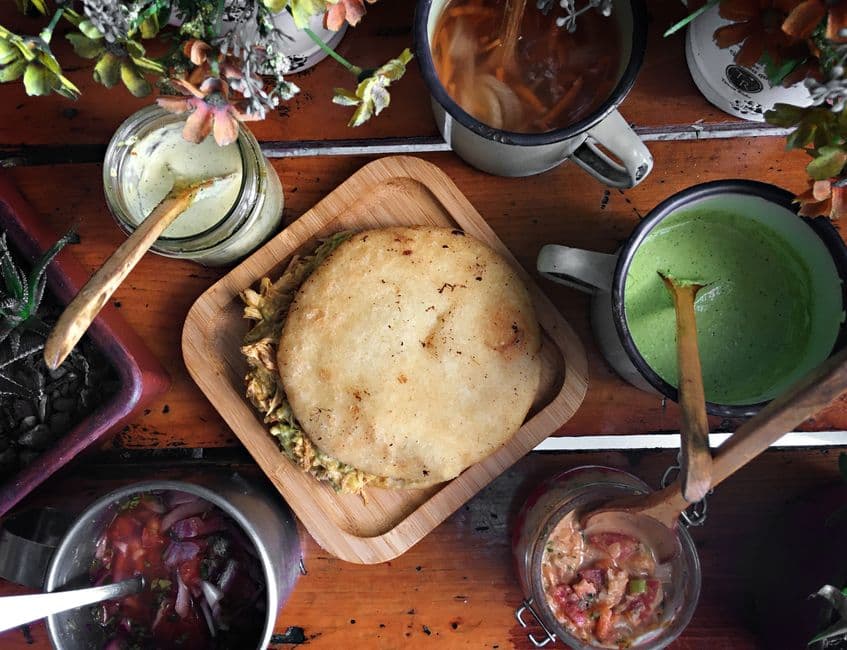
Venezuelan Arepas
Thick, golden cornmeal cakes, griddled and then split open and filled — Venezuela's daily bread, eaten at every meal and endlessly versatile.
About This Recipe
The arepa is Venezuela's most fundamental food: a thick, round patty of masarepa (pre-cooked white cornmeal) that is griddled or baked until golden outside and fluffy within, then split and stuffed with any number of fillings. Eaten morning, noon and night, the arepa is as essential to Venezuelan identity as bread is to France or rice to Japan. The most famous filling is reina pepiada — a creamy avocado and chicken salad named after a beauty queen — but arepas can be filled with black beans, fried plantain, cheese, shredded beef, or all of the above simultaneously. Making arepas requires just three ingredients: masarepa, water and salt, yet the result in the right hands is deeply satisfying.
Ingredients
Serves 4
- 400 gmasarepa (pre-cooked white cornmeal)(such as P.A.N. brand)
- 500 mlwarm water
- 1 teaspoonsalt
- 2 tablespoonsvegetable oil(for cooking)
- 2ripe avocados
- 200 gcooked chicken breast(shredded)
- 3 tablespoonsmayonnaise
- 1lime(juice only)
- 1 teaspoonsalt(for filling)
Instructions
- 1
Make arepa dough
Mix masarepa, warm water and salt in a bowl. Stir, then knead with your hands for 2 minutes until a smooth, pliable dough forms. Rest for 5 minutes. It should not crack when you shape it.
If the dough is too dry and cracks, add water one tablespoon at a time. It should feel like soft modelling clay.
- 2
Shape
Divide dough into 8 equal pieces. Roll each into a ball, then flatten between your palms into a disc about 1.5cm thick and 10cm diameter.
- 3
Cook
Brush a non-stick pan or griddle with oil and heat over medium heat. Cook arepas for 5–7 minutes per side until golden and a crust forms. Finish in a 180°C oven for 10 minutes until they sound hollow when tapped. Split open while hot.
- 4
Make reina pepiada filling
Mash avocado with mayonnaise, lime juice and salt. Fold in shredded chicken. Stuff generously into warm split arepas.
Did you make this?
Rate it and help other cooks find the recipes that actually work.
One tap to sign in, and we'll save the rating you just picked.
Everything you need to plan your week — free
- Meal calendar
- Grocery list
- AI recipe ideas
Track what you eat
Snap your meal to log calories and macros, run fasting timers and track water in the free SnapCal app.
Pro Tips
- →
Masarepa (P.A.N. brand) is available in Latin American stores and online — do not substitute with polenta or regular cornmeal.
- →
The oven step is not optional — it ensures the interior cooks through and becomes fluffy.
- →
Arepas freeze well unbaked — shape and freeze, then cook from frozen adding 5 minutes to cooking time.
- →
Taste and adjust salt at the very end — flavors concentrate as liquids reduce, and a final pinch of flaky salt sharpens the whole dish.
Variations
- •
Reina pepiada (avocado chicken) is the classic filling.
- •
Pabellón arepa: black beans, shredded beef, plantain and white cheese.
- •
Domino: black beans and white cheese.
- •
Vegetarian: swap the protein for roasted king oyster mushrooms, smoked tofu or cooked chickpeas — adjust seasoning slightly upward to compensate.
Storage
Cooked arepas keep at room temperature for 1 day or refrigerated for 3 days. Reheat in a hot pan or oven.
History & Origin
The arepa has been eaten in Venezuela and Colombia for thousands of years, predating European colonisation. Archaeological evidence suggests indigenous peoples of the region made cornmeal cakes as far back as 3000 years ago. The arepa is so fundamental to Venezuelan identity that when Venezuela's economy deteriorated in the 2010s, the 'arepa index' — tracking the availability and price of masarepa — became an informal measure of the crisis.
Frequently Asked Questions
What is masarepa and where do I find it?
Masarepa is pre-cooked, dehydrated white cornmeal — different from polenta or masa harina. The most common brand is P.A.N. (Harina PAN). Find it in Latin American supermarkets or online. It is not interchangeable with other corn products.
Can I make this ahead of time?
Yes — most of the components can be prepared up to a day in advance and refrigerated separately. Reheat gently and assemble just before serving so textures stay distinct.
What can I substitute if I don't have all the ingredients?
Stay close to the role each ingredient plays: swap aromatics for similar ones (shallot for onion, lime for lemon), and keep the fat-acid-salt balance intact. Spice blends can usually be approximated with what's in the cupboard.
How do I know it's authentic?
Authenticity sits on a spectrum — what matters more is honoring the technique and balance of flavors. If the dish tastes harmonious and respects how cooks in its home region would build it, you're on solid ground.
Nutrition Facts
Per serving (280g / 9.9 oz) · 4 servings total
Time Summary
Have Questions?
Ask our AI cooking assistant anything about this recipe — substitutions, techniques, scaling.
Chat with AI Chef →More Venezuelan Recipes
You Might Also Like
Similar dishes from other cuisines around the world.
Browse by Ingredient
More recipes built around the same core ingredients.
Free Kitchen Tools
Calculators and converters that pair with this page — no signup needed.
Put This Into a Plan
Schedule it, shop for it, and track what you already have.
Read Next
Longer reads that go deeper on the ideas behind this dish.
Community
Join the conversation
Sign in to leave a comment and save your favourite recipes