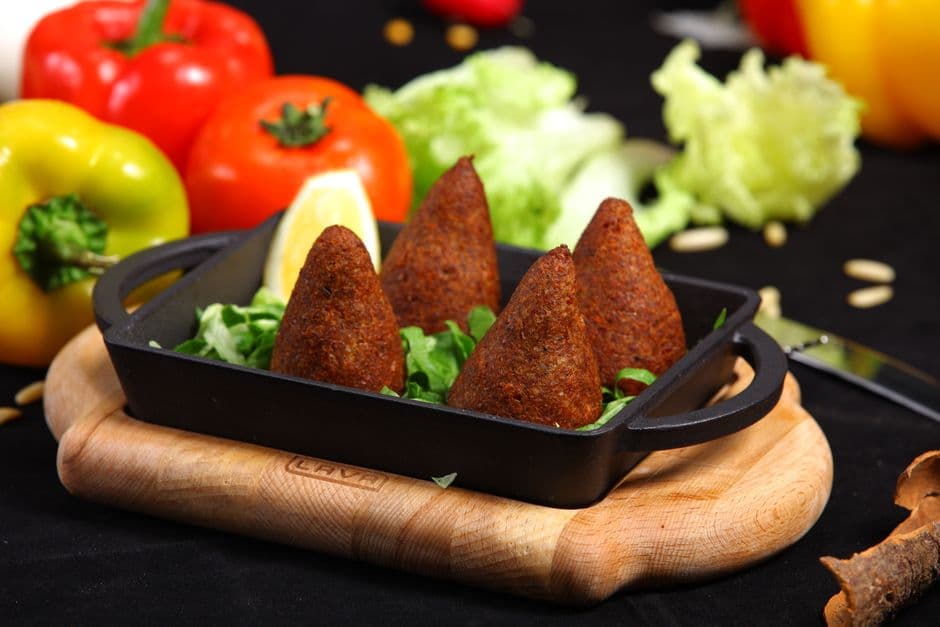
Kibbeh
Lebanon's iconic dish of spiced lamb and bulgur wheat baked into a fragrant crust around a pine nut and onion filling — a centrepiece of the mezze table.
About This Recipe
Kibbeh (كبة) is considered the national dish of Lebanon, Syria and several neighbouring countries. In its baked form (kibbeh bil saniyeh), fine bulgur wheat is mixed with minced lamb and aromatic spices to form a shell that encases a richer filling of coarser lamb, toasted pine nuts, caramelised onions and warming spices. It is cut into diamond shapes and baked until the top is golden and fragrant, the interior moist and aromatic. Kibbeh appears in dozens of forms across Lebanese cooking — raw (kibbeh nayyeh), fried (kibbeh mqaliyeh), in yoghurt broth (kibbeh labaniyeh) — but baked kibbeh is the most accessible and the version most often found at the heart of a Lebanese family meal.
Ingredients
Serves 4
- 300 gfine bulgur wheat (no. 1 grade)(soaked 20 minutes in cold water, drained)
- 350 glean minced lamb(very cold, for the shell)
- 1 smallonion(quartered, for the shell)
- 1 teaspoonground allspice(divided)
- 0.5 teaspoonground cinnamon(divided)
- 0.25 teaspoonground black pepper
- 0.25 teaspoonground cumin
- 0.5 teaspoonfine salt(for shell)
- 2 tablespoonsolive oil(for the shell mixture)
- 2 largeonions(thinly sliced, for the filling)
- 250 gminced lamb(coarser grind, for the filling)
- 50 gpine nuts(toasted)
- 3 tablespoonsolive oil(for cooking the filling)
- 0.5 teaspoonfine salt(for the filling)
- 2 tablespoonsunsalted butter(for drizzling)
Instructions
- 1
Make the filling
Heat 3 tablespoons of olive oil in a wide pan. Add the sliced onions and cook over medium heat, stirring occasionally, for 15 minutes until golden and caramelised. Add the coarser minced lamb and cook, breaking up, until browned. Season with half the allspice, half the cinnamon, salt and pepper. Stir in the toasted pine nuts. Set aside to cool.
Caramelising the onions properly — until sweet and golden — is crucial to the filling's flavour.
- 2
Make the kibbeh shell
Squeeze all excess water from the soaked bulgur. In a food processor, blend the quartered onion until finely minced. Add the cold minced lamb (for the shell), remaining allspice, cinnamon, cumin, salt and olive oil. Process until a smooth, paste-like mixture forms. Combine with the drained bulgur and knead together with wet hands for 5 minutes until the mixture is smooth, cohesive and slightly sticky. Refrigerate for 15 minutes.
- 3
Assemble the kibbeh
Grease a 30x20cm baking dish. Divide the shell mixture in half. Wet your hands and press the first half evenly across the bottom of the dish in an even layer about 1cm thick. Spread the filling evenly over the base layer. Press the remaining shell mixture evenly over the top. Smooth the surface with wet hands.
- 4
Score and bake
Using a sharp knife, score the top into diamond or square shapes — cutting all the way through to the base. Place a thin slice of butter or a drizzle of olive oil in each cut and over the surface. Bake at 190°C (375°F) for 35–40 minutes until the top is deep golden brown.
- 5
Rest and serve
Rest for 10 minutes before cutting along the scored lines. Serve with plain yoghurt, a green salad and flatbread. A sprinkle of fresh mint over the top is traditional.
Pro Tips
- →
Keep the lamb very cold for the shell — warm meat produces a sticky, difficult-to-work mixture.
- →
Wet your hands constantly while pressing the kibbeh layers — this prevents sticking.
- →
Score generously before baking — the cuts allow heat to penetrate and fat to baste the interior.
Variations
- •
Fried kibbeh balls: shape the shell mixture into footballs with filling inside and deep-fry until golden.
- •
Vegetarian kibbeh: use a shell of bulgur mixed with mashed potato, filled with sautéed mushrooms, spinach and pine nuts.
- •
Add a pinch of dried rose petals or cinnamon-scented sumac to the filling for a more complex spice profile.
Storage
Refrigerate for up to 3 days. Reheat in the oven at 160°C (320°F) for 15 minutes or microwave. Baked kibbeh also freezes well — freeze in portions and reheat from frozen at 180°C for 20–25 minutes.
History & Origin
Kibbeh is documented in medieval Arabic cookbooks and is believed to originate in ancient Mesopotamia. The name derives from the Arabic 'kubbah' (ball). Kibbeh is a defining dish across Lebanon, Syria, Palestine and Jordan, and significant diaspora communities have brought kibbeh traditions to Brazil, Mexico and Argentina.
Frequently Asked Questions
What grade of bulgur do I need for kibbeh?
Fine bulgur wheat (grade no. 1) is essential for the shell — coarser grades will not bind properly. The filling traditionally uses a medium grind (grade 2), but you can use the same fine bulgur throughout if that is what you have.
Can I use beef instead of lamb for kibbeh?
Yes — beef (ideally with 20% fat content) produces a slightly different flavour but works well. A mixture of beef and lamb is common in some regional traditions. Avoid very lean mince, which makes the shell dry and crumbly.
Why is my kibbeh shell crumbly and falling apart?
Crumbly kibbeh usually results from insufficient kneading, too much bulgur relative to meat, or the bulgur not being squeezed dry enough. Knead the mixture for a full 5 minutes until it is smooth and slightly tacky.
Nutrition Facts
Per serving (380g / 13.4 oz) · 4 servings total
Time Summary
Have Questions?
Ask our AI cooking assistant anything about this recipe — substitutions, techniques, scaling.
Chat with AI Chef →More Lebanese Recipes
Community
Join the conversation
Sign in to leave a comment and save your favourite recipes