
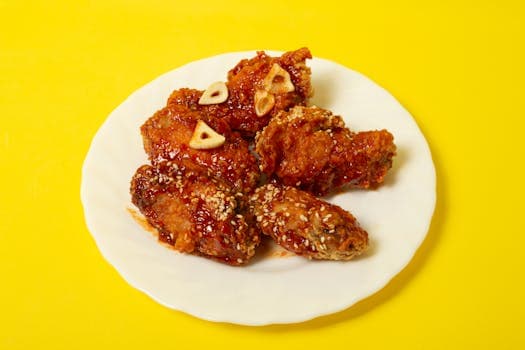
Korean Fried Chicken Wings — Hooni Kim-Inspired
Double-fried chicken wings with a sticky-sweet gochujang glaze — Korea's contribution to global comfort food, restaurant-quality at home.
⭐Inspired by Hooni Kim · 🇰🇷 South KoreaAbout This Recipe
This recipe is inspired by Chef Hooni Kim's Michelin-starred work at Danji in New York — the first Korean restaurant in the world to receive a Michelin star. Korean fried chicken (KFC) is an art: skin so thin and crisp it shatters, meat astonishingly juicy, glaze that coats without sogging the crust. The secret is the double fry — a low-temperature first fry to cook the meat, followed by a high-temperature second fry to crisp the skin to glass. This is our take on the modern Korean tradition Kim helped globalise from a fine-dining stage.
Ingredients
Serves 4
- 1 kgchicken wings(split into drums and flats, tips removed)
- 1 tbspfine sea salt
- 1 tspfreshly cracked black pepper
- 100 gpotato starch(or cornstarch)
- 30 gplain flour
- 120 mlice-cold sparkling water
- neutral oil for deep-frying(about 1.5L)
- 3 tbspgochujang (Korean chili paste)
- 2 tbspsoy sauce
- 3 tbsphoney
- 2 tbsprice vinegar
- 1 tbsptoasted sesame oil
- 4 clovesgarlic(minced)
- 1 tbspfresh ginger(grated)
- 2 tbsptoasted sesame seeds
- 3spring onions(finely sliced)
Instructions
- 1
Dry-brine the wings
Pat the wings completely dry. Toss with the salt and pepper. Spread on a wire rack and refrigerate uncovered for at least 1 hour, ideally 4–8 hours. This dries the skin — essential for crispness.
Skipping this step is the #1 reason home Korean fried chicken comes out soggy.
- 2
Make the glaze
In a small saucepan, simmer the gochujang, soy sauce, honey, rice vinegar, sesame oil, garlic and ginger for 4 minutes until glossy and slightly thickened. Set aside.
- 3
Make the batter
Whisk the potato starch and flour together. Just before frying, whisk in the ice-cold sparkling water — the batter should be runny like single cream. The bubbles in the sparkling water create extra crispness.
Make the batter at the last possible moment — flat batter doesn't crisp the same way.
- 4
First fry — 160°C
Heat the oil to 160°C / 320°F. Dip each wing in the batter, let excess drip off, and lower into the oil. Fry in batches for 8 minutes until pale golden and cooked through. Drain on a wire rack.
- 5
Second fry — 190°C
Increase the oil temperature to 190°C / 375°F. Return the wings in batches and fry for 4 more minutes until deeply golden, blistered and audibly crackly. Drain on a fresh rack.
The double-fry is the soul of Korean fried chicken — the first cooks, the second crisps.
- 6
Glaze and serve
While still hot, toss the wings in the gochujang glaze until well coated. Pile onto a warm platter. Scatter with toasted sesame seeds and spring onions. Serve immediately with cold beer (banchan if you have it). Eat with fingers.
Did you make this?
Rate it and help other cooks find the recipes that actually work.
One tap to sign in, and we'll save the rating you just picked.
Everything you need to plan your week — free
- Meal calendar
- Grocery list
- AI recipe ideas
Cook this hands-free
Get AI meal plans, step-by-step cooking mode, and your saved recipes in the free Bento app.
Pro Tips
- →
Dry-brine 4+ hours uncovered — this is the secret to glass-shattering skin.
- →
Potato starch >> cornstarch for crispness. Both work; potato is better.
- →
Don't overcrowd the fryer — drops the oil temperature and steams the chicken.
Variations
- •
Soy-Garlic Glaze (Yangnyeom mild): replace the gochujang with 4 tbsp soy sauce + 4 cloves garlic — the milder, sweet version.
- •
Half-and-Half: half the wings sweet-spicy gochujang, half soy-garlic — Korean restaurant tradition.
Storage
Best eaten immediately. Reheating cooked KFC never matches fresh.
History & Origin
Korean fried chicken emerged in the 1960s with the introduction of large-scale chicken farming and American-style fryers. The double-fry technique is uniquely Korean. The dish exploded globally in the 2000s through Korean-American restaurants. Hooni Kim's Danji was the first Korean restaurant anywhere to earn a Michelin star, in 2011.
Frequently Asked Questions
Why double-fry?
The double-fry is the secret of Korean fried chicken. The first low-temperature fry (160°C) cooks the meat through. The second high-temperature fry (190°C) blisters the skin to a glass-thin, audibly crispy texture impossible with a single fry. This technique is uniquely Korean.
What is gochujang?
Gochujang is the fundamental Korean fermented chili paste — sweet, savoury, deeply funky and moderately hot. Made from gochugaru (Korean chili powder), fermented soybeans, glutinous rice and salt, aged for months. Sold in plastic tubs at Korean and Asian groceries; cannot be substituted by Sriracha or other chili pastes.
Why was Danji historically significant?
When Danji received its Michelin star in 2011, it became the first Korean restaurant anywhere in the world to earn one. This recognition opened the door for the global rise of Korean fine dining over the following decade — restaurants in Seoul, Tokyo, Paris and London have since followed.
What is the difference between Korean and American fried chicken?
Korean fried chicken (KFC) is double-fried for an audibly thin, glass-shattering skin; American fried chicken is single-fried for a thicker, breaded crust. Korean versions are typically tossed in a sauce after frying; American versions are seasoned in the dredge. The textures are entirely different products.
Can I bake instead of fry?
Baking produces a similar flavour but never the same texture. The double-fry is what creates Korean fried chicken's signature crust; baking can't replicate it. If frying is impossible, an air fryer comes closest — high-temp, hot circulating air, light oil coating.
Nutrition Facts
Per serving (340g / 12.0 oz) · 4 servings total
Time Summary
Have Questions?
Ask our AI cooking assistant anything about this recipe — substitutions, techniques, scaling.
Chat with AI Chef →Featured in Guides
This recipe is featured in the following curated guides:
More Korean Recipes
You Might Also Like
Similar dishes from other cuisines around the world.
Browse by Ingredient
More recipes built around the same core ingredients.
Free Kitchen Tools
Calculators and converters that pair with this page — no signup needed.
Put This Into a Plan
Schedule it, shop for it, and track what you already have.
Read Next
Longer reads that go deeper on the ideas behind this dish.
Community
Join the conversation
Sign in to leave a comment and save your favourite recipes