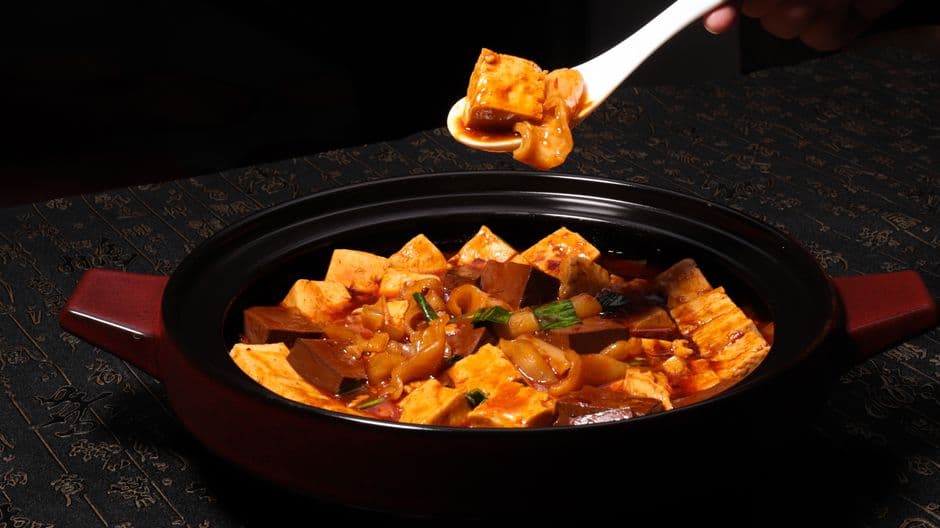
Silken tofu simmered in a fiery, numbing sauce of fermented black beans, doubanjiang and ground pork — Sichuan's most iconic and beloved dish.
Mapo Tofu (麻婆豆腐) is the soul of Sichuan cooking distilled into a single bowl. The name translates roughly to 'pockmarked old woman's tofu', honouring the legendary Chen family restaurant in Chengdu that made the dish famous in the nineteenth century. Its defining characteristic is the interplay of two sensations Sichuanese call 'mala' — 'ma' is the numbing, tingling buzz from Sichuan peppercorns, while 'la' is the searingly bright heat of doubanjiang chilli bean paste and dried chillies. Silken tofu absorbs this complex, brick-red sauce, and a small amount of minced pork provides savoury depth without dominating. The dish is finished with a slick of chilli oil and a scattering of chopped scallions, and served over steamed white rice.
Serves 4
Bring a pot of salted water to a gentle simmer. Carefully slide in the tofu cubes and blanch for 2 minutes to firm them slightly and season them. Drain carefully and set aside. This step prevents the tofu from breaking apart during stir-frying.
Use silken or soft tofu for the most authentic texture — firm tofu will not absorb the sauce in the same way.
Heat the vegetable oil in a wok over high heat until smoking. Add the minced pork and stir-fry, breaking it up, until no longer pink and lightly golden, about 3 minutes. Push to the side, reduce heat to medium and add the doubanjiang. Fry the paste, stirring constantly, for 1–2 minutes until it darkens and the oil turns a deep red.
Add the garlic, ginger and fermented black beans to the wok and stir-fry for 30 seconds until fragrant. Pour in the chicken stock, soy sauce and sugar. Stir to combine and bring to a simmer.
Gently slide the blanched tofu into the sauce. Stir very carefully using a spatula, swirling the wok rather than stirring aggressively, to coat the tofu without breaking it. Simmer for 3–4 minutes to allow the tofu to absorb the sauce.
Give the cornstarch slurry a stir and pour it in around the edges of the wok in two additions, stirring gently between each, until the sauce reaches a glossy, coating consistency. Drizzle in the chilli oil.
Transfer to a serving bowl, dust generously with the ground Sichuan peppercorn and scatter the spring onions over the top. Serve immediately over steamed jasmine rice.
Toast Sichuan peppercorns in a dry pan before grinding — the aroma intensifies dramatically.
Doubanjiang quality varies widely; Pixian doubanjiang from Sichuan is the gold standard.
Blanching the tofu first is a professional technique that prevents it from falling apart.
Taste and adjust salt at the very end — flavors concentrate as liquids reduce, and a final pinch of flaky salt sharpens the whole dish.
Make it fully vegetarian by omitting the pork and using vegetable stock and a tablespoon of extra fermented black beans.
Add a tablespoon of sesame paste to the sauce for extra richness.
Vegetarian: swap the protein for roasted king oyster mushrooms, smoked tofu or cooked chickpeas — adjust seasoning slightly upward to compensate.
Spicier: add a finely chopped fresh chile or a teaspoon of crushed Aleppo/Urfa pepper to the aromatics for warm, layered heat instead of a single sharp hit.
Store leftovers in an airtight container in the fridge for up to 2 days. Reheat gently — the tofu will soften further but remain delicious.
Mapo Tofu was created in the 1860s at the Chen Mapo Tofu restaurant in Chengdu, Sichuan province, by the wife of its founder. The restaurant still exists today in the Jinniu district of Chengdu and is considered a national culinary landmark.
Firm tofu will hold its shape better but won't have the same melt-in-the-mouth quality. Silken or soft tofu is traditional and preferred.
Most Asian supermarkets stock it. Look for Pixian brand for the most authentic flavour. It keeps for months in the fridge once opened.
Yes — most of the components can be prepared up to a day in advance and refrigerated separately. Reheat gently and assemble just before serving so textures stay distinct.
Stay close to the role each ingredient plays: swap aromatics for similar ones (shallot for onion, lime for lemon), and keep the fat-acid-salt balance intact. Spice blends can usually be approximated with what's in the cupboard.
Per serving (350g / 12.3 oz) · 4 servings total
Ask our AI cooking assistant anything about this recipe — substitutions, techniques, scaling.
Chat with AI Chef →Join the conversation
Sign in to leave a comment and save your favourite recipes