
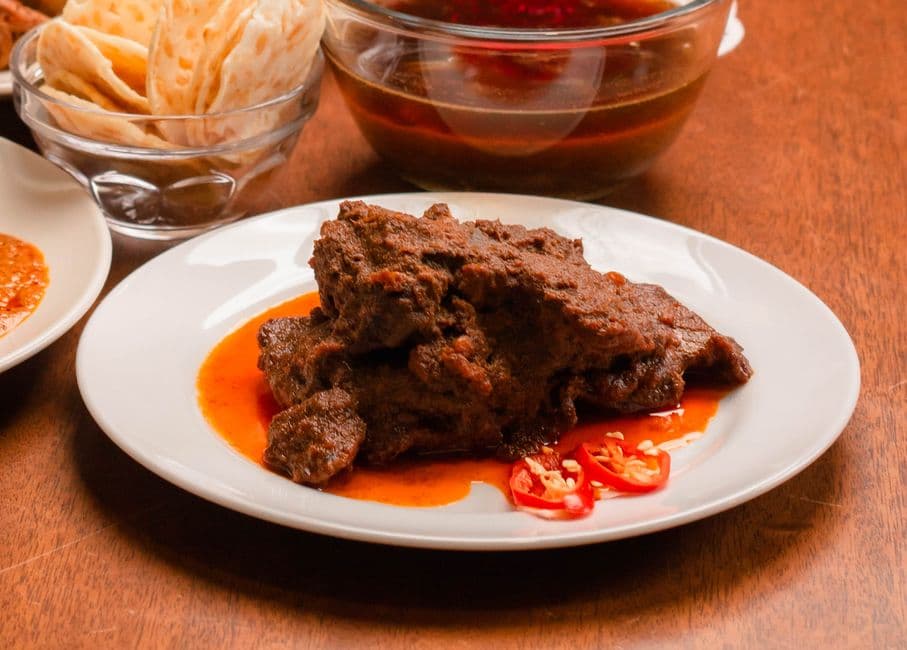
Rindfleisch-Rendang
Indonesiens legendärer trocken-gebratener Rindfleisch — langsam gekocht in würziger Kokosmilch, bis die Sauce völlig karamellisiert zu dunkelbraunem, intensiv würzigem Überzug.
Über dieses Rezept
Rendang ist einer der komplexesten und arbeitsintensivsten Gerichte in der Welt-Kulinarik, stammt vom Minangkabau-Volk West-Sumatras, Indonesien. Im Gegensatz zu vielen Braisierungen wird Rendang gekocht, bis jede Flüssigkeit evaporiert und das Kokosfett das Rindfleisch in der restlichen Würz-Paste brät — ein Prozess namens Kalio, und schlussendlich Rendang, wenn vollständig trocken.
Zutaten
Dient 6
- 1 kgRindfleisch Chuck oder kurze Rippe(in 5-cm-Würfel)
- 400 mlvolle Fett-Kokosmilch
- 50 gZitronengras(weiße Teile)
- 3 StängelKafir-Limonen-Blätter(bruised)
- 5Galangal
- 2Kurkuma-Blatt(oder 1 Teelöffel gemahlener Kurkuma)
- 2 EsslöffelTamarinden-Paste
- 1 EsslöffelPalmen-Zucker
- 8Salz(in heißem Wasser eingeweicht)
- 6Schalotten(roughly chopped)
- 4 ZehenKnoblauch
- 3 cmgetrocknete rote Chilis(sliced)
- 2 cmfrische rote Chilis(sliced)
- 1 Teelöffelfrischer Ingwer
Anleitung
- 1
Würz-Paste machen
Schalotten, Knoblauch, Chilis, Ingwer, Kurkuma, Koriander und Kreuzkümmel mischen bis glatte Paste.
- 2
Alle Bestandteile kombinieren
Rindfleisch, Würz-Paste, Kokosmilch, Zitronengras, Galangal, Limettenblätter, Tamarinden, Zucker und Salz in Topf kombinieren.
Beeilen Sie sich beim Rösten nicht – die Kokosnuss sollte eine tiefe Mahagonifarbe haben, damit sich der Geschmack voll entfalten kann.
- 3
Köcheln und reduzieren — Stadium 1
Zum Kochen bringen über mittlerer bis hoher Hitze, ständig umrühren. Auf mittler Hitze reduzieren, 1 Stunde köcheln lassen, bis Kokosmilch halbiert.
- 4
Weiterkochen zu Kalio — Stadium 2
Hitze auf mittel-niedrig reduzieren, weitere 1–1.5 Stunden kochen, bis Flüssigkeit absorbiert und Fett trennt.
- 5
Beenden und servieren
Rindfleisch-Rendang ist fertig, wenn Öl dunkelbraun ist. Mit Reis und Gurkenscheiben servieren.
- 6
Kerisik hinzufügen und karamellisieren
Wenn die Soße zu einer dicken Soße geworden ist, die das Rindfleisch gerade noch bedeckt, fügen Sie den Kerisik hinzu. Weiter kochen, dabei häufiger umrühren, da die restliche Feuchtigkeit verdunstet und die Gewürze und die Kokosnuss rund um das Rindfleisch karamellisieren. Diese letzte Phase dauert 20–40 Minuten und erfordert Aufmerksamkeit, um Verbrennungen zu vermeiden. Der Rendang ist fertig, wenn das Rindfleisch sehr dunkel, fast trocken und von einer intensiv aromatischen Gewürzkruste überzogen ist.
- 7
Rest and serve
Zitronengras und Limettenblätter entfernen. Mit gedämpftem weißem Reis oder Ketupat (komprimierten Reiskuchen) und Sambal als Beilage servieren.
Haben Sie das gekocht?
Bewerte es und hilf anderen, die Rezepte zu finden, die wirklich funktionieren.
Einmal anmelden, und wir speichern die Bewertung, die Sie gerade gewählt haben.
Alles, was Sie für Ihre Wochenplanung brauchen — kostenlos
- Essensplaner
- Einkaufsliste
- KI-Rezeptideen
Behalten Sie im Blick, was Sie essen
Fotografieren Sie Ihre Mahlzeit, um Kalorien und Makros zu erfassen, nutzen Sie Fasten-Timer und tracken Sie Ihr Wasser – in der kostenlosen SnapCal-App.
Profi-Tipps
- →
Verwenden Sie beste Kokosmilch, die Sie finden können.
- →
All-Paste ist Qualitäts-Wichtigkeit.
- →
Rendang verbessert sich nach einem Tag.
- →
Gefrorener Rendang ist von einigen bevorzugt.
Variationen
- •
Huhn-Rendang
- •
Gemüse-Rendang
- •
Blatt-Keramik-Rendang
- •
Würziger: frische Chili hinzufügen
Lagerung
Gekühlt 4–5 Tage oder bis zu 2 Monate eingefroren.
Geschichte und Herkunft
Stammt vom Minangkabau-Volk West-Sumatras. Entwickelt als Konservierungs-Weg. Einer von Indonesiens am meisten berühmten Gerichte weltweit.
Häufig gestellte Fragen
Was ist Galangal?
Eine Wurzel ähnlich Ingwer mit würzig Geschmack. Finden Sie es in asiatischen Märkten.
Kann ich meine eigene Kokosmilch verwenden?
Ja, aber kommerzielle volle Fett-Kokosmilch ist ausgezeichnet.
Warum ist mein Rendang immer noch dünn?
Es braucht nicht genug gekocht zu sein. Fahren Sie Kochen auf mittler-niedriger Hitze fort, ständig umrühren.
Kann ich das voraus machen?
Ja — Rendang wird tatsächlich besser die nächsten Tage.
Nährwertangaben
Pro Portion (300g) · 6 Portionen insgesamt
Zeitzusammenfassung
Haben Sie Fragen?
Fragen Sie unseren KI-Kochassistenten zu diesem Rezept – Ersetzungen, Techniken, Skalierung.
Chatten Sie mit AI Chef →In Reiseführern vorgestellt
Dieses Rezept ist in den folgenden kuratierten Leitfäden enthalten:
Weitere Indonesische Rezepte
Das könnte Ihnen auch gefallen
Ähnliche Gerichte aus anderen Küchen der Welt.
Nach Zutat stöbern
Weitere Rezepte rund um dieselben Hauptzutaten.
Kostenlose Küchen-Tools
Rechner und Umrechner, die zu dieser Seite passen — ohne Anmeldung.
Daraus einen Plan machen
Einplanen, einkaufen und im Blick behalten, was schon da ist.
Weiterlesen
Ausführliche Artikel zu den Ideen hinter diesem Gericht.
Gemeinschaft
Beteiligen Sie sich an der Unterhaltung
Melden Sie sich an, um einen Kommentar zu hinterlassen und Ihre Lieblingsrezepte zu speichern