
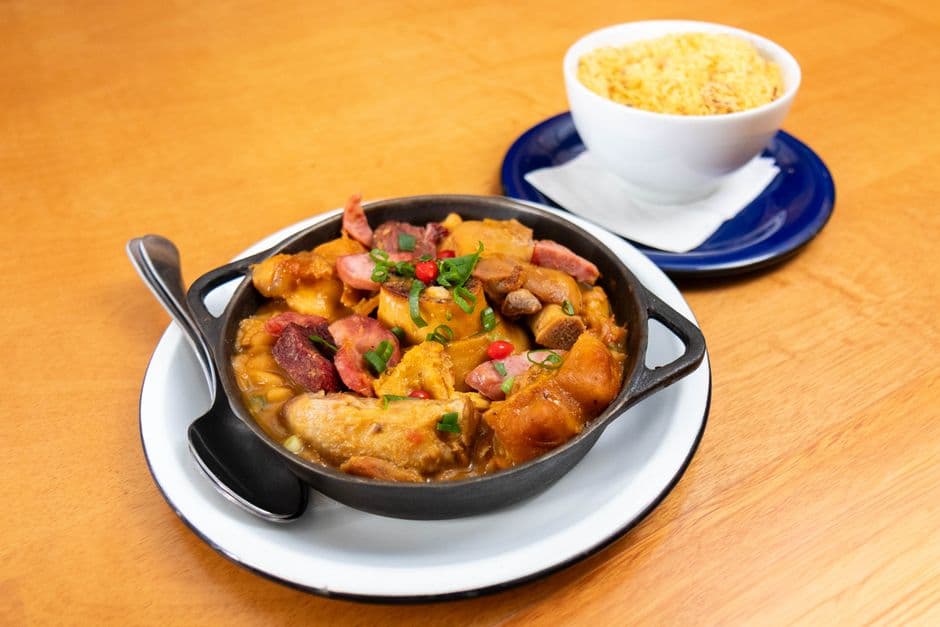
Feijoada — Guiso Brasileño de Frijoles Negros
El plato nacional de Brasil: un contundente guiso ahumado de frijoles negros cargado de costillas de cerdo, salchicha y carnes curadas, servido con arroz blanco, farofa y rodajas de naranja.
Acerca de esta receta
La feijoada es el alma de la cocina brasileña, un plato que cruza todas las líneas de clase y raza y que reúne a las familias cada sábado para la tradicional feijoada completa. Nacida de la mezcla de las tradiciones portuguesas de carne curada con el conocimiento culinario africano, la feijoada usaba originalmente partes desechadas del cerdo que las personas esclavizadas recibían en las plantaciones. A lo largo de los siglos evolucionó hasta convertirse en un celebrado tesoro nacional, ahora elaborada con cortes premium junto con los tradicionales. La combinación de carnes ahumadas, frijoles negros terrosos y la acidez brillante de la naranja es uno de los matrimonios de sabores perfectos de la gastronomía.
Ingredientes
Sirve 4
- 400 gfrijoles negros secos(remojados toda la noche)
- 300 gcostillas de cerdo(cortadas en costillas individuales)
- 200 gsalchicha linguiça ahumada o chorizo(en rodajas)
- 150 gpanceta de cerdo curada o pancetta(en cubos)
- 150 gcodillo de cerdo ahumado o paletilla de cerdo curada
- 1 grandecebolla(picada finamente)
- 4 dientesajo(picado)
- 2 enterohojas de laurel
- 1 cdtacomino
- 2 cdaaceite de oliva
- 1 cdtasal
- 2 medianonaranjas(en rodajas, para servir)
- 300 garroz blanco(cocido, para servir)
- 100 gfarofa (harina de yuca tostada)(para servir)
- 200 gberza (couve)(en juliana fina, salteada, para servir)
Instrucciones
- 1
Remojar y preparar los frijoles
Remoja los frijoles negros en agua fría toda la noche (al menos 8 horas). Escurre y enjuaga. Esto reduce el tiempo de cocción y elimina compuestos que causan molestias digestivas. Cubre los frijoles con agua fresca en una olla grande y lleva a ebullición, retirando la espuma, luego reduce a fuego lento.
- 2
Dorar las carnes
En una olla grande y pesada u olla holandesa, calienta aceite de oliva a fuego medio-alto. Dora las costillas de cerdo por todos los lados hasta que estén profundamente caramelizadas, unos 8 minutos. Retira y reserva. Dora brevemente la panceta de cerdo curada y el codillo. Añade la salchicha y séllala hasta que tome un ligero color.
Este paso de dorado a menudo se omite en las recetas rápidas pero añade una enorme profundidad de sabor al guiso final.
- 3
Construir la base
En la misma olla, reduce el fuego a medio. Cocina la cebolla hasta que ablande, unos 5 minutos. Añade el ajo y el comino y cocina 1 minuto más. Devuelve todas las carnes a la olla. Añade los frijoles escurridos, las hojas de laurel y suficiente agua para cubrir unos 5 cm.
- 4
Brasear lentamente
Lleva a ebullición, luego reduce el fuego al mínimo. Cuece parcialmente tapado durante 2 a 2,5 horas hasta que los frijoles estén completamente tiernos y el caldo se haya espesado en un guiso rico y oscuro. Revuelve de vez en cuando y añade agua caliente si el guiso se seca demasiado. Prueba y ajusta la sal.
La feijoada está lista cuando algunos frijoles se desintegran al presionarlos: este almidón natural espesa maravillosamente el caldo.
- 5
Servir el despliegue completo
Retira los huesos grandes si lo deseas y desmenuza los trozos de carne más grandes en el guiso. Sirve en boles hondos junto con arroz blanco, farofa, berza salteada y rodajas de naranja fresca. La naranja no es solo un adorno: corta la riqueza del guiso y ayuda a la digestión.
¿Has preparado esta receta?
Valórala y ayuda a otros a encontrar las recetas que de verdad funcionan.
Inicia sesión con un toque y guardaremos la valoración que acabas de elegir.
Todo lo que necesitas para planificar tu semana — gratis
- Calendario de comidas
- Lista de compras
- Ideas de recetas con IA
Controla lo que comes
Fotografía tu comida para registrar calorías y macros, usa temporizadores de ayuno y controla tu agua en la app gratuita SnapCal.
Consejos profesionales
- →
Remojar los frijoles toda la noche es esencial: los frijoles sin remojar pueden tardar más de 4 horas y la textura se ve afectada.
- →
Añade una cáscara de naranja entera a la olla durante la cocción para un brillo extra y para reducir los compuestos que causan gases.
- →
La farofa es harina de yuca tostada cocida con mantequilla y cebolla: la textura a frutos secos y crujiente es esencial para la experiencia.
- →
La feijoada es tradicionalmente un plato de sábado y mejora enormemente preparada un día antes.
Variaciones
- •
Feijoada vegetariana: Reemplaza todas las carnes con pimentón ahumado, alga kombu (para el umami) y champiñones extra.
- •
Feijoada en olla a presión: Usa una olla a presión para reducir el tiempo de cocción de los frijoles a 40 minutos a alta presión.
- •
Feijoada carioca: El estilo de Río de Janeiro usa más carnes secas (carne seca) para un sabor más salado e intenso.
- •
Más picante: añade un chile fresco picado finamente o una cucharadita de pimiento Alepo/Urfa machacado a los aromáticos para un picor cálido y en capas en lugar de un golpe único y agudo.
Almacenamiento
Refrigera hasta 5 días: la feijoada mejora cada día a medida que los sabores se funden. Congela en porciones hasta 3 meses. Recalienta suavemente con un chorrito de agua a fuego bajo, revolviendo con frecuencia para evitar que el espeso guiso se pegue.
Historia y origen
Los orígenes de la feijoada son disputados pero apasionadamente debatidos en Brasil. La narrativa popular sostiene que fue creada por africanos esclavizados en las plantaciones coloniales de azúcar usando restos de cerdo desechados y frijoles negros cultivados localmente. Los historiadores gastronómicos señalan que los inmigrantes portugueses también trajeron una tradición de guisos de frijoles y cerdo (existen platos similares en Portugal y Cabo Verde). Cualquiera que sea su origen preciso, la feijoada se convirtió en el plato nacional de Brasil hacia el siglo XIX, un símbolo culinario unificador que trasciende región y clase.
Preguntas frecuentes
¿Puedo usar frijoles negros enlatados para ahorrar tiempo?
Sí, y reduce drásticamente el tiempo de cocción a unos 45 minutos. Usa tres latas de 400 g de frijoles negros, escurridos y enjuagados. El compromiso es un caldo ligeramente más fino y menos profundidad de sabor, ya que los frijoles secos liberan almidones que espesan naturalmente el guiso. Para compensar, machaca un cuarto de taza de los frijoles cocidos contra la pared de la olla e incorpóralos de nuevo.
¿Por qué se sirven rodajas de naranja con la feijoada?
Las rodajas de naranja cumplen un propósito práctico y culinario. La acidez y la vitamina C de las naranjas ayudan a la absorción del hierro de los frijoles negros, una tradición nutricional que precede a la comprensión moderna de la biodisponibilidad del hierro. En cuanto al sabor, los cítricos brillantes cortan la intensa riqueza del guiso de cerdo y frijoles, limpiando el paladar entre bocados. Es una parte esencial de la experiencia completa de la feijoada completa.
¿Qué es la farofa y puedo hacerla en casa?
La farofa es harina de yuca (mandioca) tostada cocida con mantequilla, ajo y cebolla hasta dorar y quedar con sabor a frutos secos. Para hacerla: derrite 2 cucharadas de mantequilla en una sartén, cocina media cebolla picada y 2 dientes de ajo hasta dorar, luego añade 200 g de harina de yuca y revuelve constantemente a fuego medio durante 5–7 minutos hasta que esté tostada uniformemente. Sazona con sal. Añade un crucial contraste crujiente y sabroso a los frijoles y la carne blandos.
¿Puedo prepararla con antelación?
Sí: la mayoría de los componentes se pueden preparar hasta un día antes y refrigerar por separado. Recalienta suavemente y monta justo antes de servir para que las texturas se mantengan distintas.
Datos nutricionales
Por porción (520g) · 4 porciones totales
Resumen de tiempo
¿Tiene preguntas?
Pregúntele a nuestro asistente de cocina con IA cualquier cosa sobre esta receta: sustituciones, técnicas, escalado.
Chatea con AI Chef →Destacado en Guías
Esta receta aparece en las siguientes guías seleccionadas:
Más recetas de cocina brasileña
También Te Puede Gustar
Platos similares de otras cocinas del mundo.
Explorar por Ingrediente
Más recetas construidas alrededor de los mismos ingredientes principales.
Herramientas de Cocina Gratuitas
Calculadoras y conversores que acompañan a esta página — sin registro.
Calculadora para escalar recetas
Reduce a la mitad o duplica cada cantidad de esta receta sin hacer cuentas mentales.
Conversor de medidas
Convierte tazas, gramos, onzas y mililitros en ambos sentidos.
Conversor para freidora de aire
Convierte el tiempo y la temperatura del horno a ajustes de freidora de aire.
Conviértelo en un Plan
Prográmalo, haz la compra y controla lo que ya tienes.
Calendario de planificación de comidas
Coloca esta receta en un día y organiza la semana a su alrededor.
App de lista de la compra
Convierte esta lista de ingredientes en una lista de la compra agrupada por pasillo.
Importador de recetas
Guarda esta receta —y cualquier URL de receta— en una biblioteca ordenada.
Sigue Leyendo
Lecturas más largas que profundizan en las ideas detrás de este plato.
Clásicos de la comida de pub británico: Plowman's completo, rollos de salchicha y huevos escoceses
11 mín.
Clásicos de la comida de pub británico: pastel y puré completo, Ploughman's, rollos de salchicha y más
13 mín.
La conexión intestino-cerebro: una descripción completa de cómo el gluten afecta su concentración
13 mín.
Comunidad
Únete a la conversación
Inicia sesión para dejar un comentario y guardar tus recetas favoritas