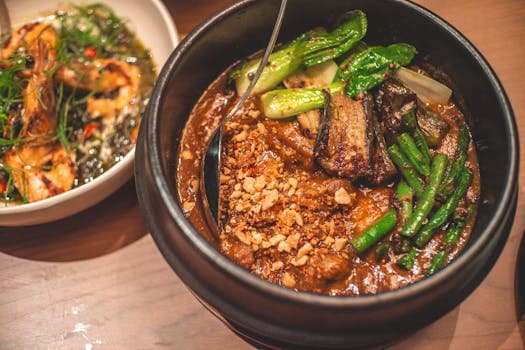
A rich Filipino oxtail and peanut sauce stew — slow-braised until meltingly tender in a thick, golden peanut and annatto sauce, served with bagoong shrimp paste on the side.
Kare-kare is one of the Philippines' most festive and labor-intensive dishes, typically reserved for special occasions, fiestas, and family celebrations. The combination of slow-braised oxtail (or tripe, or both) in a thick peanut sauce seems simple but requires careful balance — too thin and it's watery, too thick and it's pasty. The annatto seeds give the sauce its characteristic golden-orange color. The most distinctive element of kare-kare service is the obligatory bagoong — fermented shrimp paste — served on the side, which provides the salty, pungent contrast that makes the rich, mild peanut stew sing.
Serves 6
Simmer oxtail in salted water for 2–2.5 hours until very tender. Reserve 1.5 litres of broth.
Fry onion and garlic. Add strained annatto water (discard seeds). Add peanut butter and 1 litre of oxtail broth. Whisk until smooth.
Add toasted rice powder and simmer 10 minutes until the sauce coats the back of a spoon.
Add oxtail pieces, banana blossom, and string beans. Simmer 10 minutes. Add bok choy and cook 2 minutes.
Serve with steamed rice and bagoong on the side for each person to add to taste.
The bagoong is not optional — the contrast between the mild peanut sauce and pungent bagoong is the point of the dish
Toasted rice powder thickens more gently than flour
Taste and adjust salt at the very end — flavors concentrate as liquids reduce, and a final pinch of flaky salt sharpens the whole dish.
Mise en place pays for itself: chop, measure and pre-mix everything before the heat goes on, especially for any step that moves fast.
Use tripe instead of oxtail for a more traditional version
Add pork shank alongside the oxtail
Vegetarian: swap the protein for roasted king oyster mushrooms, smoked tofu or cooked chickpeas — adjust seasoning slightly upward to compensate.
Spicier: add a finely chopped fresh chile or a teaspoon of crushed Aleppo/Urfa pepper to the aromatics for warm, layered heat instead of a single sharp hit.
Keeps 3 days refrigerated. Reheat gently, adding a splash of water as the sauce thickens.
Kare-kare is believed to have originated in Pampanga, the culinary capital of the Philippines, and was historically a royal dish of the Kapampangan people. Its exact origins are debated, with some linking it to Indian curry via Sepoy soldiers.
Miso paste or a small amount of shrimp paste (belacan) can substitute, but the flavor will be different. Bagoong is truly essential to kare-kare.
Yes — most of the components can be prepared up to a day in advance and refrigerated separately. Reheat gently and assemble just before serving so textures stay distinct.
Stay close to the role each ingredient plays: swap aromatics for similar ones (shallot for onion, lime for lemon), and keep the fat-acid-salt balance intact. Spice blends can usually be approximated with what's in the cupboard.
Authenticity sits on a spectrum — what matters more is honoring the technique and balance of flavors. If the dish tastes harmonious and respects how cooks in its home region would build it, you're on solid ground.
Per serving · 6 servings total
Ask our AI cooking assistant anything about this recipe — substitutions, techniques, scaling.
Chat with AI Chef →Join the conversation
Sign in to leave a comment and save your favourite recipes