
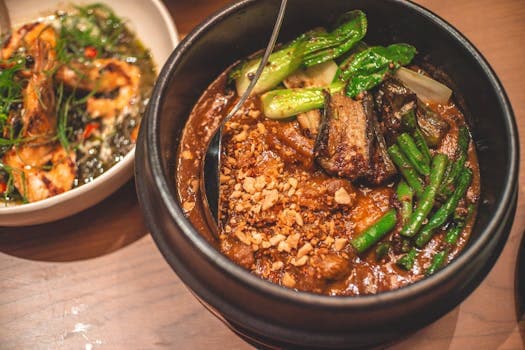
Modern Pinoy Adobo — Margarita Forés-Inspired
Pork belly braised in vinegar, soy, garlic and bay leaves until lacquered and meltingly tender — the Philippines' national dish, refined.
⭐Inspired by Margarita Forés · 🇵🇭 PhilippinesAbout This Recipe
This recipe is inspired by Chef Margarita Forés — Asia's Best Female Chef 2016 — and her championship of modern Filipino cuisine on the global stage. Adobo is the Philippines' national dish: meat braised in vinegar, soy, garlic and bay leaves, with countless regional variations. Forés has long argued that adobo, properly made, deserves the same fine-dining attention given to ramen or pho. This recipe takes the home tradition and elevates it through patience and technique — slow-braised pork belly until the sauce reduces to a glossy, lacquer-like glaze.
Ingredients
Serves 6
- 1.2 kgpork belly(skin on, cut into 5cm cubes)
- 120 mlFilipino white vinegar (sukang puti)(or rice vinegar)
- 120 mlsoy sauce
- 10 clovesgarlic(smashed and peeled)
- 5bay leaves
- 2 tspblack peppercorns(lightly crushed)
- 2Thai bird chilies(optional, slit)
- 2 tbspbrown sugar
- 300 mlwater
- 2 tbspneutral oil
- 2spring onions(thinly sliced, to serve)
- steamed jasmine rice(to serve)
Instructions
- 1
Marinate
Combine pork, vinegar, soy sauce, garlic, bay leaves, peppercorns and chilies in a heavy pot. Massage and rest 30 minutes — at least. Don't skip; the marinade is the foundation.
- 2
Boil first — never stir vinegar
Place the pot uncovered on the stove. Bring to a boil WITHOUT STIRRING — Filipino tradition holds that stirring vinegar before it boils makes it taste raw. Boil hard for 2 minutes, then reduce to a gentle simmer.
The 'don't stir' rule is genuine technique, not superstition. Boiling cooks off the raw vinegar harshness.
- 3
Braise low and slow
Add the water and brown sugar. Cover loosely and simmer over low heat for 60-75 minutes, turning the pork once or twice, until the meat is fork-tender.
- 4
Reduce to lacquer
Uncover and continue cooking 15-20 minutes until the sauce reduces to about 200ml of glossy, almost syrupy liquid. The pork should look lacquered.
- 5
Crisp the pork (optional but recommended)
Lift the pork onto a plate. In a separate skillet, heat the neutral oil very hot. Sear the pork pieces skin-side down for 90 seconds until the surfaces are deeply browned and slightly crispy. Return to the sauce and toss to glaze.
- 6
Serve adobo-style
Pile onto a warm platter. Spoon the lacquered sauce over the top. Scatter with spring onions. Serve with a heaped bowl of steamed jasmine rice — adobo without rice is incomplete.
Did you make this?
Rate it and help other cooks find the recipes that actually work.
One tap to sign in, and we'll save the rating you just picked.
Everything you need to plan your week — free
- Meal calendar
- Grocery list
- AI recipe ideas
Cook this hands-free
Get AI meal plans, step-by-step cooking mode, and your saved recipes in the free Bento app.
Pro Tips
- →
Don't stir during the first boil — this is genuine Filipino kitchen wisdom.
- →
Pork belly with skin on is essential for the final crisp.
- →
Adobo always tastes better the next day — make ahead if you can.
Variations
- •
Chicken Adobo: substitute bone-in chicken thighs; reduce simmer to 30 minutes.
- •
Adobong Puti (White Adobo): omit the soy sauce — just vinegar, garlic, bay, peppercorns. The earlier, pre-Spanish version.
- •
Adobo sa Gata: stir in 200ml coconut milk in the last 10 minutes — Bicolano regional variation.
Storage
Improves with age — refrigerate 5 days, freezes 3 months.
History & Origin
Adobo predates Spanish colonisation of the Philippines — indigenous Filipinos were preserving meat in vinegar long before the Spanish gave it a name (from Spanish 'adobar,' to marinate). Today there are dozens of regional variants. Margarita Forés, named Asia's Best Female Chef in 2016, has been a leading voice in elevating Filipino cuisine to global fine-dining attention.
Frequently Asked Questions
Why don't you stir vinegar adobo?
Filipino kitchen tradition holds that stirring before the vinegar has fully boiled out leaves the dish tasting raw and harsh. Boiling hard for 2 minutes uncovered cooks off the volatile acidity, after which you can stir freely. This is genuine technique, not superstition.
What kind of vinegar should I use?
Filipino sukang puti (white cane vinegar) is traditional and ideal — slightly sweet and not overly harsh. Rice vinegar is the closest substitute. Don't use distilled white vinegar, which is too aggressive.
Why was Margarita Forés named Asia's Best Female Chef?
The 50 Best Restaurants Asia named her Best Female Chef in 2016, recognising her four decades of work building modern Filipino cuisine — through Cibo, Grace Park and Lusso, and through extensive international ambassadorship for Filipino food. She has been one of the central figures in the global 'modern Filipino' movement.
Why is adobo the Philippines' national dish?
Adobo predates Spanish colonisation — indigenous Filipinos preserved meat in vinegar long before the Spanish arrived. Today there are dozens of regional variants. Its combination of vinegar, soy, garlic and bay leaves is uniquely Filipino, and the dish is eaten in some form across all 7,000+ islands of the archipelago.
Why don't you stir vinegar adobo before it boils?
Filipino kitchen tradition holds that stirring before the vinegar has fully boiled out leaves the dish tasting raw and harsh. Boiling hard for 2 minutes uncovered cooks off the volatile acidity, after which you can stir freely. This is genuine technique, not superstition — try it both ways and the difference is noticeable.
Nutrition Facts
Per serving (320g / 11.3 oz) · 6 servings total
Time Summary
Have Questions?
Ask our AI cooking assistant anything about this recipe — substitutions, techniques, scaling.
Chat with AI Chef →Featured in Guides
This recipe is featured in the following curated guides:
More Filipino Recipes
You Might Also Like
Similar dishes from other cuisines around the world.
Browse by Ingredient
More recipes built around the same core ingredients.
Free Kitchen Tools
Calculators and converters that pair with this page — no signup needed.
Put This Into a Plan
Schedule it, shop for it, and track what you already have.
Read Next
Longer reads that go deeper on the ideas behind this dish.
Community
Join the conversation
Sign in to leave a comment and save your favourite recipes