
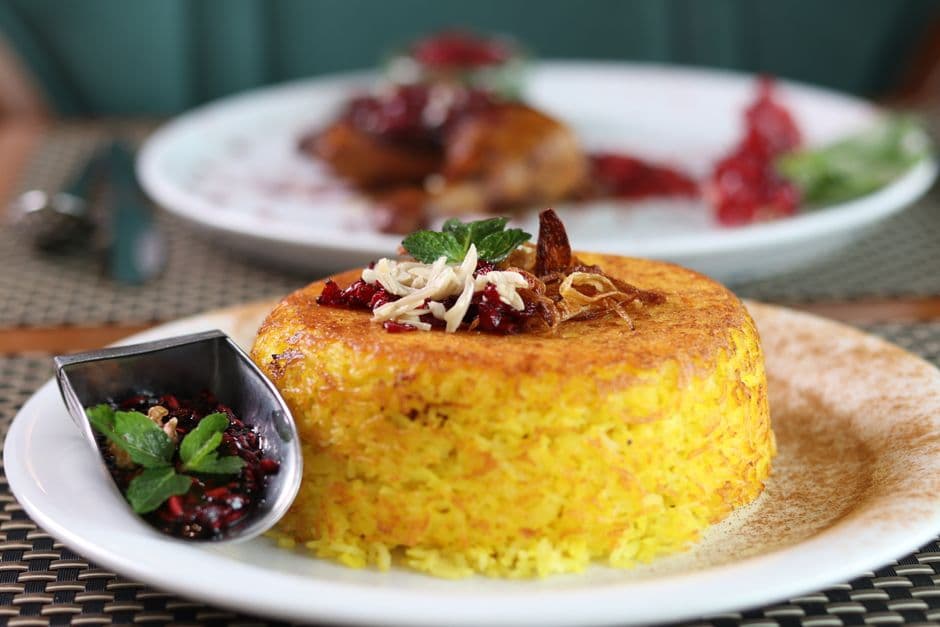
Zereshk Polo Morgh
Persischer Safran-aromatischer Reis mit Juwelen aus saueren Berberitzen, serviert neben zartem geschmortem Huhn – Irans meistgefeiertes Festgericht.
Über dieses Rezept
Zereshk Polo Morgh – Berberitzenreis mit Huhn – ist wohl das beliebteste Gericht der persischen Küche, serviert bei Hochzeiten, Feiern und Familientreffen im Iran und in der iranischen Diaspora. Es kombiniert zwei der größten Errungenschaften der persischen Küche: perfekt gedämpfter Reis mit gloriöser knuspriger Kruste (Tahdig) und sanft gewürzter, safranfarbener Hühnerbraise. Die Berberitzen (Zereshk), die dem Gericht seinen Namen geben, sind kleine, intensiv säuerliche getrocknete Früchte, die wie Rubine gegen den goldenen Reis leuchten. Die perfekte Tahdig – die knusprige, karamellisierte Reisbasis, die das wertvollste Element jeder persischen Mahlzeit ist – erfordert Übung, belohnt aber Geduld.
Zutaten
Dient 4
- 400 gbasmati-reis
- 800 ghuhnerschenkel und trommeln(mit knochen, mit haut)
- 1 großezwiebel(dünn geschnitten)
- 0.5 Teelöffelgemahlene kurkuma
- 1 Teelöffelgemahlenes zimt
- 0.5 Teelöffelgemahlener kardamom
- 250 mlhühnerbrühe oder wasser
- 1 Prisesafranfäden(etwa 0,3g)
- 3 Esslöffelkochendes wasser(zum aufblühen von safran)
- 80 ggetrocknete berberitzen (zereshk)(gespült)
- 2 Esslöffelzucker
- 80 gungesalzene butter oder ghee(aufgeteilt)
- 3 Esslöffelpflanzenöl
- 1.5 teaspoonsfeines salz(plus mehr zum parkochen)
- 0.5 Teelöffelschwarzer pfeffer
Anleitung
- 1
Den Safran aufblühen lassen und das Huhn schmoren
Den Safran in einem Mörser mit einer Prise Zucker zerquetschen, 3 Esslöffel kochendes Wasser hinzufügen und 15 Minuten ziehen lassen. In einem schweren Topf Öl bei mittlerer bis hoher Hitze erhitzen, die Hühnerteile auf allen Seiten braun werden lassen (8 Minuten), dann entfernen. Die Zwiebel im gleichen Topf anbraten, bis golden (10 Minuten). Das Huhn zurück, Kurkuma, Zimt, Kardamom, Salz, Pfeffer, Brühe und die Hälfte des Safranwassers hinzufügen. Zudecken und bei niedriger Hitze 40–45 Minuten köcheln lassen, bis das Huhn sehr zart ist.
Das Brauen nicht überstürzen – Farbe am Huhn erzeugt Geschmack in der Braise.
- 2
Den Reis vorgaren
Den Reis in mehreren Wasserwechseln waschen, bis das Wasser klar läuft. 30 Minuten in gesalzenem kaltem Wasser einweichen, dann abtropfen. Einen großen Topf mit reichlich gesalzenem Wasser zum Kochen bringen. Den Reis hinzufügen und 6–7 Minuten kochen, bis fast zart, aber mit leichtem Biss in der Mitte. Abtropfen und mit kaltem Wasser spülen.
- 3
Das Tahdig erstellen
In einem schweren antihaftbeschichteten Topf 3 Esslöffel Butter oder Ghee mit 2 Esslöffel Wasser bei mittlerer Hitze schmelzen. Wenn es zischt, eine dünne Schicht vorgegartes Reis (etwa ein Viertel der Gesamtmenge) hinzufügen und sanft flach drücken, um die Basis zu bedecken. Den restlichen Reis in Kegelform darauf aufhäufen. Mit dem Griff eines Holzlöffels 5–6 Löcher durch den Reis bis zur Basis machen, damit Dampf entweicht.
- 4
Den Reis dämpfen
Ein sauberes Geschirrtuch oder doppelte Schicht Papiertuch über den Topfrand drapieren, bevor Sie den Deckel ansetzen. Zudecken und 10 Minuten bei mittlerer Hitze kochen, dann auf die niedrigstmögliche Hitze reduzieren und weitere 35–40 Minuten kochen. Die Basis sollte nussig riechen und der Reis sollte perfekt gekocht sein.
- 5
Die Berberitzen vorbereiten und servieren
In einer kleinen Pfanne 1 Esslöffel Butter bei mittlerer Hitze schmelzen, die gespülten Berberitzen und Zucker hinzufügen und 2–3 Minuten rühren, bis die Beeren glänzen. Das restliche Safranwasser einrühren. Zum Servieren: Den Reis auf einem Teller aufhäufen, die Berberitzen über die Oberseite streuen. Den Topf kurz auf einen Teller invertieren, um das goldene Tahdig daneben zu enthüllen. Die Hühnerteile um den Reis herum anordnen und die Braischerflüssigkeiten darüber löffeln.
Haben Sie das gekocht?
Bewerte es und hilf anderen, die Rezepte zu finden, die wirklich funktionieren.
Einmal anmelden, und wir speichern die Bewertung, die Sie gerade gewählt haben.
Alles, was Sie für Ihre Wochenplanung brauchen — kostenlos
- Essensplaner
- Einkaufsliste
- KI-Rezeptideen
Behalten Sie im Blick, was Sie essen
Fotografieren Sie Ihre Mahlzeit, um Kalorien und Makros zu erfassen, nutzen Sie Fasten-Timer und tracken Sie Ihr Wasser – in der kostenlosen SnapCal-App.
Profi-Tipps
- →
Das Tuch unter dem Deckel ist unerlässlich – es absorbiert Dampf, der sonst den Reis nass machen würde.
- →
Für ein goldenes Joghurt-Tahdig, mischen Sie die erste Reisschicht mit 2 Esslöffeln Vollmilch-Joghurt und dem restlichen Safranwasser, bevor Sie in die Pfanne drücken.
- →
Berberitzen sind in iranischen Lebensmittelgeschäften und online erhältlich – getrocknete Preiselbeeren sind der zugänglichste Ersatz.
- →
Am Ende Geschmack und Salz anpassen – die Aromen konzentrieren sich, wenn Flüssigkeiten verdunsten, und eine letzte Prise Flockensalz schärft das ganze Gericht.
Variationen
- •
Vegetarische Version: Ersetzen Sie das Huhn durch gebratenen Butternusskürbis und Kichererbsen in einer ähnlichen Gewürzbraise.
- •
Geschälte Mandeln und Pistazien zum Berberitzenbelag hinzufügen für zusätzliche Textur.
- •
Mit Lammschankeln statt Huhn für eine noch reichlichere, festlichere Version zubereiten.
- •
Würziger: Einen fein gehackten frischen Chili oder einen Teelöffel zerquetschten Aleppo-/Urfa-Pfeffer zu den Aromaten hinzufügen für warme, vielschichtige Hitze anstatt eines einzelnen scharfen Schlags.
Lagerung
Reste bis zu 3 Tage im Kühlschrank aufbewahrt. Das Tahdig verliert beim Lagern seine Knusprigkeit, aber der Reis und das Huhn wärmen sich gut auf. Zugedeckt in einem niedriger Ofen aufwärmen oder sanft in einem Topf mit einem Wasserschuss.
Geschichte und Herkunft
Zereshk Polo Morgh wird in persischen Kulinarischen Texten seit Jahrhunderten serviert und ist in mittelalterlichen persischen Culinary Texts erwähnt. Der Name leitet sich wahrscheinlich vom arabischen "Harir" (Seide) ab und beschreibt seine glatte, seidige Textur. Als traditionelle Festmahlzeit-Suppe des Persischen Neujahres trägt sie tiefe kulturelle und spirituelle Bedeutung über den Iran, Armenien und Aserbaidschan.
Häufig gestellte Fragen
Was kann ich für Berberitzen ersetzen?
Getrocknete Preiselbeeren sind der am weitesten verbreitete Ersatz – sie sind weniger sauer, reduzieren oder lassen Sie den hinzugefügten Zucker weg. Getrocknete saure Kirschen sind eine andere Möglichkeit. Granatapfelkerne, die am Ende frisch hinzugefügt werden, bieten einen ähnlichen juwelengeschmückten Effekt.
Woher weiß ich, wenn das Tahdig fertig ist?
Sie werden ein sanftes Zischen von der Basis der Pfanne hören und einen leicht nussigen Duft riechen. Nach 35–40 Minuten bei sehr niedriger Hitze sanft die Reiskante in der Nähe der Topfwand mit einem Spatel anheben – wenn sie golden ist und sauber abzieht, ist sie fertig.
Kann ich das ohne einen antihaftbeschichteten Topf machen?
Ja – eine Schicht dünn geschnittener Kartoffeln oder Fladenbrot (Lavash) stattdessen verwenden, um eine antihaftbeschichtete Oberfläche und ein essbares, extra knuspriges Tahdig zu erstellen.
Kann ich das im Voraus zubereiten?
Ja – die meisten Komponenten können bis zu einen Tag im Voraus zubereitet und separat im Kühlschrank aufbewahrt werden. Sanft erneut erhitzen und kurz vor dem Servieren zusammensetzen, damit die Texturen unterschiedlich bleiben.
Nährwertangaben
Pro Portion (560g) · 4 Portionen insgesamt
Zeitzusammenfassung
Haben Sie Fragen?
Fragen Sie unseren KI-Kochassistenten zu diesem Rezept – Ersetzungen, Techniken, Skalierung.
Chatten Sie mit AI Chef →In Reiseführern vorgestellt
Dieses Rezept ist in den folgenden kuratierten Leitfäden enthalten:
Weitere Persische Rezepte
Das könnte Ihnen auch gefallen
Ähnliche Gerichte aus anderen Küchen der Welt.
Nach Zutat stöbern
Weitere Rezepte rund um dieselben Hauptzutaten.
Kostenlose Küchen-Tools
Rechner und Umrechner, die zu dieser Seite passen — ohne Anmeldung.
Daraus einen Plan machen
Einplanen, einkaufen und im Blick behalten, was schon da ist.
Weiterlesen
Ausführliche Artikel zu den Ideen hinter diesem Gericht.
Ernährung in der Perimenopause: Eine umfassende Ernährungsweise zur Bewältigung von Hitzewallungen, Schlaf und Gewicht
16 Min.
Pflanzliche Komplettproteine: Aminosäuren kombinieren
11 Min.
Pflanzliches Protein: Der vollständige Leitfaden zu Quellen, Kombinationen und zur Deckung Ihres täglichen Bedarfs
14 Min.
Gemeinschaft
Beteiligen Sie sich an der Unterhaltung
Melden Sie sich an, um einen Kommentar zu hinterlassen und Ihre Lieblingsrezepte zu speichern