
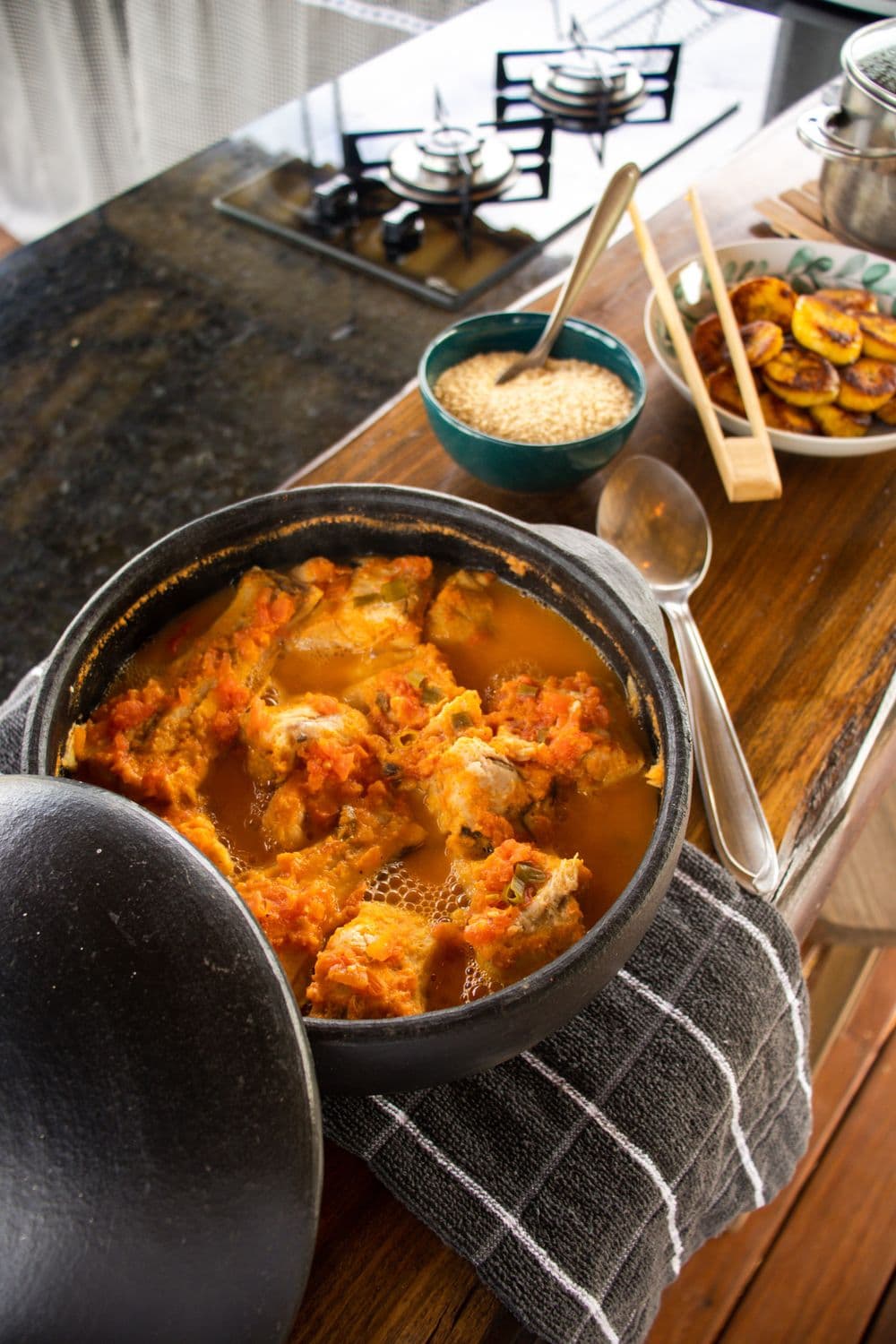
Amazonischer Fischeintopf mit Tucupi — Atala-Stil
Weißfisch sanft pochiert in Tucupi (fermentierte Maniokbrühe) mit Jambu, Limette und Koriander — Brasiliens tiefste kulturelle Küche.
⭐Inspired by Alex Atala · 🇧🇷 BrazilÜber dieses Rezept
Dieses Gericht ist vom lebenslangen Engagement des Chefs Alex Atala für Amazonas-Zutaten und Brasiliens erstaunliche Biodiversität inspiriert. Tucupi — eine leuchtend gelbe, fermentierte Brühe aus wildem Maniok (Kassava) — ist die Grundflüssigkeit der Amazonas-Küche, und Atala hat mehr als jeder andere Koch getan, um sie in der globalen Fine-Dining-Szene an seinem Flaggschiff D.O.M. in São Paulo einzuführen. Kombiniert mit Jambu (einem elektrischen Kraut, das die Zunge kurzzeitig betäubt), Weißfisch, Limette und Koriander ergibt es eine Suppe, die wie nichts anderes in der Weltküche schmeckt. Wir haben das Rezept angepasst, damit Koch*innen außerhalb Brasiliens es mit verfügbaren Zutaten angehen können, während wir die Amazonas-Tradition ehren, die Atala geprägt hat.
Zutaten
Dient 4
- 600 gWeißfischfilets(wie z. B. Tambaqui, Goldbrasse oder Seebarsch, Haut entfernt)
- 750 mlTucupi(oder Ersatz: 600ml Hühnerbrühe + 150ml Limettensaft + 1 TL Kurkuma (siehe Anmerkungen))
- 30 gJambu-Blätter(oder Ersatz: Brunnenkresse + gemahlene Sichuan-Pfefferkörner, am Ende über das Gericht gestreut)
- 1Weiße Zwiebel(dünn geschnitten)
- 4 ZehenKnoblauch(gehackt)
- 1Kleine frische rote Chili(dünn geschnitten)
- 2 ELNeutrales Öl
- 0.5 BundFrischer Koriander(Blätter und zarte Stiele)
- 2Limetten(1 ausgepresst + 1 als Spalten)
- 1 ELFischsoße(oder nach Geschmack)
- Salz(nach Geschmack)
- 100 gTapiokaperlen(gekocht, für den Boden der Schüssel, optional)
Anleitung
- 1
Tucupi-Basis vorbereiten
Bei echter Tucupi: zum Köcheln in einem Topf mit der Zwiebel und dem Knoblauch bringen. Bei Verwendung des Ersatzes: Hühnerbrühe mit Kurkuma 10 Minuten köcheln lassen, dann die Limettensaft zugeben — dies ahmt den fermentierten Zitruscharakter von Tucupi nach.
Echte Tucupi muss mindestens 30 Minuten köcheln — rohe Tucupi ist durch das Cyanid in frischem Maniok schwach giftig. Köcheln beseitigt dies.
- 2
Brühe aufbauen
Das Öl in einem tiefen Topf erhitzen und Zwiebel, Knoblauch und Chili 5 Minuten sanft anbraten, bis sie weich sind, aber nicht braun. Die gesimmerte Tucupi (oder den Ersatz) hinzufügen. Zum leichten Köcheln bringen und 15 Minuten köcheln lassen, um die Aromen zu verbinden. Mit Fischsoße und Salz würzen — abschmecken; die Brühe sollte aromatisch, leicht sauer und herzhaft sein.
- 3
Fisch garen
Fisch in große Stücke schneiden. In die köchelnde Brühe gleiten lassen und 4–6 Minuten pochieren, bis das Fleisch gerade eben undurchsichtig wird und sich leicht mit einer Gabel zerlegen lässt. Nicht kochen — die Brühe sollte nie heftig blubbern.
- 4
Jambu hinzufügen
Die Jambu-Blätter (oder das Brunnenkresse-Ersatzmittel) in den letzten 60 Sekunden einrühren — sie sollten gerade eben zusammenfallen. Bei Verwendung des Brunnenkresse-Ersatzes jede Schüssel mit ein paar Rissen Sichuan-Pfeffer abschließen, um das charakteristische "elektrische" Zungenprickeln zu erhalten.
- 5
Anrichten und servieren
Eine kleine Menge gekochte Tapiokaperlen (falls verwendet) am Boden jeder warmen Schüssel anordnen. Die Brühe und den Fisch darüber gießen. Großzügig mit frischen Koriander-Blättern bestreuen. Sofort mit Limettenspalten servieren. Restliche Brühe direkt aus der Schüssel trinken.
Hast du das gekocht?
Bewerte es und hilf anderen, die Rezepte zu finden, die wirklich funktionieren.
Einmal anmelden, und wir speichern die Bewertung, die du gerade gewählt hast.
Alles, was du für deine Wochenplanung brauchst — kostenlos
- Essensplaner
- Einkaufsliste
- KI-Rezeptideen
Freihändig kochen
Hol dir KI-Essenspläne, einen Schritt-für-Schritt-Kochmodus und deine gespeicherten Rezepte in der kostenlosen Bento-App.
Profi-Tipps
- →
Echte Tucupi ist die Seele dieses Gerichts — brasilianische und südamerikanische Spezialgeschäfte führen sie gefroren.
- →
Jambu-Blätter erzeugen ein einzigartiges Prickelgefühl — die Ersatz-Näherung nutzt Sichuan-Pfefferkörner für einen ähnlichen Effekt.
- →
Die Brühe nicht kochen — sanftes Pochieren hält den Fisch zart.
Variationen
- •
Tacacá: die Suppenversion, die traditionell von Amazonas-Straßenhändlern verkauft wird — getrocknete Garnelen hinzufügen und in einem ausgehöhlten Kürbis servieren.
- •
Pato no Tucupi: Gegrillte Entenbeine durch Fisch ersetzen — ein klassisches Pará-Gericht.
Lagerung
Am besten sofort gegessen. Nur die Tucupi-Basis hält sich 3 Tage im Kühlschrank.
Geschichte und Herkunft
Tucupi ist die Grundbrühe der brasilianischen Amazonas-Küche, hergestellt aus dem fermentierten Saft der Wurzel des wilden Maniok — ein Prozess, den indigene Amazonas-Völker über Tausende von Jahren entwickelt haben, um die Kassavapflanze zu entgiften. Das D.O.M. von Alex Atala in São Paulo hat seit den frühen 2000er Jahren mehr als jedes andere Restaurant getan, um Tucupi, Jambu und andere Amazonas-Zutaten in der globalen Fine-Dining-Szene einzuführen.
Häufig gestellte Fragen
Was ist Tucupi?
Tucupi ist eine leuchtend gelbe, fermentierte Brühe, die aus dem Saft der Wurzel des wilden Maniok (Kassava) hergestellt wird. Sie muss mindestens 30 Minuten köcheln, um das natürlicherweise vorhandene Cyanid aus rohem Maniok zu beseitigen. Sie ist die Grundflüssigkeit der brasilianischen Amazonas-Küche und unmöglich exakt zu ersetzen — verwenden Sie die Limetten-und-Brühe-Näherung, wenn Sie sie nicht beschaffen können.
Wie schmeckt Jambu?
Jambu (Acmella oleracea, auch Zahnschmerzkraut genannt) hat eine ungewöhnliche Eigenschaft: Das Kauen der Blätter erzeugt ein prickelndes, fast elektrisches Gefühl auf Zunge und Lippen, aufgrund des natürlichen Stoffes Spilanthol. Es ist ein wesentliches Element der Amazonas-Küche. Sichuan-Pfefferkörner nähern sich dem Gefühl an, obwohl nicht dem Krautgeschmack.
Warum konzentriert sich Atala auf Amazonas-Zutaten?
Brasilien enthält etwa 60 % des Amazonas-Regenwaldes und schätzungsweise 20 % der weltweiten Pflanzenarten. Atala hat seine Karriere damit verbracht, zu argumentieren, dass Brasiliens Biodiversität es möglicherweise zur zutatenreichsten Küche der Welt macht — aber die meisten dieser Zutaten sind vor seiner Arbeit nie auf einem Fine-Dining-Menü erschienen.
Wo kann ich Tucupi kaufen?
Brasilianische, peruanische und südamerikanische Spezialgeschäfte verkaufen Tucupi gefroren in Plastikflaschen. Online-Spezialimporteure versenden international. Der Ersatz (Hühnerbrühe + Limette + Kurkuma) nähert sich der Farbe und Säure an, kann aber die fermentierte Tiefe von Tucupi nicht replizieren.
Ist Tucupi sicher zu trinken?
Nur nach mindestens 30 Minuten Köcheln. Frischer Manioksaft enthält natürlicherweise vorkommende Cyanidverbindungen; Köcheln beseitigt diese und ist nicht verhandelbar für die Sicherheit. Indigene Amazonas-Völker entwickelten diesen Entgiftungsprozess über Tausende von Jahren.
Nährwertangaben
Pro Portion (350g) · 4 Portionen insgesamt
Zeitzusammenfassung
Haben Sie Fragen?
Fragen Sie unseren KI-Kochassistenten zu diesem Rezept – Ersetzungen, Techniken, Skalierung.
Chatten Sie mit AI Chef →Weitere Brasilianische Rezepte
Das könnte dir auch gefallen
Ähnliche Gerichte aus anderen Küchen der Welt.
Nach Zutat stöbern
Weitere Rezepte rund um dieselben Hauptzutaten.
Kostenlose Küchen-Tools
Rechner und Umrechner, die zu dieser Seite passen — ohne Anmeldung.
Daraus einen Plan machen
Einplanen, einkaufen und im Blick behalten, was schon da ist.
Weiterlesen
Ausführliche Artikel zu den Ideen hinter diesem Gericht.
Brasilianische Küche: Feijoada, Churrasco und mehr
14 Min.
Die Dukan-Diät erklärt: Alle vier Phasen, Ergebnisse und warum Ärzte besorgt sind
12 Min.
Die Galveston-Diät für die Wechseljahre: Eine vollständige entzündungshemmende Ernährung, um der Gewichtszunahme im mittleren Lebensalter entgegenzuwirken
14 Min.
Gemeinschaft
Beteiligen Sie sich an der Unterhaltung
Melden Sie sich an, um einen Kommentar zu hinterlassen und Ihre Lieblingsrezepte zu speichern