
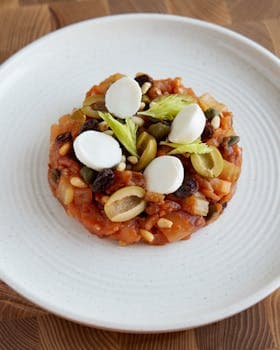
Caponata Siciliana (Sweet and Sour Aubergine Stew)
Sicily's addictive sweet-and-sour aubergine relish with olives, capers, celery and tomato — equally delicious warm, at room temperature or cold.
About This Recipe
Caponata is one of Sicily's most distinctive and beloved dishes — a slow-cooked agrodolce (sweet-and-sour) stew of fried aubergine, celery, onion, olives, capers and tomato, finished with wine vinegar and sugar. Every Sicilian family has their own version; some add pine nuts and raisins, others use fresh tomato, others add red peppers. What unites them all is the characteristic balance of acidic vinegar and sweet sugar against the savoury aubergine base. Caponata improves dramatically overnight as the flavours meld — it is almost always better the next day — and is traditionally served at room temperature as an antipasto or contorno (side dish). It travels and keeps well, making it perfect for summer picnics and meal prep.
Ingredients
Serves 6
- 2 largeaubergines (eggplant)
- 3celery stalks, roughly chopped
- 1 largeonion, roughly chopped
- 300 gcanned tomatoes, crushed
- 80 ggreen olives, pitted and halved
- 2 tbspcapers in brine, rinsed
- 4 tbspred wine vinegar
- 1 tbspsugar
- 100 mlolive oil for frying
- 2 tbspextra-virgin olive oil for finishing
- handfulfresh basil leaves
- to tastesalt and pepper
Instructions
- 1
Salt and drain aubergine
Cut aubergine into 2 cm cubes. Toss with salt and place in a colander for 30 minutes. Rinse and pat dry.
- 2
Fry aubergine
Fry aubergine cubes in generous olive oil in batches until golden on all sides. Drain on kitchen paper.
- 3
Sauté celery and onion
In the same pan, sauté onion and celery in fresh olive oil over medium heat until soft, about 8 minutes.
- 4
Add tomatoes
Add crushed tomatoes and cook for 10 minutes until reduced slightly.
- 5
Add agrodolce
Stir in olives, capers, vinegar and sugar. Taste — it should be a clear balance of sweet and sour. Adjust as needed.
- 6
Combine and rest
Add fried aubergine to the sauce. Cook together for 5 minutes. Remove from heat, stir in extra-virgin olive oil and torn basil. Rest for at least 2 hours before serving.
Did you make this?
Rate it and help other cooks find the recipes that actually work.
One tap to sign in, and we'll save the rating you just picked.
Everything you need to plan your week — free
- Meal calendar
- Grocery list
- AI recipe ideas
Cook this hands-free
Get AI meal plans, step-by-step cooking mode, and your saved recipes in the free Bento app.
Pro Tips
- →
Caponata is always better the next day — make it ahead.
- →
Taste and adjust the agrodolce balance: the sweet-sour ratio should be clean and assertive, not timid.
- →
Fry the aubergine in generous oil — skimping produces soggy, oil-starved pieces.
- →
Taste and adjust salt at the very end — flavors concentrate as liquids reduce, and a final pinch of flaky salt sharpens the whole dish.
Variations
- •
Add pine nuts and raisins for a Palermitan version with extra texture and sweetness.
- •
Some versions use fresh tomatoes rather than canned for a lighter, more acidic caponata.
- •
Vegetarian: swap the protein for roasted king oyster mushrooms, smoked tofu or cooked chickpeas — adjust seasoning slightly upward to compensate.
- •
Spicier: add a finely chopped fresh chile or a teaspoon of crushed Aleppo/Urfa pepper to the aromatics for warm, layered heat instead of a single sharp hit.
Storage
Keeps in the fridge for up to 5 days. Flavour improves with time. Can be frozen for up to 2 months.
History & Origin
Caponata's roots trace to Arab-Norman Sicily (9th–12th centuries), when sweet-and-sour flavour combinations and aubergines arrived via North Africa. The agrodolce tradition persisted in Sicilian cooking while largely disappearing from mainland Italian cuisine.
Frequently Asked Questions
Do I have to salt the aubergine?
Salting removes some moisture and bitterness and helps the aubergine fry rather than steam. It is not strictly necessary with modern aubergine varieties but still improves the result.
Can I serve caponata warm?
Yes, but room temperature or cold (from the fridge) actually showcases the flavours better.
Can I make this ahead of time?
Yes — most of the components can be prepared up to a day in advance and refrigerated separately. Reheat gently and assemble just before serving so textures stay distinct.
What can I substitute if I don't have all the ingredients?
Stay close to the role each ingredient plays: swap aromatics for similar ones (shallot for onion, lime for lemon), and keep the fat-acid-salt balance intact. Spice blends can usually be approximated with what's in the cupboard.
Nutrition Facts
Per serving · 6 servings total
Time Summary
Have Questions?
Ask our AI cooking assistant anything about this recipe — substitutions, techniques, scaling.
Chat with AI Chef →Featured in Guides
This recipe is featured in the following curated guides:
More Italian Recipes
You Might Also Like
Similar dishes from other cuisines around the world.
Browse by Ingredient
More recipes built around the same core ingredients.
Free Kitchen Tools
Calculators and converters that pair with this page — no signup needed.
Put This Into a Plan
Schedule it, shop for it, and track what you already have.
Read Next
Longer reads that go deeper on the ideas behind this dish.
Community
Join the conversation
Sign in to leave a comment and save your favourite recipes