
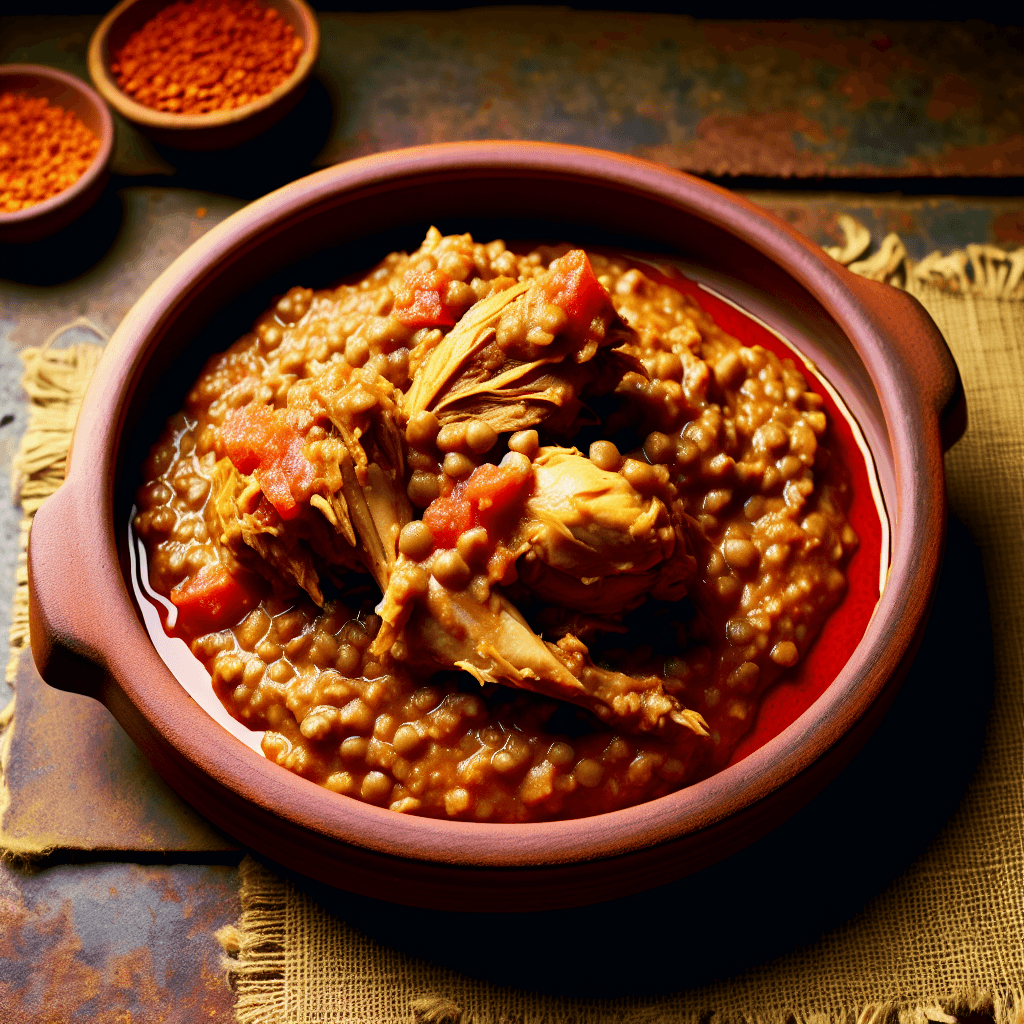
Doro Misir Wat
Ethiopian chicken and red lentil stew — rich, spiced, deeply warming.
About This Recipe
Doro Misir Wat marries Ethiopia's two best-loved stew traditions in one pot: doro wat, the celebratory chicken stew, and misir wat, the everyday red lentil staple. Chicken pieces are browned in niter kibbeh — the spiced clarified butter infused with fenugreek, cardamom, and sacred basil that gives Ethiopian food its unmistakable perfume — then simmered with red lentils that gradually collapse, thickening the sauce into something rich, velvety, and deeply savory. Berbere supplies slow-building heat while caramelized onions provide the sweet foundation every good wat is built on. The lentils stretch the chicken generously, making this a practical family dish as much as a comforting one, traditionally mounded on injera and eaten by hand.
Ingredients
Serves 6
- 800 gchicken, cut into pieces
- 1 cupred lentils
- 1/4 cupniter kibbeh
- 2 largeonions, diced
- 4 clovesgarlic, minced
- 1 tbspfresh ginger, grated
- 2 tspberbere spice
- 1 tspturmeric
- 1 tspsalt
- 5 cupswater
Instructions
- 1
Caramelize onions
Melt the niter kibbeh in a heavy pot over medium heat and cook the onions for a patient 10–15 minutes, stirring often, until deeply golden and reduced to nearly half their volume. This slow caramelization is the structural backbone of every wat. Add garlic and ginger and cook 2 minutes more.
If you can't find niter kibbeh, simmer butter with a pinch each of fenugreek, cardamom, and dried oregano, then strain — it approximates the flavor.
- 2
Bloom the spices
Stir the berbere and turmeric into the onion base and fry for about a minute, stirring constantly so nothing scorches. The mixture should turn a deep brick red and smell intensely aromatic — this blooming step wakes the spices and colors the whole stew.
- 3
Brown chicken
Add the chicken pieces and turn them in the spiced onion paste until sealed and lightly browned on all sides, about 5 minutes. Coating the meat in berbere butter at this stage lets the spice penetrate rather than just sitting in the sauce.
Skin-off, bone-in pieces are traditional — the bones enrich the sauce while excess skin would make it greasy.
- 4
Add lentils
Rinse the red lentils well and stir them in, then pour over the water and scrape up any fond stuck to the pot. Bring everything to a boil, skimming any foam that rises from the lentils in the first few minutes.
- 5
Simmer
Reduce to a low simmer, partially cover, and cook about 45 minutes, stirring more frequently toward the end as the lentils dissolve and thicken the sauce. The stew is ready when the chicken is fall-apart tender and the sauce coats a spoon thickly.
Stir from the bottom — collapsed lentils settle and scorch easily in the final 15 minutes.
- 6
Serve
Season with salt, taste, and adjust the heat with more berbere if you like. Serve mounded on injera in the traditional way, or over rice, ideally with a cooling side like yogurt or a simple tomato salad to balance the spice.
Did you make this?
Rate it and help other cooks find the recipes that actually work.
One tap to sign in, and we'll save the rating you just picked.
Everything you need to plan your week — free
- Meal calendar
- Grocery list
- AI recipe ideas
Cook this hands-free
Get AI meal plans, step-by-step cooking mode, and your saved recipes in the free Bento app.
Pro Tips
- →
Take the onions all the way to deep gold — undercooked onions are the most common reason a wat tastes flat.
- →
Niter kibbeh is worth seeking out or making; plain butter works but loses the signature Ethiopian aroma.
- →
Stir attentively in the last 15 minutes, as the broken-down lentils stick and scorch easily.
- →
Adjust berbere to your blend's heat level — authentic Ethiopian blends can be twice as hot as supermarket versions.
- →
Like doro wat, this improves dramatically overnight; consider making it a day ahead for company.
Variations
- •
Add hard-boiled eggs in the last 10 minutes, scored lightly so the sauce penetrates — a nod to classic doro wat.
- •
Substitute lamb shoulder for the chicken and extend the simmer to about 75 minutes for a richer wat.
- •
Stir in cubed potatoes with the lentils for an even heartier one-pot family meal.
- •
Make it dairy-free by using oil instead of niter kibbeh with a pinch of fenugreek and cardamom for aroma.
Storage
Refrigerate for up to 4 days; the flavors deepen and the texture thickens overnight, so loosen with a little water when reheating gently on the stove. It freezes well for up to 3 months in portioned containers.
History & Origin
Doro wat, the slow-cooked chicken stew, is widely considered Ethiopia's national dish, traditionally served at holidays like Easter and Meskel after long fasting periods. Misir wat, the red lentil stew, is its humble everyday counterpart. Combining them reflects common Ethiopian home cooking practice, where lentils stretch precious meat into a generous family meal without sacrificing the deep berbere-and-niter-kibbeh flavor of the festive original.
Frequently Asked Questions
Can I make it vegetarian?
Yes — omit the chicken, swap the niter kibbeh for oil (adding a pinch of fenugreek and cardamom for aroma), and use 4 cups of water or vegetable broth. You will essentially have a classic misir wat, the red lentil stew eaten throughout Ethiopia on fasting days. Reduce the simmer time to about 35 minutes.
What is niter kibbeh and how do I make it?
Niter kibbeh is Ethiopian spiced clarified butter: butter simmered slowly with garlic, ginger, fenugreek, cardamom, turmeric, and herbs like koseret or oregano, then strained. To make it, melt 250g butter over low heat with the aromatics for 30–40 minutes, strain through cheesecloth, and store refrigerated for weeks. It keeps like ghee and transforms any wat.
How spicy is this dish?
As written, moderately spicy — but everything depends on your berbere. Ethiopian-made blends are typically much hotter than Western supermarket versions. Start with 1 teaspoon if you are heat-sensitive, taste midway through the simmer, and add more. The caramelized onions and lentils both temper the chili, so the heat builds slowly rather than hitting up front.
Which chicken pieces work best?
Bone-in thighs and drumsticks are ideal: the bones enrich the sauce during the 45-minute simmer and the dark meat stays juicy. Traditional doro wat uses a whole skinned, jointed bird. Boneless breast will cook through long before the lentils break down and turn dry, so if you must use it, add it during the final 20 minutes instead.
Nutrition Facts
Per serving (400g / 14.1 oz) · 6 servings total
Time Summary
Have Questions?
Ask our AI cooking assistant anything about this recipe — substitutions, techniques, scaling.
Chat with AI Chef →Featured in Guides
This recipe is featured in the following curated guides:
More Ethiopian Recipes
You Might Also Like
Similar dishes from other cuisines around the world.
Browse by Ingredient
More recipes built around the same core ingredients.
Free Kitchen Tools
Calculators and converters that pair with this page — no signup needed.
Put This Into a Plan
Schedule it, shop for it, and track what you already have.
Read Next
Longer reads that go deeper on the ideas behind this dish.
Community
Join the conversation
Sign in to leave a comment and save your favourite recipes