
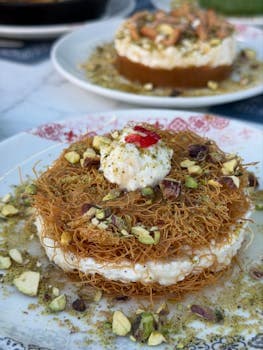
Halawet el-Jibn
Lebanese cheese-filled semolina rolls in rose water syrup — a Hama sweet.
About This Recipe
Halawet el-Jibn — the sweetness of cheese — is one of the Levant's most surprising desserts: a smooth, stretchy dough made by melting mild white cheese into semolina and syrup, rolled out thin while warm, filled with thick ashta cream, and sliced into elegant pinwheels drenched in rose and orange-blossom syrup. The result confounds first-timers — chewy yet silky, dairy-rich yet floral, somewhere between pastry and confection. The craft is all in the dough stage: the cheese must melt fully and be worked with the semolina until glossy and elastic, then rolled immediately, because it stiffens as it cools. Made well, it is among the most refined sweets on the Lebanese table, served cool with crushed pistachios and extra syrup.
Ingredients
Serves 10
- 500 gakkawi cheese, desalted and crumbled
- 1 cupfine semolina
- 1/4 cupsugar
- 1 cupwater
- 1 cupqishta (thick cream) or clotted cream
- 2 cupssimple syrup with rose water
- 1/4 cupcrushed pistachios
Instructions
- 1
Cook dough
Bring the water and sugar to a simmer in a wide non-stick pan, then add the desalted, crumbled cheese and stir over medium heat until it melts completely into a stretchy mass. Rain in the semolina while stirring vigorously and keep working the dough for about 5 minutes, folding and pressing, until it is smooth, glossy, and pulls away from the pan in one elastic piece.
Any unmelted cheese lumps now become lumps forever — stir until the mixture is perfectly uniform before adding semolina.
- 2
Roll
Turn the hot dough onto a large sheet of plastic wrap or a syrup-brushed surface, cover with a second sheet, and roll it out to about 3–4 mm thick while still warm and pliable — it stiffens quickly as it cools. Peel off the top sheet and spread or pipe a line of ashta cream along the dough.
Brush your rolling pin and surface with a little of the syrup to stop sticking without flour.
- 3
Roll and slice
Using the plastic wrap to help, roll the dough snugly around the cream into an even log about 4 cm thick, sealing the seam underneath. Let the log set for 10 minutes, then slice it into 3 cm rounds with a sharp knife wiped clean between cuts, so each pinwheel shows a neat spiral of cream.
- 4
Serve
Arrange the slices on a platter, douse generously with the cold rose water syrup, and scatter crushed pistachios over the top. Some cooks add candied orange-blossom petals. Serve cool or at room temperature with extra syrup on the side — never hot, as chilling sets the texture.
Did you make this?
Rate it and help other cooks find the recipes that actually work.
One tap to sign in, and we'll save the rating you just picked.
Everything you need to plan your week — free
- Meal calendar
- Grocery list
- AI recipe ideas
Track what you eat
Snap your meal to log calories and macros, run fasting timers and track water in the free SnapCal app.
Pro Tips
- →
Desalt the akkawi thoroughly — soak slices in cold water 4–8 hours with several changes until a taste is purely milky; salty dough ruins the dessert.
- →
Work fast once the dough comes off the heat; you have perhaps ten minutes of easy rolling before it stiffens.
- →
If the dough cools and hardens, return it briefly to low heat with a spoonful of syrup and knead it back to pliability.
- →
No qishta? Simmer 2 cups whole milk with 3 tablespoons cornstarch and a splash of rose water until thick, then chill — a fine homemade ashta.
- →
Slice with a thin, sharp knife wiped between cuts for clean spirals worthy of a sweets-shop window.
Variations
- •
Flat presentation: spread the dough in a layer, top with ashta, and roll loosely or fold rather than slicing — the casual home style.
- •
Mozzarella version: use fresh mozzarella (drained well) with a squeeze of lemon in the dough where akkawi is unavailable.
- •
Pistachio cream filling: blend ground pistachios into the ashta for a green-hearted luxury version.
- •
Mini rolls: cut the rolled sheet into squares and roll individual bite-sized cylinders for a party platter.
Storage
Keep refrigerated, covered, with the syrup spooned over for up to 2 days — the dough firms when cold, so let slices sit 15 minutes at room temperature before serving. It does not freeze well; the cheese dough turns grainy on thawing.
History & Origin
Halawet el-Jibn is generally credited to the Syrian city of Hama, where sweet-makers are said to have developed the cheese-dough technique centuries ago before it spread to Damascus and across the border into Lebanon, where it became thoroughly naturalized. Today Lebanese sweet shops, especially in Tripoli and Saida, produce it alongside knafeh as a staple of the cheese-dessert family the Levant uniquely mastered. Its exact origin story, like most in the region, is told with local pride on both sides of the border.
Frequently Asked Questions
What can I substitute for akkawi?
Fresh mozzarella is the standard substitute — drain it very well and expect a slightly stretchier dough — or use a blend of mozzarella and a few spoonfuls of ricotta for tenderness. The cheese must be mild, white, and melty; salted cheeses need the same long desalting soak as akkawi, and aged cheeses will not work at all.
What is qishta and how do I replace it?
Qishta (ashta) is the Levant's thick clotted cream, traditionally skimmed from slowly heated milk, with a gentle flavor and a texture between whipped cream and ricotta. Outside the region, substitute English clotted cream, mascarpone lightened with a little cream, or the quick homemade version: milk thickened with cornstarch and perfumed with rose water, then chilled.
Why did my dough turn stiff and unworkable?
It cooled too far — this dough is only elastic while warm. Roll it immediately after cooking, and if it does seize, return it to the pan over low heat with a spoonful of syrup and knead until pliable again. Working on plastic wrap and pre-portioning your cream filling before you start cooking buys you the speed this recipe demands.
Is halawet el-jibn served warm or cold?
Cool or at room temperature, always — chilling sets the cheese dough to its proper gentle chew and firms the cream filling so the spirals hold. Straight from the fridge it can be slightly rubbery, so the sweet spot is letting it stand 15 minutes before serving, with cold syrup poured over at the table.
Nutrition Facts
Per serving (150g / 5.3 oz) · 10 servings total
Time Summary
Have Questions?
Ask our AI cooking assistant anything about this recipe — substitutions, techniques, scaling.
Chat with AI Chef →Featured in Guides
This recipe is featured in the following curated guides:
More Lebanese Recipes
You Might Also Like
Similar dishes from other cuisines around the world.
Browse by Ingredient
More recipes built around the same core ingredients.
Free Kitchen Tools
Calculators and converters that pair with this page — no signup needed.
Put This Into a Plan
Schedule it, shop for it, and track what you already have.
Read Next
Longer reads that go deeper on the ideas behind this dish.
Community
Join the conversation
Sign in to leave a comment and save your favourite recipes