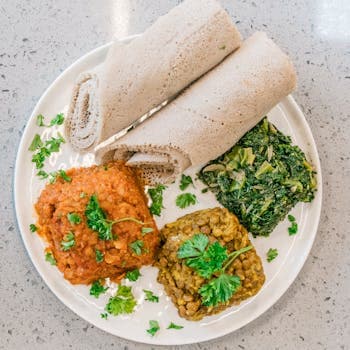
Injera is made from teff flour fermented for 2–3 days to create a sourdough batter that is then poured onto a hot griddle. The bread is uniquely spongy and porous, designed to scoop up stews and salads. The slight sourness complements the rich, spiced dishes of Ethiopian cuisine. Making injera at home is a rewarding project that transforms your Ethiopian cooking.
Serves 6
Whisk teff flour with water (and yeast if using) until smooth. Cover loosely with a cloth and leave at room temperature for 2–3 days until bubbly and slightly sour.
In a warm kitchen, 2 days is usually enough. Cold kitchens may need 3 days.
Stir the fermented batter. Season with salt. Add a little water if it looks too thick — it should pour easily like a thin pancake batter.
Heat a large non-stick skillet over medium-high heat. Pour in a ladleful of batter in a circular motion from the outside in. Cover with a lid and cook 2–3 minutes until the surface is dry and full of holes. Do not flip.
Transfer to a clean cloth to cool. Injera firms up slightly as it cools.
Everything you need to plan your week — free
Cook this hands-free
Get AI meal plans, step-by-step cooking mode, and your saved recipes in the free Bento app.
Teff flour is naturally gluten-free but use certified GF if needed.
Stack cooled injera between cloth pieces to prevent sticking.
Taste and adjust salt at the very end — flavors concentrate as liquids reduce, and a final pinch of flaky salt sharpens the whole dish.
Mise en place pays for itself: chop, measure and pre-mix everything before the heat goes on, especially for any step that moves fast.
Mix 50/50 with regular flour for milder flavour.
Add a pinch of fenugreek for extra depth.
Vegetarian: swap the protein for roasted king oyster mushrooms, smoked tofu or cooked chickpeas — adjust seasoning slightly upward to compensate.
Spicier: add a finely chopped fresh chile or a teaspoon of crushed Aleppo/Urfa pepper to the aromatics for warm, layered heat instead of a single sharp hit.
Wrap in foil or cloth and refrigerate up to 3 days. Reheat briefly in a dry pan.
Injera is built on injera, berbere and the communal eating that defines Ethiopian hospitality. Regional variations are the rule rather than the exception — neighboring villages, families and even individual cooks adapt the dish to what's in the pantry and what's in season, which is why no two versions taste exactly alike and why the recipe has stayed alive for so long.
Yes — most of the components can be prepared up to a day in advance and refrigerated separately. Reheat gently and assemble just before serving so textures stay distinct.
Stay close to the role each ingredient plays: swap aromatics for similar ones (shallot for onion, lime for lemon), and keep the fat-acid-salt balance intact. Spice blends can usually be approximated with what's in the cupboard.
Authenticity sits on a spectrum — what matters more is honoring the technique and balance of flavors. If the dish tastes harmonious and respects how cooks in its home region would build it, you're on solid ground.
The two most common issues are under-seasoning and rushing the heat. Taste as you go, season in layers, and give aromatics and proteins the time they need to develop color and depth before moving on.
Per serving (150g / 5.3 oz) · 6 servings total
Ask our AI cooking assistant anything about this recipe — substitutions, techniques, scaling.
Chat with AI Chef →This recipe is featured in the following curated guides:
Join the conversation
Sign in to leave a comment and save your favourite recipes
Everything you need to plan your week — free
Have feedback or need help?
We read every email and reply within 1–2 business days.
© 2026 MyCookingCalendar. All rights reserved.