
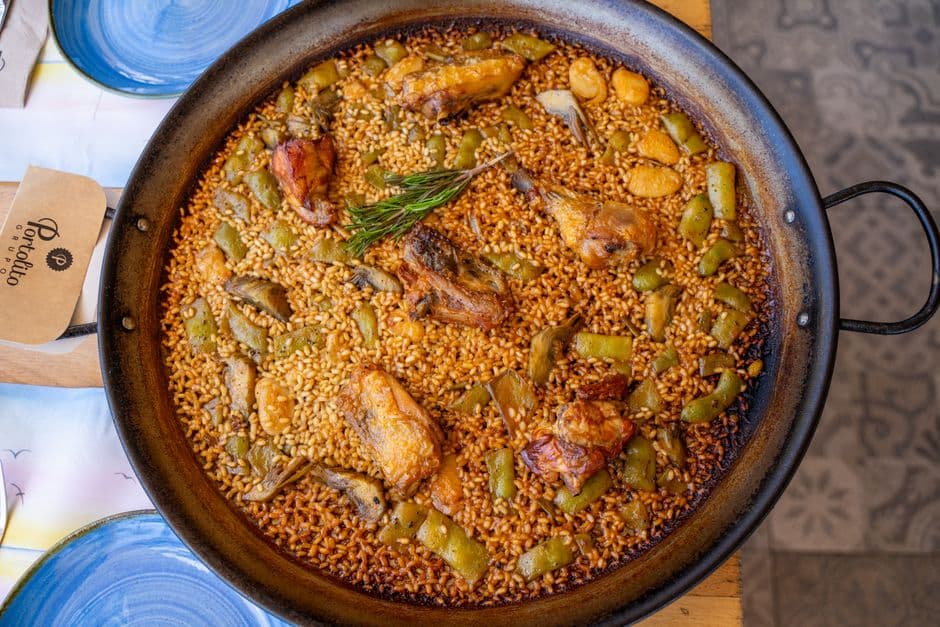
Paella Valenciana (Authentic Chicken & Rabbit)
The original Valencian paella — chicken, rabbit, flat green beans, and butter beans simmered with bomba rice over a wide pan until the prized socarrat forms.
About This Recipe
Paella valenciana is the original, the dish from which all other paellas descend, and it has almost nothing to do with the seafood-laden tourist versions served on the Mediterranean coast. Born in the rice fields and orchards around Lake Albufera south of Valencia, it is a farmer's dish — what shepherds and field hands cooked outdoors over orange-wood fires at midday using whatever the land provided: rabbit from the hedgerows, chicken from the yard, flat green beans (ferraura) from the garden, butter beans (garrofó) from the pulse store, ripe tomatoes, sweet pimentón, a few threads of saffron, and rice from the paddies they tended. The pan itself — wide, shallow, hammered carbon steel — is the genius of the dish: a thin layer of rice cooked uncovered so every grain meets heat, with the bottom forming the prized socarrat, a caramelised crust of toasted rice that locals scrape off with the back of a spoon and fight over. There are no peas, no chorizo, no peppers, no onion, and absolutely no stirring once the rice goes in. The Valencia regional government codified the ten core ingredients in 2012 to protect the dish from invention. Done correctly the rice is dry, separate, saffron-stained, and tastes of slow-rendered animal fat, ripe tomato, and woodsmoke.
Ingredients
Serves 4
- 400 gbomba or Calasparra rice (do not substitute long-grain)
- 500 gbone-in chicken thighs and drumsticks, cut into 4 cm pieces through the bone
- 500 grabbit, cut into similar small bone-in pieces (ask your butcher)
- 200 gflat green beans (ferraura or Romano), trimmed and cut into 4 cm lengths
- 150 gcooked white butter beans (garrofó), or dried lima beans soaked and simmered
- 2ripe tomatoes, grated on the box grater (skin discarded)
- 1 tspsweet pimentón de la Vera
- 1 generous pinchsaffron threads, lightly toasted and crumbled
- 1.2 Lhot chicken stock (approx — the pan dictates)
- 80 mlSpanish extra virgin olive oil
- 1 sprigfresh rosemary
- sea salt, to taste
Instructions
- 1
Heat the pan and brown the meat
Set a 40 cm paella pan over two burners or a wide gas ring on medium-high heat for 3 minutes. Add the olive oil and a pinch of salt, then the chicken and rabbit skin-side down. Brown deeply on all sides for 12–15 minutes — this fond is the backbone of the dish.
Do not crowd; the meat should sizzle, not steam. Adjust burner power so the oil never smokes.
- 2
Add the green beans
Push the meat to the rim of the pan and tip the flat green beans into the centre. Sauté 4–5 minutes until lightly blistered and slightly softened, then redistribute everything across the pan.
- 3
Sofrito stage
Clear a small well in the centre, add the grated tomato pulp and a pinch of salt, and let it fry hard in the oil for 4–5 minutes until it darkens from red to brick and the oil separates. Stir in the pimentón off the heat for 10 seconds so it does not burn.
- 4
Add stock and bring to a rolling boil
Pour in the hot stock until it reaches the rivets on the handles (this is the traditional Valencian measure). Add the cooked butter beans, the saffron, and the rosemary sprig. Boil hard for 5 minutes to build flavour and check seasoning — the broth should taste a touch too salty because the rice will absorb it.
- 5
Add the rice
Scatter the rice evenly across the pan in a cross or stripe pattern, then stir once to distribute. From this moment, do not stir again — stirring releases starch and you will end up with risotto. Adjust to a steady, lively simmer over the whole surface.
- 6
Boil 10 minutes hard, then reduce 8 minutes
Boil aggressively for the first 10 minutes to set the grain, then reduce the heat to low for the final 8 minutes so the rice absorbs the remaining liquid. Rotate the pan a quarter turn every couple of minutes if your burner has hot spots.
- 7
Build the socarrat
In the last 90 seconds, turn the heat back up to medium-high. You should hear a faint crackling from the bottom — that is the socarrat forming. Stop the moment you smell toasted (not burnt) rice; pull the pan off the heat.
- 8
Rest under cloth and serve
Cover loosely with a clean cotton tea towel and rest 5 minutes off the heat. This evens out the grain and lets residual steam finish the cooking. Serve straight from the pan with lemon wedges on the side; scrape the socarrat from the bottom and share it.
Did you make this?
Rate it and help other cooks find the recipes that actually work.
One tap to sign in, and we'll save the rating you just picked.
Everything you need to plan your week — free
- Meal calendar
- Grocery list
- AI recipe ideas
Cook this hands-free
Get AI meal plans, step-by-step cooking mode, and your saved recipes in the free Bento app.
Pro Tips
- →
Use only short-grain Spanish rice — bomba absorbs three times its volume in liquid without bursting. Arborio is a poor substitute; basmati is wrong.
- →
Stock must be hot when it hits the pan. Cold stock drops the pan temperature and the rice will gum up.
- →
The pan should be wider than your burner. Move it around every couple of minutes for even cooking, or use a paella ring outdoors.
- →
Do not cover the pan at any point. Paella is cooked uncovered so the steam escapes and the rice stays dry and separate.
Variations
- •
Paella de marisco — Valencia's coastal version with prawns, mussels, squid, fish stock and no meat (traditional but distinct from valenciana).
- •
Paella mixta — the tourist favourite combining meat and seafood, regarded as heresy by Valencian purists but widely eaten.
- •
Arroz a banda — a fisherman's paella where the seafood is cooked, removed, and the rice cooks alone in the intense stock.
- •
Fideuà — same technique but with short toasted noodles instead of rice, served with garlic aioli.
Storage
Paella is at its peak the moment it comes off the heat. Leftovers refrigerate 2 days in a sealed container; reheat covered in a 160°C oven with a splash of stock to revive the grain. Do not freeze — bomba rice turns chalky after thawing.
History & Origin
Paella valenciana originated in the mid-19th century among farm labourers around Lake Albufera, Valencia, who cooked rice in wide shallow pans over open vine-cutting fires at midday. The dish was codified in 2012 by Wikipaella and the Valencia regional government to define ten authorised ingredients after decades of touristic distortion.
Frequently Asked Questions
Can I leave out the rabbit?
You can use only chicken — the dish is sometimes made with chicken and duck in the inland villages — but rabbit gives a leaner, gamier note that defines the original. Avoid pork; it is non-traditional and overpowers the saffron.
Why is my rice mushy?
Three common causes: you stirred after adding rice, you used the wrong rice (long-grain or risotto rice), or you used too much liquid. The water-to-rice ratio for bomba is roughly 3:1 by volume; let the pan and the rivets guide you.
Do I really need a paella pan?
Yes — the dish needs a wide, shallow surface so the rice sits in a single thin layer. A 40 cm carbon steel paella pan costs €15–25 and lasts forever. A regular deep skillet will produce risotto, not paella.
Is socarrat the same as burnt rice?
No. Socarrat is the caramelised crust on the bottom of the pan — golden-brown, crunchy and nutty. Burnt rice is black and bitter. The difference is 30 seconds of attention at the end.
Nutrition Facts
Per serving (520g / 18.3 oz) · 4 servings total
Time Summary
Have Questions?
Ask our AI cooking assistant anything about this recipe — substitutions, techniques, scaling.
Chat with AI Chef →Featured in Guides
This recipe is featured in the following curated guides:
More Spanish Recipes
You Might Also Like
Similar dishes from other cuisines around the world.
Browse by Ingredient
More recipes built around the same core ingredients.
Free Kitchen Tools
Calculators and converters that pair with this page — no signup needed.
Put This Into a Plan
Schedule it, shop for it, and track what you already have.
Read Next
Longer reads that go deeper on the ideas behind this dish.
Community
Join the conversation
Sign in to leave a comment and save your favourite recipes