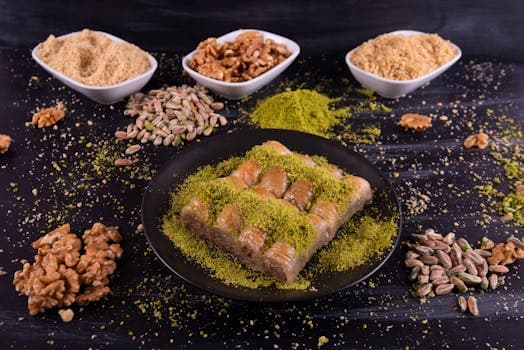
Baklava — Honey Walnut and Pistachio Turkish Pastry
Flaky layers of filo pastry filled with ground walnuts and pistachios, soaked in a fragrant honey and rose water syrup. The king of Turkish desserts.
About This Recipe
Baklava is one of the world's great desserts — a triumph of patience and technique that has been refined in Turkish kitchens over centuries. Dozens of paper-thin filo (or yufka) sheets are layered with generous amounts of clarified butter and ground nuts, baked to shimmering, shattering golden perfection, then immediately drenched in a cold sugar syrup scented with lemon and rose water. The rapid temperature differential creates the unique texture: crackle-crisp on top, yielding and syrup-soaked below. The finest Turkish baklava comes from Gaziantep, a city in southeastern Turkey famous for its pistachio groves and baklava masters (baklavacılar). Gaziantep-style baklava uses unsalted pistachios, minimal spice and a lighter syrup. Elsewhere in Turkey, walnuts are more common and honey adds a floral dimension. Making baklava at home is a labour of love but entirely achievable with shop-bought filo pastry. The most common mistakes are using too little butter (each sheet needs thorough buttering), cutting before baking (always cut before, not after), and pouring hot syrup on hot pastry — always use cold syrup on hot baklava or vice versa.
Ingredients
Serves 24
- 400 gfilo pastry(thawed, kept covered with a damp cloth)
- 250 gunsalted butter(clarified (ghee works perfectly))
- 250 gwalnuts(finely chopped (not ground to powder))
- 150 gunsalted pistachios(finely chopped, to top)
- 1 tspground cinnamon
- 0.5 tspground cloves
- 350 gcaster sugar
- 250 mlwater
- 3 tbsphoney
- 1 tbsplemon juice
- 1 tsprose water(optional but traditional)
Instructions
- 1
Make the syrup
Combine sugar, water and lemon juice in a pan. Bring to the boil, stirring to dissolve the sugar. Simmer 10 minutes until slightly thickened. Add honey and rose water, stir and cool completely in the fridge.
Cold syrup on hot baklava is the rule. Make the syrup first so it has time to chill fully.
- 2
Prepare
Preheat oven to 180°C. Melt clarified butter. Mix chopped walnuts with cinnamon and cloves. Cut filo sheets to fit your 30×40cm baking tray, keeping them covered.
- 3
Layer
Brush tray with butter. Layer 10 filo sheets, brushing each one generously with clarified butter. Spread walnut mixture evenly. Add remaining filo sheets, again brushing each one thoroughly with butter. Press down gently.
Don't skimp on the butter — each sheet should be glossy. Use a pastry brush and work quickly.
- 4
Cut and bake
Using a sharp knife, cut the baklava into diamond or square shapes (cutting all the way through to the bottom). Bake 40–45 minutes until deep golden and crispy.
- 5
Syrup soak
Remove from oven. Immediately and slowly pour the cold syrup all over the hot baklava — you will hear it sizzle. Leave to absorb at room temperature for at least 2 hours before serving. Top with chopped pistachios.
Pro Tips
- →
Clarified butter (or ghee) is essential — regular butter's water content makes the pastry soggy.
- →
Cut before baking, not after — cutting hot baklava shatters the pastry.
- →
Cold syrup on hot baklava is the crucial rule. Hot syrup on hot pastry produces soggy baklava.
Variations
- •
Pistachio-only baklava: use all pistachios for a brighter, less sweet result — the Gaziantep style.
- •
Dry baklava (kuru baklava): use less syrup for a crispier, less sticky result preferred by some.
Storage
Baklava keeps at room temperature (not refrigerated) for up to 2 weeks covered. The texture improves after the first day as syrup distributes. Do not refrigerate — condensation makes it soggy.
History & Origin
Baklava's history is contested — Turkish, Greek, Arab and Armenian cultures all claim it. The most credible evidence points to Ottoman palace kitchens, where elaborate pastry making was a high art. The Topkapı Palace kitchens refined baklava into the form we know today during the 15th–16th centuries, and the city of Gaziantep has been the world centre of baklava production since Ottoman times.
Frequently Asked Questions
Why is my baklava soggy?
Usually caused by hot syrup on hot baklava, or not enough butter between the filo layers. Always use cold syrup, and butter every single layer thoroughly.
How thin should I cut the nuts?
Finely chopped, not ground — roughly 3–4mm pieces give the best texture. A food processor works well — pulse briefly rather than grinding.
Can I use ghee instead of clarified butter?
Yes — ghee is clarified butter and works perfectly. It has a slightly nuttier flavour than homemade clarified butter.
Nutrition Facts
Per serving (60g) · 24 servings total
Time Summary
Have Questions?
Ask our AI cooking assistant anything about this recipe — substitutions, techniques, scaling.
Chat with AI Chef →More Turkish Recipes
Community
Join the conversation
Sign in to leave a comment and save your favourite recipes