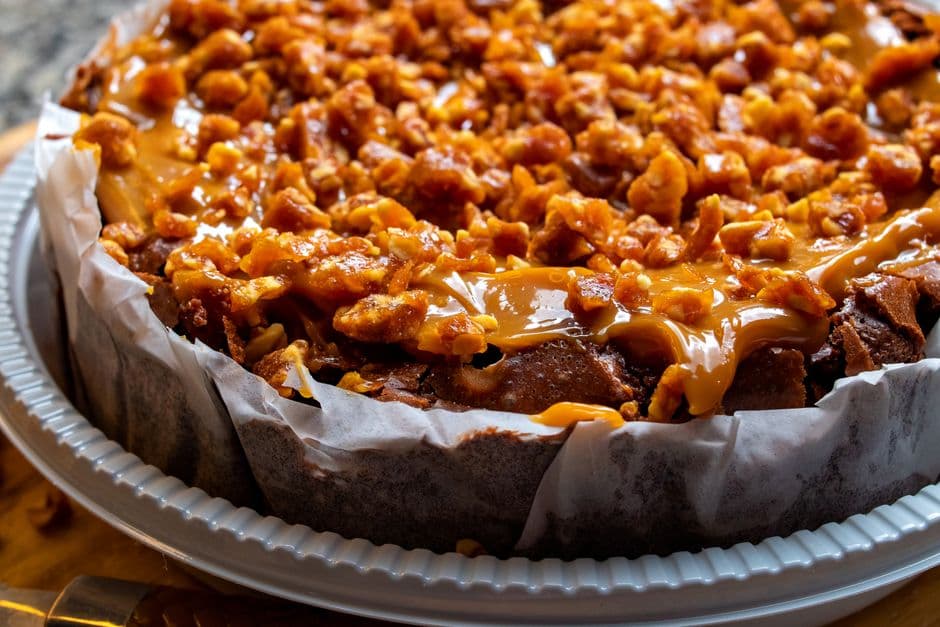
Sticky Toffee Pudding
Britain's most indulgent pudding — a tender date sponge drenched in a glossy, buttery toffee sauce and served with cream or ice cream.
About This Recipe
Sticky toffee pudding is the crown jewel of British comfort desserts. Despite its regal status, it is a relatively modern invention, popularised in the Lake District in the 1970s by Francis Coulson at the Sharrow Bay Hotel. The sponge is made with blended Medjool dates that give it an extraordinarily moist, almost fudge-like texture. The toffee sauce — a lavish combination of butter, brown sugar and cream — is made separately and poured over at two stages: once hot from the oven, and again generously when serving. The result is a pudding that is simultaneously feather-light and indecently rich.
Ingredients
Serves 6
- 200 gMedjool dates(pitted and roughly chopped)
- 200 mlboiling water
- 1 teaspoonbicarbonate of soda
- 85 gunsalted butter(softened, for the sponge)
- 140 glight brown sugar(for the sponge)
- 2large eggs
- 175 gself-raising flour
- 200 glight brown sugar(for the toffee sauce)
- 200 mldouble cream
- 100 gunsalted butter(for the toffee sauce)
Instructions
- 1
Soak the dates
Place the chopped dates in a bowl. Pour over the boiling water and stir in the bicarbonate of soda — it will fizz. Leave to soak for 10 minutes, then blend to a smooth purée with a stick blender.
- 2
Make the sponge batter
Preheat the oven to 180°C (160°C fan). Grease a 20 cm square baking tin. Beat the softened butter and light brown sugar together until pale and fluffy, about 3 minutes. Beat in the eggs one at a time. Fold in the flour, then stir in the date purée until combined.
- 3
Bake the sponge
Pour the batter into the prepared tin and bake for 25–30 minutes until a skewer inserted in the centre comes out clean. The sponge should be springy to the touch.
- 4
Make the toffee sauce
While the sponge bakes, combine the brown sugar, double cream and butter for the sauce in a saucepan. Heat gently, stirring, until the butter melts and the sugar dissolves. Bring to a simmer and cook for 3–4 minutes until slightly thickened and glossy.
- 5
Soak the pudding
As soon as the sponge comes out of the oven, poke it all over with a skewer. Pour about one-third of the hot toffee sauce over the top, allowing it to seep into the holes. Leave for 5 minutes.
- 6
Serve
Cut into portions and plate. Reheat the remaining sauce until just warm and pour generously over each serving. Accompany with vanilla ice cream, clotted cream or pouring cream.
Pro Tips
- →
Medjool dates give the richest, most caramel-like flavour. Dried regular dates also work but are less luxurious.
- →
The soaking and blending of dates is the secret to the pudding's extraordinary moistness.
- →
The toffee sauce keeps refrigerated for up to a week and reheats beautifully.
- →
For individual puddings, bake in buttered dariole moulds or a muffin tin for about 18–20 minutes.
Variations
- •
Sticky toffee pudding with whisky sauce: add a tablespoon of whisky to the toffee sauce.
- •
Gingerbread sticky toffee pudding: add 1 teaspoon of ground ginger and ½ teaspoon of mixed spice to the sponge batter.
- •
Salted caramel version: add a generous pinch of flaky sea salt to the toffee sauce.
Storage
The sponge keeps wrapped for 3 days and reheats well in the microwave. Toffee sauce keeps refrigerated for 1 week.
History & Origin
The origins of sticky toffee pudding are disputed, with the most credible claim coming from Francis Coulson at the Sharrow Bay Hotel in the English Lake District in the 1970s. It has since become one of the most popular puddings on British restaurant menus.
Frequently Asked Questions
Can I make this ahead?
Yes — bake the sponge, soak with some sauce, and refrigerate. Reheat individual portions in the microwave with extra sauce warmed separately.
Can I use shop-bought toffee sauce?
You can, but homemade sauce takes only 5 minutes and tastes significantly better. It is well worth the minimal effort.
Nutrition Facts
Per serving · 6 servings total
Time Summary
Have Questions?
Ask our AI cooking assistant anything about this recipe — substitutions, techniques, scaling.
Chat with AI Chef →More British Recipes
Community
Join the conversation
Sign in to leave a comment and save your favourite recipes