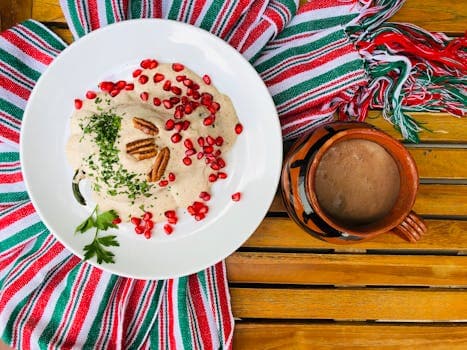
Mexico's most patriotic dish — roasted poblano peppers stuffed with pork and fruit picadillo, topped with creamy walnut sauce, pomegranate and parsley.
Chiles en nogada is the most visually and symbolically patriotic dish in Mexican cuisine. Roasted poblano peppers are stuffed with a fragrant picadillo of minced pork, almonds, raisins, peaches, pears and spices, then covered in a cold creamy nogada sauce made from fresh walnuts, cream cheese, sherry and milk, and garnished with ruby pomegranate seeds and flat-leaf parsley. The three colours — green pepper and parsley, white walnut sauce, red pomegranate — represent the Mexican flag. The dish is traditionally served in August and September when all its seasonal ingredients align. It is served at room temperature, never hot. Making it is a project, but the result is unlike anything else in Mexican cooking.
Sert 6
Place poblanos directly over a gas flame or under a broiler, turning, until the skin is completely charred all over. Place in a sealed bag for 10 minutes to steam, then peel off the skin. Carefully make a slit down one side and remove seeds without tearing the pepper.
Brown pork mince in oil. Add onion, garlic and tomatoes and cook 10 minutes. Add fruit, almonds, raisins, cinnamon and cloves. Season and cook together 10 minutes until fragrant and slightly dry. Cool.
Blanch walnuts in boiling water for 2 minutes; drain and peel the papery skin. Blend walnuts with cream cheese, sherry and milk until smooth and creamy. Season with salt.
Fill each pepper generously with the picadillo through the slit. Press the pepper back together.
Arrange stuffed peppers on a platter. Spoon nogada sauce generously over each pepper. Scatter pomegranate seeds and fresh parsley leaves over the top. Serve at room temperature.
Use fresh, young walnuts for the nogada — they should be creamy white, not bitter. Bitter walnuts make an inedibly astringent sauce.
The dish should be served at room temperature — never hot or cold from the fridge.
Make the picadillo a day ahead for a more developed flavour.
Taste and adjust salt at the very end — flavors concentrate as liquids reduce, and a final pinch of flaky salt sharpens the whole dish.
Vegetarian version: replace pork with a mixture of lentils, potato and the same fruits and spices.
Spicier: add a finely chopped fresh chile or a teaspoon of crushed Aleppo/Urfa pepper to the aromatics for warm, layered heat instead of a single sharp hit.
Lighter: reduce the fat by a third and finish with a squeeze of citrus or a splash of vinegar to keep brightness without losing body.
Make-ahead: prepare the base a day in advance and reheat gently — most braises and stews actually taste better on day two.
Components can be made a day ahead and assembled just before serving. Do not sauce ahead — the nogada turns brown.
Chiles en nogada was created by Augustinian nuns in Puebla in 1821 to celebrate Agustín de Iturbide's entrance into the city following Mexican independence. The three colours of the dish intentionally evoke the newly designed Mexican flag.
Jarred walnuts often have a bitter, oxidised flavour. Fresh-shelled walnuts or vacuum-packed are far preferable.
Large green peppers or Anaheim chillies can substitute, though they lack the specific flavour and heat level of poblano.
Yes — most of the components can be prepared up to a day in advance and refrigerated separately. Reheat gently and assemble just before serving so textures stay distinct.
Stay close to the role each ingredient plays: swap aromatics for similar ones (shallot for onion, lime for lemon), and keep the fat-acid-salt balance intact. Spice blends can usually be approximated with what's in the cupboard.
Par portion · 6 portions totales
Demandez quoi que ce soit à notre assistant culinaire IA sur cette recette : substitutions, techniques, mise à l'échelle.
Discutez avec AI Chef →Rejoignez la conversation
Connectez-vous pour laisser un commentaire et enregistrer vos recettes préférées