
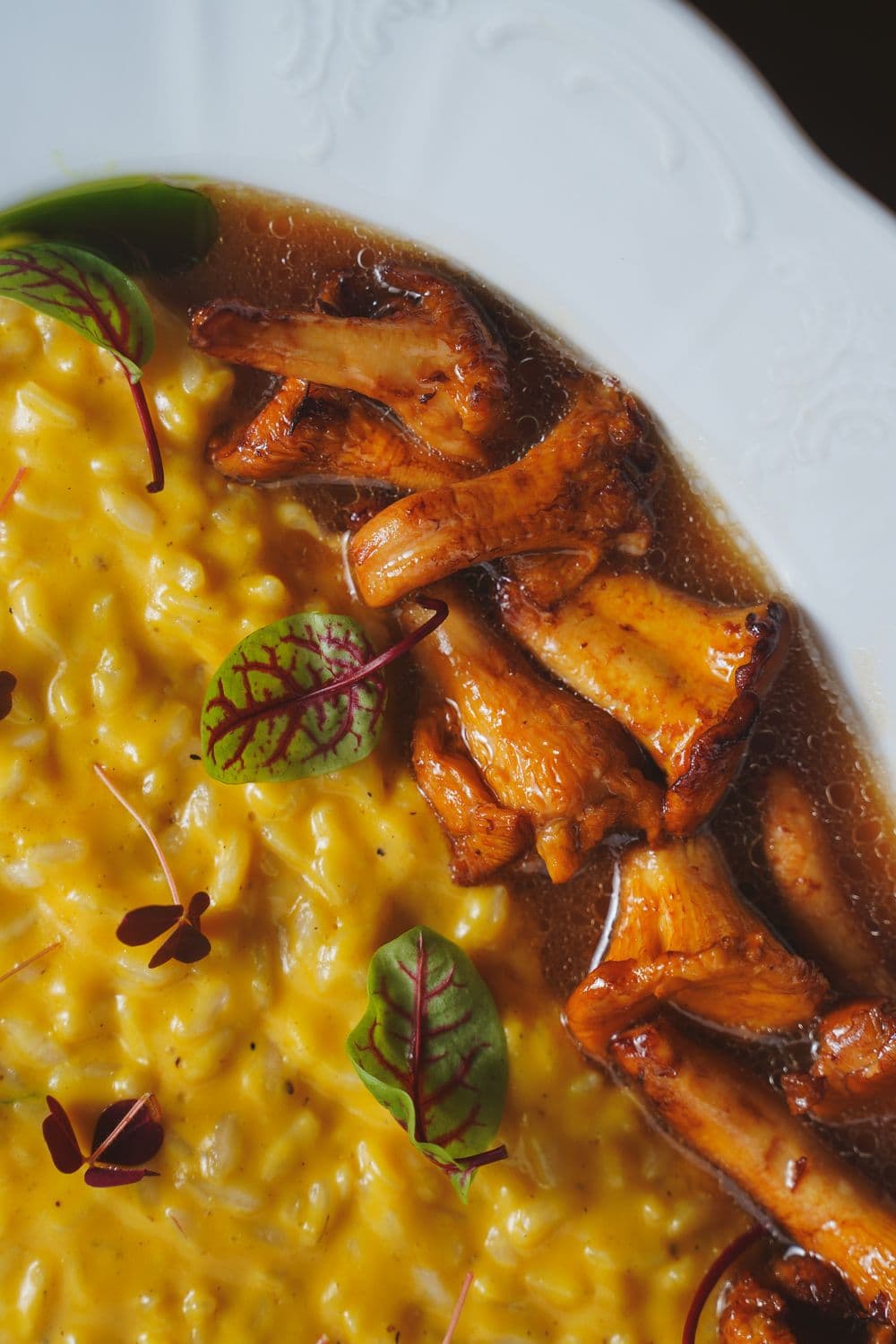
Risotto alla Milanese (Risotto au Safran)
Le risotto doré de Milan teinté et parfumé avec safran — crémeux, beurré et profondément savoureux, le partenaire classique de l'ossobuco.
À propos de cette recette
Risotto alla Milanese est le bijou du patrimoine culinaire de Lombardie. Le riz Arborio ou Carnaroli est cuit lentement dans le bouillon avec le vin blanc, la moelle osseuse de boeuf (dans la version classique), safran et fini avec une généreuse quantité de beurre froid et Parmesan dans la mantecatura — l'agitation vigoureuse du beurre froid hors chaleur qui donne au risotto sa consistance caractéristique onduleuse (all'onda). Le safran, traditionnellement trempé dans du vin blanc ou bouillon tiède avant d'ajouter, tourne le plat entier jaune doré profond et impart un parfum floral subtil. À Milan, ce risotto est inséparable de l'ossobuco — le jarret de veau braisé — et ensemble ils forment l'un des appariements les plus emblématiques d'Italie. Faire du risotto exige de la présence : vous ne pouvez pas vous éloigner pendant 18 minutes.
Ingrédients
Sert 4
- 320 griz Carnaroli ou Arborio
- 1.2 litrebon bouillon de boeuf ou poulet, chaud
- 150 mlvin blanc sec
- 0.5 gfilaments de safran
- 2échalotes ou oignon, finement dés
- 80 gbeurre
- 80 gParmesan, finement râpé
- 30 gmoelle osseuse (optionnel, classique)
- selon le goûtsel
Étapes
- 1
Tremper le safran
Tremper les filaments de safran dans 3 c. à soupe de bouillon chaud ou vin blanc pendant 10 minutes. Réserver.
- 2
Faire sauter les échalotes
Faire fondre 30 g de beurre (et moelle osseuse si on utilise) dans une large casserole lourde à feu moyen. Faire sauter les échalotes jusqu'à tendre et translucide, environ 5 minutes.
- 3
Griller le riz
Ajouter le riz et remuer pendant 2 minutes jusqu'à ce que les grains regardent translucides aux bords et sentent grillés.
- 4
Ajouter le vin
Verser le vin et remuer jusqu'à complètement absorbé.
- 5
Ajouter le bouillon graduellement
Ajouter le bouillon chaud une louche à la fois, remuant constamment et attendant que chaque addition soit absorbée avant d'ajouter la prochaine. Après 12 minutes, verser le liquide de safran.
- 6
Vérifier la texture
Continuer à ajouter le bouillon pour un temps de cuisson total de 18 minutes. Le riz devrait être al dente — tendre mais avec une légère morsure. Le mélange devrait couler comme lave lente (all'onda).
- 7
Mantecatura
Retirer du feu. Ajouter le beurre froid (coupé en cubes) et Parmesan. Remuer et plier vigoureusement pendant 1-2 minutes jusqu'à crémeux, glossy et émulsionné. Goûter et assaisonner.
- 8
Servir immédiatement
Le risotto n'attend personne. Servir à l'instant dans des bols chauds.
Vous l'avez cuisinée ?
Notez-la et aidez les autres à trouver les recettes qui fonctionnent vraiment.
Connectez-vous en un geste : nous enregistrons la note que vous venez de choisir.
Tout ce qu'il faut pour planifier votre semaine — gratuit
- Calendrier des repas
- Liste de courses
- Idées de recettes IA
Cuisinez les mains libres
Profitez de plans de repas IA, d'un mode cuisine pas à pas et de vos recettes enregistrées dans l'appli gratuite Bento.
Conseils de pro
- →
Utiliser le bouillon chaud — le bouillon froid baisse la température de la casserole et prolonge le temps de cuisson inégalement.
- →
Ne jamais arrêter de remuer — le risotto a besoin d'agitation constante pour libérer l'amidon et construire la crémosité.
- →
La mantecatura (finition beurre) est non-négociable pour la crémosité authentique.
- →
Goûter et ajuster le sel à la fin — les saveurs se concentrent à mesure que les liquides réduisent, et une pincée finale de sel floconné affûte le plat.
Variantes
- •
Servir à côté de l'ossobuco de veau braisé pour la combinaison milanaise classique.
- •
Ajouter 100 g de gorgonzola à la place du Parmesan pour une version riche au fromage bleu.
- •
Végétarien : remplacer la protéine par des champignons pleurotes royaux rôtis, tofu fumé ou pois chiches cuits — ajuster l'assaisonnement légèrement vers le haut pour compenser.
- •
Épicé : ajouter un piment frais finement haché ou une cuillère à café de poivre d'Alep/Urfa écrasé aux aromatiques pour une chaleur chaleureuse et en couches au lieu d'un coup simple et net.
Stockage
Le risotto est mieux mangé immédiatement. Le risotto restant peut être frit en arancini (boules de riz).
Histoire et origine
Le risotto au safran date au moins du 16ème siècle à Milan. La légende attribue sa création à un verrier flamand travaillant sur le Duomo qui a utilisé le safran (utilisé à l'époque comme pigment) dans les plats de riz du banquet de mariage comme une blague, créant un chef-d'oeuvre accidentel.
Foire aux questions
Puis-je utiliser un substitut de safran moins cher ?
Le curcuma peut imiter la couleur mais pas la saveur. Pour le vrai risotto alla Milanese, le safran est non-négociable.
Quel riz dois-je utiliser ?
Carnaroli est préféré par la plupart des chefs italiens pour sa capacité à absorber le bouillon tout en gardant un centre ferme. Arborio est plus facile à trouver et aussi excellent.
Puis-je préparer cela à l'avance ?
Oui — la plupart des composants peuvent être préparés jusqu'à un jour à l'avance et réfrigérés séparément. Réchauffer doucement et assembler juste avant de servir pour que les textures restent distinctes.
Que puis-je substituer si je n'ai pas tous les ingrédients ?
Rester près du rôle que chaque ingrédient joue : échanger les aromatiques pour des similaires (échalote pour oignon, citron vert pour citron), et conserver l'équilibre graisse-acide-sel. Les mélanges d'épices peuvent généralement être approximés avec ce qui se trouve dans le placard.
Faits nutritionnels
Par portion · 4 portions totales
Résumé du temps
Vous avez des questions ?
Demandez quoi que ce soit à notre assistant culinaire IA sur cette recette : substitutions, techniques, mise à l'échelle.
Discutez avec AI Chef →Présenté dans les guides
Cette recette est présentée dans les guides sélectionnés suivants :
comparisons
Cuisine italienne et cuisine grecque : similitudes, différences et recettes
cuisine guides
Cuisine française : 40 recettes classiques que tout le monde devrait connaître
conversions
Beurre : bâtonnets, tasses et cuillères à soupe en grammes
conversions
Riz : de tasses en grammes, cru contre cuit
Plus de recettes italiennes
Vous Aimerez Aussi
Des plats similaires venus d'autres cuisines du monde.
Parcourir par Ingrédient
D'autres recettes construites autour des mêmes ingrédients principaux.
Outils de Cuisine Gratuits
Calculateurs et convertisseurs qui accompagnent cette page — sans inscription.
Transformer en Plan
Programmez-le, faites les courses et suivez ce que vous avez déjà.
À Lire Ensuite
Des articles de fond sur les idées derrière ce plat.
Communauté
Rejoignez la conversation
Connectez-vous pour laisser un commentaire et enregistrer vos recettes préférées