
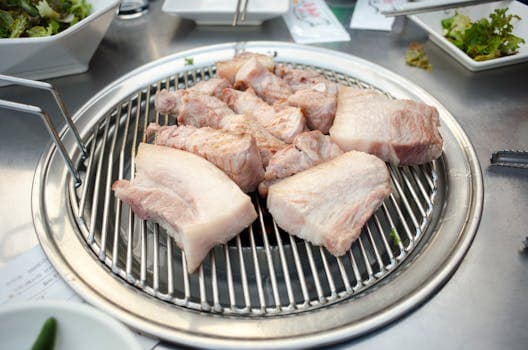
Samgyeopsal (Poitrine de Porc Grillée Coréenne)
Le barbecue le plus populaire de Corée : une poitrine de porc épaisse grillée à table et enveloppée dans de la laitue avec du ssamjang, de l'ail, du kimchi et des feuilles de périlla.
À propos de cette recette
Le Samgyeopsal (삼겹살, littéralement « chair à trois couches ») est une poitrine de porc épaisse, grillée sur un gril de table et consommée en communauté. C'est le plat le plus populaire dans les restaurants de barbecue coréens et la pierre angulaire de l'alimentation sociale coréenne. La cuisine est interactive : des tranches de poitrine de porc sont grillées jusqu'à ce que la graisse soit fondue et les bords croustillants, puis enveloppées dans des feuilles de périlla fraîches ou de laitue avec un frottis de ssamjang (pâte de haricots fermentés et de piment), d'ail cru, de kimchi, de piment tranché et d'oignon nouveau. Le contraste entre le porc riche et gras avec la laitue fraîche, l'ail piquant et les condiments fermentés est profondément satisfaisant. Il se mange avec du riz, plusieurs banchan (plats d'accompagnement) et des shots de soju. Enraciné dans la cuisine quotidienne des cuisines coréennes, le Samgyeopsal (ventre de porc grillée coréenne) équilibre technique et tradition : la poitrine de porc épaisse, tranchée de 1 cm, est traitée avec soin, en s'appuyant sur des proportions séculaires que les habitants ont affinées au fil des générations. Le plat porte une signature sensorielle indubitable : des arômes qui remplissent la cuisine pendant la cuisson, des textures superposées qui se révèlent bouchée par bouchée et une profondeur de saveur qui vient d'un assaisonnement patient plutôt que de raccourcis. Qu'il soit servi comme dîner de semaine ou comme pièce maîtresse d'une table de fête, il reflète un garde-manger régional où les produits locaux, les habitudes d'assaisonnement et les récipients de cuisson façonnent le résultat final. Les cuisiniers amateurs qui préparent ce plat notent souvent à quel point il est indulgent une fois la méthode de base comprise, et comment quelques petits choix — la fraîcheur de la poitrine de porc épaisse, tranchée de 1 cm, l'ordre des ajouts, le temps de repos à la fin — séparent une bonne version d'une mémorable. Cette recette passe en revue ces choix pour que le plat arrive avec le caractère qu'il a sur son terrain d'origine.
Ingrédients
Sert 4
- 800 gpoitrine de porc épaisse, tranchée de 1 cm
- 2 headsfeuilles de laitue (beurrée ou feuille verte)
- handfulfeuilles fraîches de périlla (kkaennip)
- 4 c. à s.ssamjang (trempette)
- 6gousses d'ail, tranchées finement
- 2piments verts frais, tranchés
- 200 gkimchi
- 3oignons nouveaux, tranchés
- 2 c. à s.huile de sésame
- 1 c. à s.sel et poivre noir
- riz cuit pour servir
Étapes
- 1
Préparer les condiments
Disposer la laitue, les feuilles de périlla, le ssamjang, l'ail tranché, les piments et le kimchi sur la table. Mélangez l'huile de sésame avec du sel et du poivre dans un petit plat pour tremper.
- 2
Poitrine de porc grillée
Faites chauffer une poêle à griller, une poêle en fonte ou un gril de table à feu vif. Cuire les tranches de poitrine de porc pendant 3 à 4 minutes de chaque côté jusqu'à ce qu'elles soient profondément dorées et croustillantes. Utilisez des ciseaux pour couper en petits morceaux.
- 3
Faire des ssam (wraps)
Déposez un morceau de poitrine de porc dans une feuille de laitue. Ajoutez un peu de ssamjang, une tranche d'ail, un morceau de kimchi et une feuille de périlla. Pliez et mangez en une seule bouchée.
Vous l'avez cuisinée ?
Notez-la et aidez les autres à trouver les recettes qui fonctionnent vraiment.
Connectez-vous en un geste : nous enregistrons la note que vous venez de choisir.
Tout ce qu'il faut pour planifier votre semaine — gratuit
- Calendrier des repas
- Liste de courses
- Idées de recettes IA
Suivez ce que vous mangez
Photographiez votre repas pour enregistrer calories et macros, lancez des minuteurs de jeûne et suivez votre hydratation avec l’app gratuite SnapCal.
Conseils de pro
- →
Utilisez des ciseaux (avec des pinces) pour couper la poitrine de porc pendant la cuisson sur le gril – c'est la méthode traditionnelle.
- →
La combinaison dans le ssam wrap est tout – ne sautez pas le ssamjang.
- →
Faites griller des tranches d'ail à côté du porc : elles deviennent sucrées et moelleuses.
- →
Procurez-vous la poitrine de porc épaisse la plus fraîche, tranchée de 1 cm, que vous puissiez trouver - c'est le point d'ancrage de la saveur du plat.
- →
Assaisonner en couches au fur et à mesure; la dégustation à chaque étape évite un résultat final plat ou trop salé.
Variantes
- •
Daeji bulgogi : faire mariner le porc dans du gochujang, du soja, de l'ail et du sésame avant de le griller pour une version épicée.
- •
Makchang : remplacez le gros intestin de porc par une version aventureuse d'abats populaire dans les barbecues coréens.
- •
Végétarien : remplacez la protéine principale par des champignons, du paneer, du tofu ou des haricots copieux pour une version sans viande.
- •
Plus épicé : ajoutez du piment frais, une pâte de piment ou une pincée de poivre de Cayenne avec les aromates pour un profil plus chaleureux.
- •
Plus léger : réduisez la graisse d'un tiers et utilisez du bouillon à la place : la saveur reste intacte mais le plat semble moins riche.
Stockage
Meilleur cuit et consommé frais. La poitrine de porc crue peut être réfrigérée pendant 2 jours. Réfrigérer dans un contenant hermétique jusqu'à 3 à 4 jours. Réchauffez doucement sur la cuisinière à feu doux avec un peu d'eau ou de bouillon pour desserrer, ou passez au micro-ondes à 60 % de puissance couverte pour qu'il se réchauffe sans sécher. Se congèle bien jusqu'à 2 mois dans des contenants portionnés ; décongeler toute la nuit au réfrigérateur avant de réchauffer. Les plats à base de produits laitiers ou d'éléments frits peuvent changer de texture après la congélation – rafraîchissez-les avec une garniture croustillante.
Histoire et origine
Le barbecue coréen en tant qu'institution sociale remonte à l'ère Goguryeo (37 avant JC – 668 après JC), lorsque la viande était grillée au feu sur des grilles en fer. Le format de grill de table commun a été commercialisé à Séoul au 20e siècle et s'est répandu dans le monde entier avec la vague coréenne (Hallyu).
Foire aux questions
Puis-je préparer du Samgyeopsal (ventre de porc grillée coréenne) à l'avance ?
Oui, la plupart des composants se conservent bien au réfrigérateur pendant un jour ou deux. Réchauffez doucement avec un peu de liquide pour lui redonner vie.
Par quoi puis-je remplacer la poitrine de porc épaisse, tranchée de 1 cm ?
Si la poitrine de porc épaisse tranchée de 1 cm est difficile à trouver, les substituts les plus proches partagent sa texture et sa teneur en eau. Ajustez légèrement l'assaisonnement, car les substituts ont souvent moins de caractère.
Cette recette est-elle authentique de la cuisine coréenne ?
Il suit le modèle de cuisine maison le plus largement accepté. Des variantes régionales existent et nous notons les principales dans la rubrique variantes.
Pourquoi ma version est-elle devenue fade ?
Généralement sous-assaisonné ou précipité la phase aromatique. Créez de la saveur en couches, goûtez au fur et à mesure et terminez avec une touche d'acide ou de sel pour égayer le plat.
Faits nutritionnels
Par portion · 4 portions totales
Résumé du temps
Vous avez des questions ?
Demandez quoi que ce soit à notre assistant culinaire IA sur cette recette : substitutions, techniques, mise à l'échelle.
Discutez avec AI Chef →Présenté dans les guides
Cette recette est présentée dans les guides sélectionnés suivants :
Plus de recettes coréennes
Vous Aimerez Aussi
Des plats similaires venus d'autres cuisines du monde.
Asado Argentin avec Chimichurri
argentines · 120 min.
Mici (Rouleaux de Viande Hachée Grillée Roumaine)
romanian · 50 min.
Köfte Turcs – Boulettes de Viande Hachée Épicée Grillées
turques · 35 min.
Brochettes de porc grillées à la thaïlandaise avec sauce au gingembre et aux oignons verts
thaïlandaises · 35 min.
Parcourir par Ingrédient
D'autres recettes construites autour des mêmes ingrédients principaux.
Outils de Cuisine Gratuits
Calculateurs et convertisseurs qui accompagnent cette page — sans inscription.
Calculateur de proportions
Divisez par deux ou doublez chaque quantité de cette recette sans calcul mental.
Convertisseur de mesures
Convertissez tasses, grammes, onces et millilitres dans les deux sens.
Convertisseur pour friteuse à air
Convertissez le temps et la température du four en réglages pour friteuse à air.
Transformer en Plan
Programmez-le, faites les courses et suivez ce que vous avez déjà.
Calendrier de planification des repas
Placez cette recette sur un jour et organisez la semaine autour.
Appli de liste de courses
Transformez cette liste d’ingrédients en liste de courses regroupée par rayon.
Nutritionniste IA
Posez vos questions sur les substitutions, les macros et les portions de ce plat, en langage simple.
À Lire Ensuite
Des articles de fond sur les idées derrière ce plat.
Naviguer dans une vie sans gluten : un guide complet du débutant sur les céréales sûres
13 min.
Maîtrise du quinoa : une science nutritionnelle complète, une cuisine parfaite et une absorption maximale des protéines
13 min.
Cuisine coréenne : un guide complet de la cuisine coréenne authentique à la maison
15 min.
Communauté
Rejoignez la conversation
Connectez-vous pour laisser un commentaire et enregistrer vos recettes préférées